China 2-Week Itinerary for First-Timers: 3-Stop vs 4-Stop Routes Without Transit Burnout
Fourteen calendar days in China equal 13 nights and roughly 10 to 11 full sightseeing days once station transfers and flights are counted. Compare realistic 3-base and 4-stop first-timer routes, open-jaw flight strategy, 240-hour transit visa math, and the exact 15-day rail booking countdown.
· By Yunjie

For a first 2-week trip to China, cap your itinerary at 3 or 4 overnight bases across 13 nights, flying into Beijing and departing from Shanghai (or Hong Kong) on an open-jaw ticket so you never waste a day backtracking.
Many sample 14-day plans online try to chain six stops together: Beijing, Xi'an, Zhangjiajie, Guilin, Chengdu, and Shanghai. On paper, high-speed trains make that look doable. On the ground, 14 calendar days equal 13 hotel nights and roughly 10 to 11 full sightseeing days once you subtract arrival jet lag, hotel check-outs, metro rides to mammoth rail terminals, passport security gates, and departure-day airport buffers.
Choosing your pace first, picking a single wildcard region in the middle, and booking trains and timed attractions in the right countdown window keeps a two-week China route exciting rather than exhausting.
The 14-Day Math Most Itineraries Ignore
Before picking cities, look at where your 14 calendar days actually go on an international trip:
- Day 1 (Arrival): Long-haul flight lands, immigration and baggage claim, eSIM and payment check, transfer into the city, early sleep. Sightseeing yield: one light evening walk at best.
- Intercity transfer days (2 to 3 moves): Even an efficient high-speed rail hop or short domestic flight eats 5 to 7 hours door-to-door once you pack bags, ride 40 minutes to a suburban high-speed station, clear real-name passport gates, ride the train, and check into your next hotel.
- Day 14 (Departure): Packing, city-to-airport transfer, international check-in three hours ahead. Sightseeing yield: one relaxed morning coffee or temple stroll if your flight leaves at night, zero if it leaves before noon.
Every extra city you add after stop number four trades a full day at the Great Wall, a karst river valley, or a Chengdu teahouse for another afternoon inside transit corridors.
Always Book an Open-Jaw International Ticket
China's classic north-to-south corridor runs thousands of kilometers from Beijing down toward Xi'an, central or southwestern China, and east to Shanghai or south to Hong Kong. Booking a multi-city ("open-jaw") international flight into Beijing (PEK or PKX) and home from Shanghai (PVG or SHA) or Hong Kong (HKG) often costs roughly the same as a round-trip ticket while saving you an entire vacation day and an extra long-distance fare back to your starting airport.
Check the 14-Day Visa Math Before Locking Flights
One critical trap catches first-timers from the US, UK, Canada, and Australia: China's official 240-Hour Visa-Free Transit Policy covers nationals of 57 countries across permitted regions in 24 provinces, yet 240 hours equals 10 days, not 14 days.
If you have two full weeks off, your passport determines how you structure the map:
- Passports covered by China's 30-day unilateral visa-free entry (or travelers holding a Chinese
Ltourist visa): You can spend all 14 days inside mainland China without a third-region stopover. - Passports relying on 240-hour visa-free transit without applying for a tourist visa: Split your 14 days into 9 to 10 days in mainland China plus 4 to 5 days in Hong Kong or Macau at the beginning or end of the trip. Because Hong Kong and Macau count as separate exit-entry regions for transit purposes, flying Home → Beijing → mainland stops → Hong Kong → Home keeps your mainland stay safely inside the 240-hour ceiling while giving you a two-week holiday. See our 240-hour visa-free transit guide for port and ticket rules.
Two Realistic 2-Week China Route Blueprints
The two editorial blueprints below allocate 13 nights across proven rail and flight corridors without assuming fixed train timetables. Swap the middle stop to match what excites your group most.
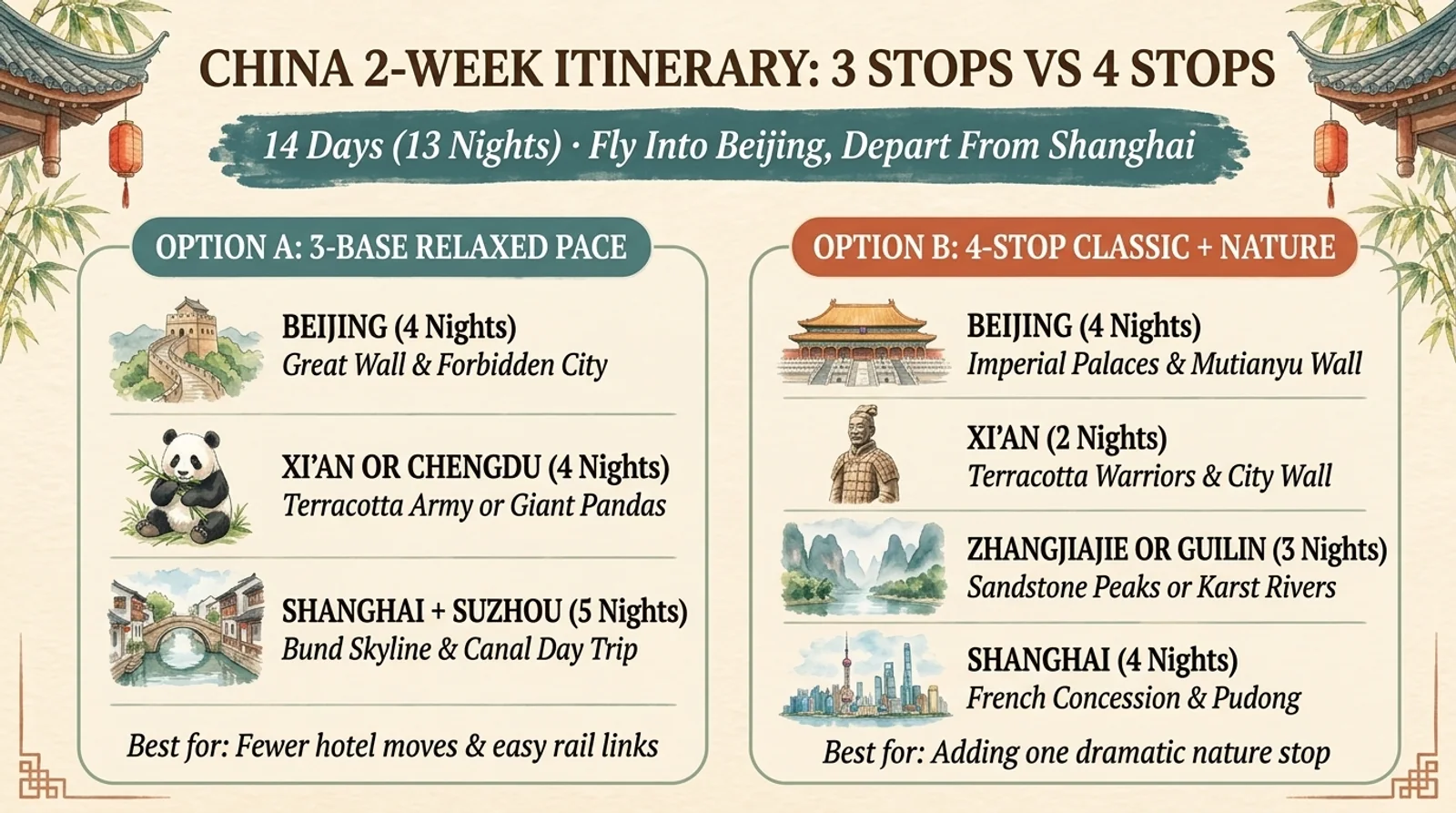
Option A: The 3-Base Relaxed Route (Least Packing, All High-Speed Rail)
Best for travelers who hate repacking every 48 hours, families, winter trips, and anyone who wants deep city exploration plus easy day trips without domestic flights.
| Days & Nights | Base City | How the Days Unfold | Detailed City Module |
|---|---|---|---|
| Days 1 to 5 (4 nights) | Beijing | Day 1 arrival & hutong walk; Day 2 Forbidden City & Jingshan Park; Day 3 Mutianyu Great Wall; Day 4 Temple of Heaven & Summer Palace | 4-day Beijing itinerary |
| Days 5 to 9 (4 nights) | Xi'an OR Chengdu | Day 5 morning bullet train from Beijing; 3 full days for Terracotta Army, City Wall & Muslim Quarter (Xi'an) OR giant pandas, Jinli & Sichuan food (Chengdu) | 2-day Xi'an guide / 3-day Chengdu guide |
| Days 9 to 14 (5 nights) | Shanghai (+ Suzhou or Hangzhou day trip) | Day 9 rail or flight to Shanghai; Day 10 Bund & Yu Garden; Day 11 Former French Concession; Day 12 canal day trip; Day 13 Pudong & shopping; Day 14 depart | 3-day Shanghai guide / Suzhou day trip |
Why 3 bases feel so calm: sleeping four to five nights per hotel means a rainy morning or a sold-out museum slot never wrecks your schedule, and your Suzhou or 2-day Hangzhou side trip can run with a light daypack while heavy suitcases stay in Shanghai.
Option B: The 4-Stop Classic + Nature Route (Balanced First-Timer Favorite)
Best for travelers who want China's imperial capitals, modern skyline, and one iconic mountain or river stop (either Zhangjiajie's sandstone pillars or Guilin and Yangshuo's karst valleys) without crossing the 4-hotel red line.
| Days & Nights | Base City | Realistic Sightseeing vs. Transit Split | Detailed City Module |
|---|---|---|---|
| Days 1 to 5 (4 nights) | Beijing | Day 1 arrival buffer; Days 2 to 4 cover Forbidden City, Great Wall, Temple of Heaven & Summer Palace at an unhurried pace | 4-day Beijing itinerary |
| Days 5 to 7 (2 nights) | Xi'an | Day 5 high-speed train via our Beijing to Xi'an rail guide + evening City Wall ride; Day 6 morning Terracotta Warriors & Muslim Quarter street food | 2-day Xi'an itinerary |
| Days 7 to 10 (3 nights) | Zhangjiajie OR Guilin/Yangshuo | Day 7 transit day (flight or rail); Days 8 & 9 give two full outdoor days for Yuanjiajie & Tianmen Mountain OR Li River & Yangshuo countryside | 3-day Zhangjiajie guide / 3-day Guilin & Yangshuo guide |
| Days 10 to 14 (4 nights) | Shanghai | Day 10 transit to Shanghai & evening Bund walk; Day 11 Old City & French Concession; Day 12 Suzhou canal day trip or Pudong towers; Day 13 buffer/shopping; Day 14 depart | 3-day Shanghai itinerary |
The Keep-or-Cut Test: Choosing Your One Middle Wildcard
Most two-week route regrets happen between Days 6 and 10, when travelers try to bolt Zhangjiajie, Guilin, Chengdu, and Chongqing onto the same Beijing-to-Shanghai spine. Pick a single middle wildcard using this four-question test:
- Can you give Zhangjiajie at least 3 nights (2 full park days)? If travelers ask whether Zhangjiajie is worth a 1-night stopover, the honest answer is no. Wulingyuan's sandstone peaks and Tianmen Mountain sit in separate ticket zones, cableways queue up, and mountain fog can blank out views for half a day. Give Zhangjiajie 3 nights, or save it for a future trip.
- Do you want dramatic hikes or relaxed river scenery? Choose Zhangjiajie if cliffside skywalks, cable cars, and towering stone pillars top your list. Choose Guilin and Yangshuo if cycling past rice paddies, bamboo rafting, and milder southern valleys fit your pace better.
- Are giant pandas and nightlife a higher priority than mountain parks? Swap the nature slot for 3 to 4 nights in Chengdu (or split 2 nights Chengdu + 2 nights Chongqing, linked by frequent short bullet trains) for morning panda research bases, neon hillside monorails, and hotpot.
- What month are you visiting? In July and August, southern valleys are hot and humid; in January, northern cities drop below freezing while southwestern basins stay misty. Match your middle stop to daylight hours and seasonal weather rather than copying a summer route into winter.
Step-by-Step Booking Timeline Before Departure
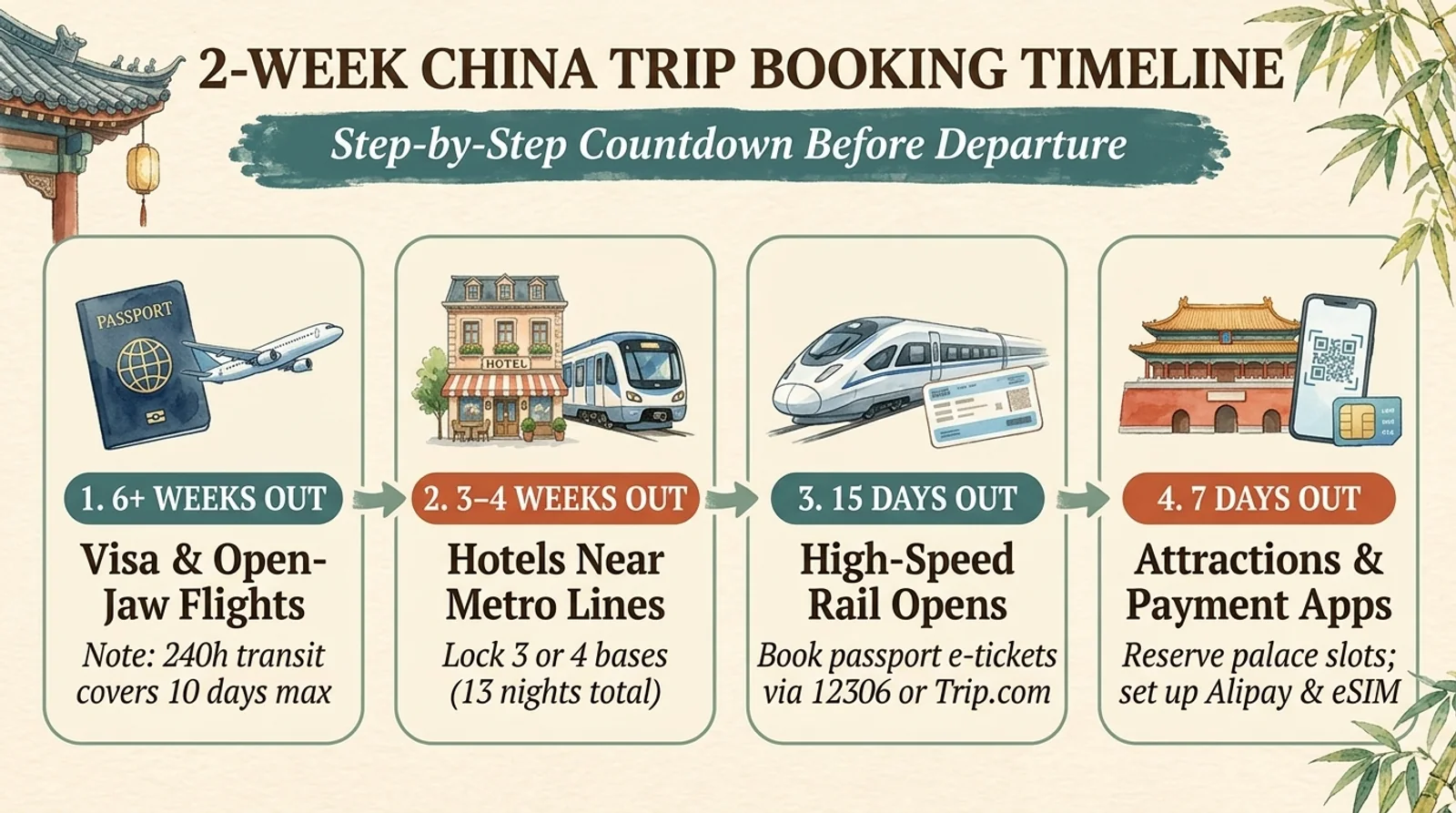
Unlike Europe or Japan, you cannot buy Chinese bullet train tickets or Forbidden City entry slots three months early. Trying to book too soon makes everything look "sold out" when sales have simply not opened yet. Follow this sequence instead:
- 6+ weeks before departure (Entry rules & open-jaw flights): Confirm whether your passport qualifies for 30-day visa-free entry, needs an
Lvisa, or works best as a 10-day mainland + 4-day Hong Kong route under the 240-hour transit rule. Lock your inbound and outbound international flights. - 3 to 4 weeks before departure (Refundable city hotels): Book 3 or 4 hotels near metro transfer stations with free-cancellation windows, message independent properties ahead to confirm foreign passport registration, and check deposit payment methods.
- 15 days before each train ride (High-speed rail e-tickets): Regular China Railway tickets normally go on sale 15 days in advance. According to China Railway 12306's official English FAQ, foreign travelers buy real-name e-tickets with their passport on
12306.cn(or viaTrip.comreservation queues) and scan their physical passport at station gates without picking up paper tickets. Note that railway authorities occasionally release extra holiday overnight high-speed trains on shorter 5-to-7-day windows during major public holidays, as noted by Beijing's municipal government portal, so check12306directly for your exact travel date and review China train luggage rules before packing oversized trunks. - 7 days before each major sight (Timed attractions & apps): Flagship monuments such as Beijing's Palace Museum (Forbidden City) require real-name passport reservations days ahead and close on Mondays outside statutory holidays. Follow our China attraction ticket booking guide, bind your foreign card via our Alipay and WeChat Pay setup guide, and install a China travel eSIM before boarding your flight.
Common 2-Week China Planning Mistakes to Avoid
- Counting arrival day and departure day as full sightseeing days: Scheduling the Great Wall on Day 1 or a cross-country train on the morning of an international flight leaves zero margin for flight delays.
- Scheduling Beijing museums on a Monday: The Forbidden City, National Museum of China, and most municipal museums close on Mondays; put the Great Wall, Summer Palace, or Temple of Heaven on Monday instead.
- Traveling across May 1 to 5 (Labor Day) or October 1 to 7 (National Day Golden Week) unawares: Domestic holiday surges pack stations and scenic cableways across the country; if your dates overlap, stick to Option A (3 bases) and reserve trains the minute the 15-day window opens.
- Packing two giant hard-shell suitcases for a 4-stop rail trip: High-speed carriages store medium 24-inch suitcases easily overhead, whereas bulky 28-to-30-inch trunks compete for limited end-of-car racks.
Frequently Asked Questions
Is 2 weeks enough time for a first trip to China?
Yes, 14 days (13 nights) is the sweet spot for a first visit as long as you resist cramming the whole map into one trip. Sticking to 3 or 4 bases lets you experience imperial history in Beijing, ancient walls or pandas in Xi'an or Chengdu, dramatic natural scenery in Zhangjiajie or Guilin, and modern city life in Shanghai without living out of a suitcase.
How many cities should I visit in China in 2 weeks?
Three to four overnight bases work best. Three bases (for example Beijing, Chengdu or Xi'an, and Shanghai with a day trip to Suzhou) give a relaxed rhythm with minimal transit loss; four bases represent the comfortable upper limit once realistic airport and railway transfers are counted.
Can I do a 2-week China itinerary using the 240-hour visa-free transit policy?
Not if all 14 days are spent inside mainland China, because the 240-hour transit rule caps your mainland stay at 10 days. To travel for two weeks without applying for a tourist visa (if your passport is not on China's 30-day visa-free list), pair 9 to 10 days in mainland China with 4 to 5 days in Hong Kong or Macau at one end of your open-jaw route.
Should I take high-speed trains or domestic flights on a 2-week China trip?
Use high-speed trains for legs up to roughly five hours (such as Beijing to Xi'an, Chengdu to Chongqing, or Shanghai to Suzhou and Hangzhou), where city-center stations beat airport check-in queues. Consider a domestic flight for longer cross-mountain hops such as Xi'an to Zhangjiajie or Guilin to Shanghai when rail schedules take most of the day.
How far in advance do I need to book trains and attractions for a 2-week China route?
Lock international flights and refundable hotels 1 to 2 months out, then set calendar reminders for 15 days before each train ride when regular China Railway 12306 sales open, and 7 to 10 days ahead for high-demand timed attractions like the Forbidden City.
Last checked: November 18, 2026.