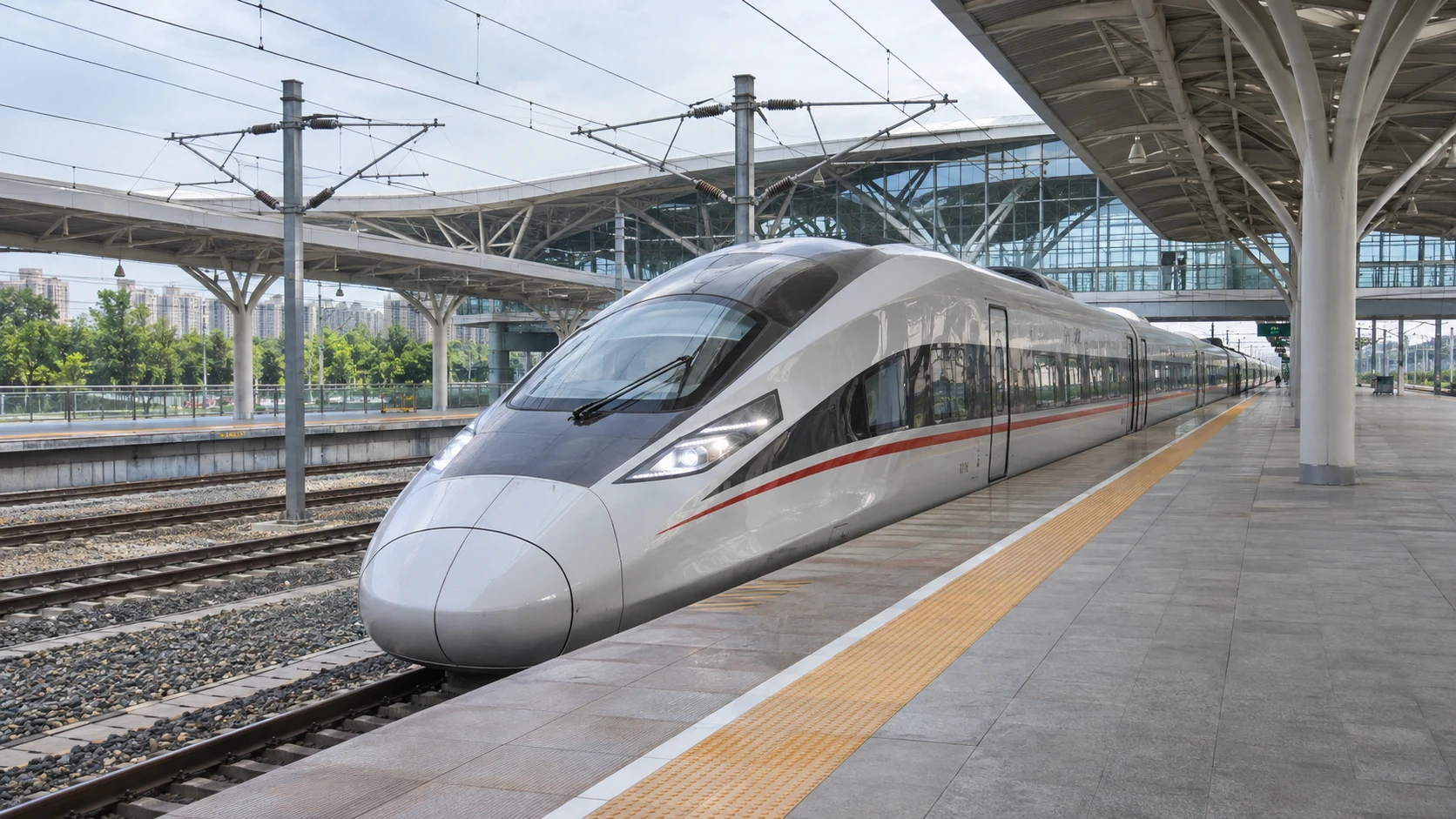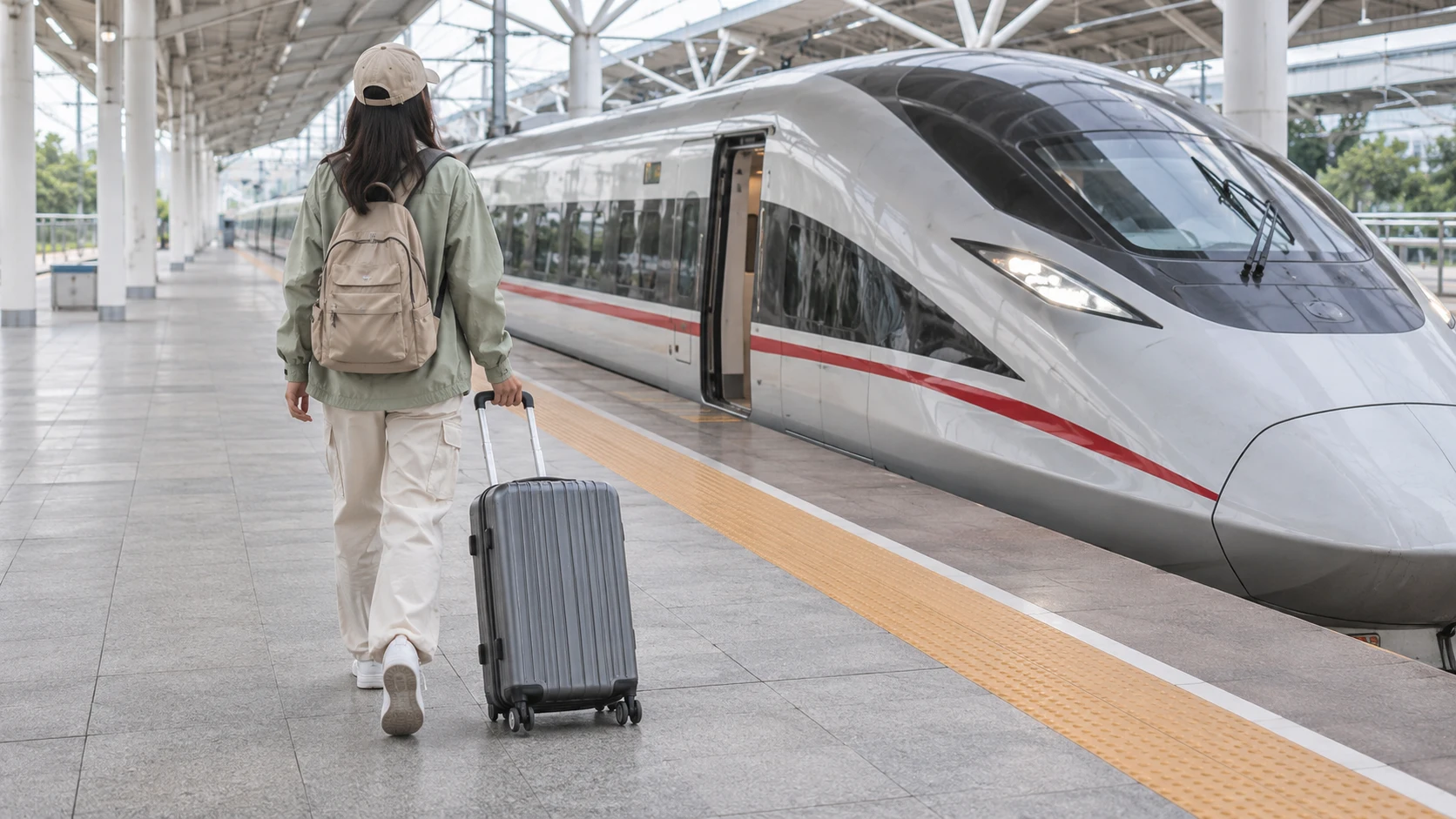
For most adult passengers, mainland China’s published train luggage allowance is 20 kg in total. On high-speed and other EMU trains, each item’s length, width and height must add up to no more than 130 cm, and each item must weigh no more than 20 kg. You carry and look after your own bags. A suitcase sold as “airline checked luggage” is not automatically within the railway limit.
Check weight and dimensions before choosing a suitcase
The Chinese-language 12306 luggage rules list 20 kg for ordinary passengers, 10 kg for children and 35 kg for diplomatic personnel. They also set a maximum of 20 kg for each individual item. Your allowance is not a separate 20 kg entitlement for every suitcase.
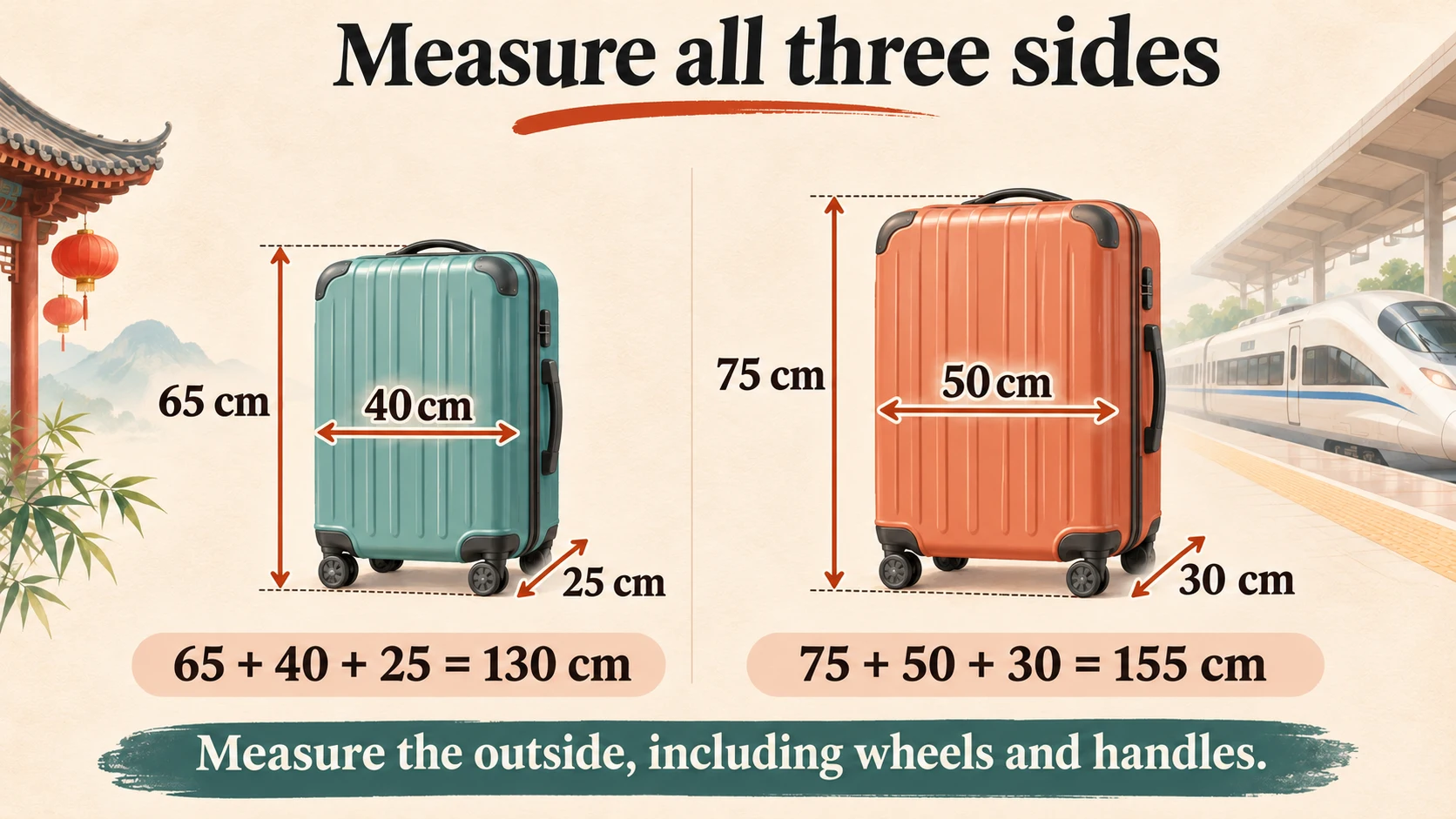
Measure the outside of the packed bag, including protruding wheels and handles. Add its three dimensions rather than comparing only its height with a luggage-shop label. A bag measuring 65 × 40 × 25 cm totals 130 cm; a 75 × 50 × 30 cm bag totals 155 cm. These are arithmetic examples, not approval of a particular product.
For conventional trains, the published general size limit is 160 cm across the three dimensions, with a separate provision for rod-shaped items. The EMU limit is 130 cm. Do not assume a slower-looking train has the conventional allowance: check your booked service, and ask 12306 if its classification is unclear.
Folding wheelchairs needed by passengers who rely on mobility aids, and folding strollers used for accompanying infants, are exempt from the stated allowance under the published conditions. That does not make every wheeled item exempt.
Can you take a large suitcase if nobody weighs it?
A report that somebody carried a larger bag is an account of that journey. It does not change the written allowance or guarantee that your bag will be accepted. Plan around the published rule rather than an assumed lack of checks.
If your bag is over the limit, reduce what you pack, split the load only where the resulting items and your total weight comply, or ask about a suitable transport service before travel. Repacking one overweight suitcase into two does not increase your personal total allowance.
The rules describe how excess weight and indivisible oversized items may be charged. Do not interpret that as a guaranteed option to buy permission at the platform. Whether an item can travel and how it will be handled needs to be resolved with railway staff.
There is no routine airport-style bag drop
For ordinary carry-on luggage, expect to take your bags through the station and onto the train yourself. Booking a seat does not reserve a checked-bag service, a trolley attendant or a dedicated storage compartment.
Separate railway consignment is a different arrangement. Before relying on it, confirm the departure and arrival stations, accepted item, booking method, delivery time and collection procedure. Do not arrive shortly before a high-speed departure expecting to hand over an oversized suitcase as you would at an airline counter.
You should also distinguish storage from transport. Leaving a bag in a station locker does not move it to your next city. A luggage delivery product, where available, has its own coverage and booking conditions. This guide does not promise that a service works with every foreign-passport account or in every station.
Where to put your bags on the train
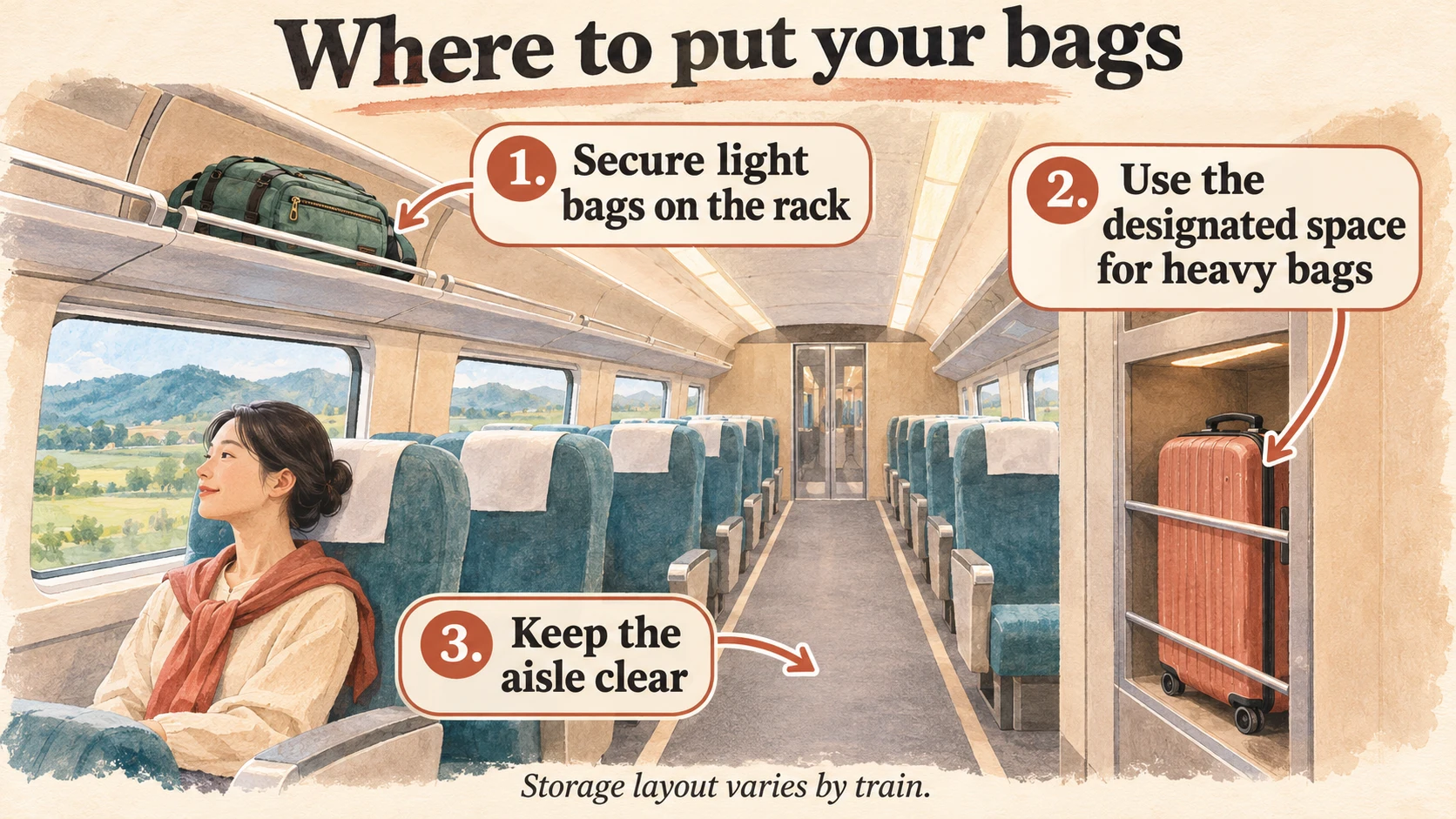
The 12306 train-service guidance says luggage on racks should be secured and stable. It directs heavy items, rods and items with sharp corners to appropriate large-item storage or underneath seats.
On boarding, first identify the actual storage provided in your carriage. Its layout depends on the train. Put a manageable bag where it sits securely; ask the attendant if you cannot find a suitable place for a larger item. A description of one train’s rack is not a promise of the same rack on your service.
Keep passports, medication, money and devices you need during the journey in a smaller bag you can supervise. Store liquids so a leaking bottle will not damage other passengers’ belongings. These are packing recommendations rather than additional railway allowances.
Do not block an aisle, doorway or emergency equipment while you decide where everything goes. If storage is full, ask the attendant for help instead of moving somebody else’s bag or treating an empty seat as a baggage reservation.
Make boarding easier before the doors open
Choose luggage you can lift and manoeuvre without needing a stranger to carry it. This matters beyond the train: your journey can also include a station entrance, a lift queue and the walk to your hotel.
Keep the train number, carriage and seat available without unpacking your main suitcase. Have the document used for booking accessible for the station’s checks. The exact gate procedure depends on the station and document; follow staff instructions rather than assuming every foreign passport uses the same lane.
If you are travelling with children, decide in advance which adult manages the bags and which supervises the children. Ask about accessible routes when you need them. An exemption for a folding stroller does not guarantee priority boarding, a reserved rack or an empty neighbouring seat.
Before getting off, check your seat area and the storage location. Keep luggage labels useful but discreet: avoid displaying passport numbers or unnecessary personal information.
Size rules and restricted-item rules are separate
A bag can meet every measurement and still contain something prohibited. Likewise, a permitted bottle does not mean the suitcase containing it is within the allowance.
Read our China train restricted-items guide for liquids, aerosols and power banks. If your itinerary includes a flight or a cross-border train, check that leg separately. An airline baggage purchase does not expand the railway allowance, and mainland rules should not be substituted for another operator’s conditions.
For the wider journey, see the China transport guide. Our Beijing–Xi’an rail guide covers a specific route; this article answers the packing question rather than repeating its itinerary.
FAQ
Does a first-class ticket automatically give me more luggage?
Do not assume so. The general published allowance cited here distinguishes passenger categories, not a blanket upgrade for first-class seats. Check any separate terms attached to your actual service.
Is a backpack counted as well as my suitcase?
Plan your total carried weight across your bags. The ordinary passenger allowance is not described as a suitcase allowance with an unlimited additional backpack.
Can I book a seat beside me for luggage?
Do not treat a passenger seat as a substitute for baggage compliance. Ask the railway about transport options for the item instead of assuming an extra seat makes it acceptable.
What if I cannot lift my bag onto a rack?
Keep it out of the aisle and ask the attendant where it can be placed safely. For the next journey, pack for the handling you can manage, not just the largest suitcase you own.
Last checked: November 6, 2026. This guide covers the published mainland railway rules cited above. Check the conditions of your particular train and any separate flight or cross-border leg.