Most first-timers underestimate Chongqing. They book it as a 2-day stopover and realize at hour 36 they still haven't done either of the city's two UNESCO World Heritage day trips. Three days is the version where Chongqing actually pulls ahead of the standard two-day cities like Hangzhou or Xi'an — two days for the central spine (Hongya Cave at night, the Liziba metro-through-a-building, Ciqikou, hotpot), and a third day for Wulong or Dazu.
Hotpot ordering — mala vs yuanyang, sauce dishes, what to actually put in the pot — is a topic of its own and lives in the dedicated hotpot article linked at the end.
Before you start
Where to stay. Default to the Liberation Monument (解放碑) area — downtown, walkable to Hongya Cave (15 min on foot), metro Lines 1 / 2 / 6 converge nearby. Jiangbeizui (江北嘴) across the river is a quieter alternative with Hongya Cave views from your window. Skip Ciqikou-area hotels — too far from where you'll spend your time.
Which station you arrive at. Chongqing has four mainline stations, confusingly named: Chongqing North (重庆北站), West (重庆西站), East (重庆东站), and Shaping (沙坪坝站, next to Ciqikou). All on the metro. Most travelers from Chengdu or Xi'an land at North or West; for the Wulong day trip on Day 3 you specifically want East.
Apps and payment. Alipay and WeChat Pay linked to a foreign card before you fly. DiDi for ride-hail (works inside Alipay). Amap (高德) or Baidu Maps for navigation — Google Maps is wrong about Chongqing because it doesn't model the vertical levels. Dianping for restaurants.
Best window: late March to early May, and October to mid-November. Summer is one of China's worst — July–August regularly hits 40°C with heavy humidity. Locals call this city one of the "Three Furnaces."
Day 1 — The mountain-city spine and night view
Arrival day. Goal: see what makes Chongqing visually unique (Liziba), eat your first hotpot, end the day with Hongya Cave lit up.
Morning — arrive and drop bags
If you fly into Jiangbei (CKG): take Line 10 from the airport, transfer at Zengjiayan onto Line 2, get off at Linjiangmen (Exit 1) — about an hour, ~¥7. DiDi runs ~¥30 / 28 minutes in light traffic; the airport express bus is a flat ¥15.
If you land before 10am and your room isn't ready, the bell desk will hold luggage. Head out.
Late morning — Liziba (李子坝) Light Rail Station
The metro line that runs through a residential building. From Liberation Monument, take Line 2 to Liziba. Don't try to shoot from inside the train — the platform looks normal. Use Exit 1, cross the street, and walk to the dedicated Liziba Rail Park (李子坝轨道公园) viewing platform — free, purpose-built. Trains pass every 5–8 minutes; 20 minutes is enough.
Lunch — your first hotpot
Walk or Line 2 back to Liberation Monument. For your first Chongqing hotpot, the safer move is a big local chain — Liuyishou (刘一手) is the travel-friendly default, with multiple Liberation Monument locations and a picture-heavy menu. (Xiaolongkan / 小龙坎 is everywhere too, but every Chongqing friend I have treats it as a punchline — use only as a fallback.)
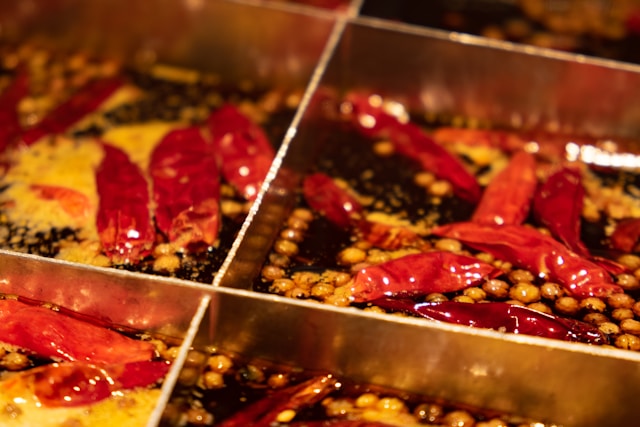
Two rules for meal one: order a 鸳鸯锅 (yuanyang) — split pot, half mala and half clear, never a full red pot your first time — and use the default sauce dish of sesame oil + minced garlic to cool the heat. Everything else (what to actually drop in the pot, how mala builds, why the sauce dish matters) lives in the hotpot article below.
Afternoon — Liberation Monument, slow
Walk. Liberation Monument's pedestrian core is fine to wander but don't plan to "do" it — it's mostly malls and chain restaurants and functions more as a reference point than a sight. Bayi Good-Food Street (八一好吃街), a few minutes from the monument, is the legitimate snack-stall option for 酸辣粉 (sour-spicy rice noodles) and 小面 (Chongqing breakfast noodles). Skip the loudest, biggest storefronts on the main strip — Chinese food bloggers' "红黑榜" (red-and-black list) posts roast them weekly. Or just nap — there's a long evening ahead.
Evening — Hongya Cave at night
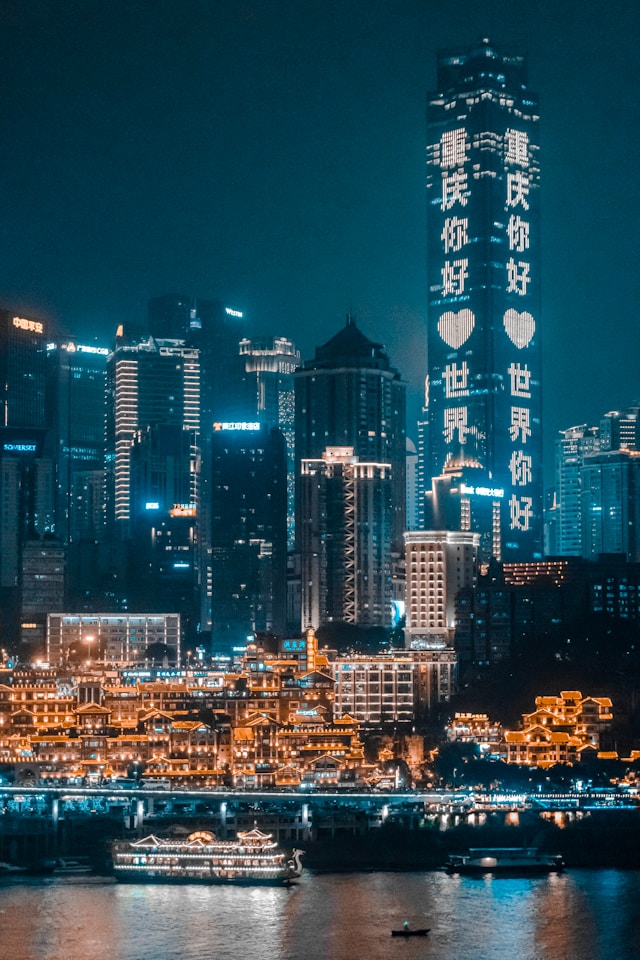
This is the photo you came for: the stilted folk-style building stack lit up over the Jialing River, looking like a Studio Ghibli set. Walk there from Liberation Monument (~700m, 7–8 minutes downhill); the approach views from above are part of the experience.
Two timing details most travel posts miss:
- The shooting window is 20:00–21:30. Hongya Cave's own lights are on 18:00–23:00, but Qiansimen Bridge — which lights up the scene at the angle you want — is only lit 19:30–21:30. Arriving at 18:30 gets you half-lit buildings and an unlit bridge; arriving at 22:00 misses the bridge entirely.
- Shoot from the opposite bank, not inside Hongya Cave. Walk across Qiansimen Bridge (千厮门大桥) — it runs right past the building stack at the perfect angle. A quieter alternative is the Jiangbeizui side near the Grand Theatre (大剧院) — same building, fewer people.
Heads-up on the building itself: Hongya Cave's main entrance is the 11th floor (street level), the 1st floor is at the river, and there's no "fast pass" elevator no matter what touts claim. Inside is souvenir shops and crowds — worth a 15-minute walk-through, not worth eating in.
Day 2 — Ciqikou, the skyline, and a slower hotpot
Day 2 is the lower-intensity day. Goal: a riverside old town in the morning, a skyline view, and a more authentic hotpot in the evening.
Morning — Ciqikou (磁器口) Ancient Town
Take metro Line 1 direct from Xiaoshizi (the closest station to Liberation Monument, 5–7 minutes on foot) to Ciqikou, Exit 1 — about 40 minutes on the train, no transfer. Then a 5–10 minute walk down to the old-town entrance.
Ciqikou is a 1000-year-old riverside village that's been turned into a snack-and-souvenir corridor, and a meaningful share of Chinese travel posts about it use words like "tourist trap" and "skip." It still holds up — but only if you go early. Arrive between 9 and 10am, before the tour buses. The stone-step alleys, the Jialing river view from the far end, and the lower streets near the river hold up. By 11:30 the "old town" mostly disappears under crowds.
Right next to the east gate is Shaci Lane (沙磁巷) — a newer commercial street designed to feel old-town-ish without the crowds. Walk through it once on the way back to the metro; it takes 10 minutes and gives a calmer counterpoint.
Lunch — a non-hotpot meal
Line 1 back into the city. A non-hotpot lunch is a good idea — your stomach will thank you. Look for 江湖菜 (jianghu cai), Chongqing's home-style cooking: dishes like 辣子鸡 (la zi ji — chicken buried in dried chillies), 毛血旺 (mao xue wang — a spicy stew of duck blood and offal), 水煮鱼 (shui zhu yu — fish poached in chilli oil). Pick a place on Dianping with a long line of locals; English menus are a warning sign here, not a help.
Afternoon — skyline viewpoint (pick one)
Two real options with a meaningful price difference.
- Eling Park (鹅岭公园) — free, open 7:00–22:00, on the Yuzhong peninsula's highest point. The viewpoint inside is Kansheng Tower (瞰胜楼) — ¥5 to climb, pay it. From the top: the Jialing meeting the Yangtze, plus the dense vertical core. Metro Line 1 to Eling station, Exit 2A, then ~10 minutes uphill. The time-efficient choice. Note: parts of the park are under renovation through 2026 — some side paths may be closed, but the main route to Kansheng Tower stays open.
- Nanshan Yikeshu (南山一棵树) — ¥30, open 9:00–22:30, on Nanshan across the Yangtze. The traditional postcard view of Chongqing. Catch: metro doesn't reach it, so DiDi each way (~¥40 from Liberation Monument). Worth it if you want the cityscape at sunset and the sky is clear.
Default to Eling Park on a clear afternoon. Take the DiDi out to Yikeshu only if you specifically want the postcard view at dusk and the sky is clear.
Evening — a second, more local hotpot
For your second hotpot, step out of the chain comfort zone. Look for what locals call 社区老火锅 (community old-style hotpot) — small storefronts in residential blocks, plastic stools, prices ~30% lower than chains, broth not tuned for non-spicy palates. Easiest path: ask your hotel for "a non-tourist hotpot" or use Dianping but skip the top-ranked Instagram plays. This is where you actually learn what mala is.
Day 3 — UNESCO World Heritage day trip
Day 3 leaves the city. Two UNESCO sites — pick one.
Option A — Wulong Three Natural Bridges (武隆天生三桥)
The karst landscape used in Transformers 4: Age of Extinction and Zhang Yimou's Curse of the Golden Flower. Three natural stone bridges arching over a valley, plus the Longshui Gorge (龙水峡地缝) — a long narrow cleft you walk through. Visually the strongest thing within day-trip range.
Getting there. High-speed train from Chongqing East Station (not Chongqing North) to Wulong South — about 38 minutes. Make sure it's the new Wulong South (武隆南) — the old Wulong station is much further. Out ~8:30am, back 19:00–22:00 is a comfortable pair.
At Wulong South. Turn right out of the station to the blue-painted shuttle stand — ¥16, ~1h direct to Xiannüshan Visitor Centre. This is the only clean way in without a car; skip the touts.
Tickets through the official "武隆景区" mini-program inside Alipay/WeChat. Park entry + Tianlong elevator + inter-section shuttles are bundled; the ¥15 in-park sightseeing bus is separate.
Inside: the Tianlong rotating elevator (天龙电梯) drops you 115m into the valley with a 360° rotation (don't lean a camera against the glass). Then the Three Natural Bridges loop (~1.5km, paved, easy — the Curse of the Golden Flower film-set buildings still sit in the valley) and a shuttle to Longshui Gorge (~1km boardwalk). Plan 4–5 hours total; head back to Wulong South by 18:00.
Option B — Dazu Rock Carvings (大足石刻)
Tang and Song dynasty Buddhist cliff sculptures, in better condition than they have any right to be and far less crowded than Mogao (Dunhuang) or Yungang (Datong). Two sections: Baoding Mountain (宝顶山) — the largest carvings, the famous ones, ~2 hours — and North Mountain (北山) — smaller, often skipped, worth seeing if you have time.
High-speed train from Chongqing North or West to Dazu South Station (大足南站) — about an hour. From the station, take the Dazu Stone Carving tourist line (大足石刻旅游专线) to Baoding Mountain — about an hour, no transfer. A DiDi runs ~30 minutes if you want to save time.
Pick Dazu over Wulong if: you don't want to hike, you're more interested in culture than landscape, or the forecast is bad (Wulong is exposed rock; Dazu is mostly tree-covered).
Pick Wulong over Dazu if: you want the postcard, you have anyone under 30 in the group, or you've already seen plenty of Buddhist cliff sculpture.
Either way, expect to be back in Chongqing by 19:00–20:00 for a last dinner.
Common mistakes
- Trusting Google Maps' walking time — this is the first thing I tell anyone headed to Chongqing: the map projection ignores vertical distance, so a 600m "10-min walk" can be a 25-min stair climb with bags. DiDi anything cross-district.
- Going to Hongya Cave too early — the bridge doesn't light until 19:30. Aim to be on Qiansimen Bridge by 20:00.
- Booking the wrong Wulong train — it's Wulong South from Chongqing East. The old station still appears on some booking sites.
- Squeezing a Yangtze cruise into 3 days — the cruise is 4d/3n on its own. Separate leg.
What to skip
- Yangtze Cable Car (长江索道) — 30-second tourist ride, 1–2h queues in season. The "cable car over the river" shot is easier from Qiansimen Bridge.
- Jiefangbei Pedestrian Street as a planned stop — walk through it naturally; don't slot it as a "sight."
- Pandas + Wulong in the same leg — for pandas, extend to Chengdu (~1h HSR); Chengdu's panda base is stronger than Chongqing Zoo. Keep Day 3 for Wulong or Dazu.
Extending the trip
- Chongqing Zoo (重庆动物园) — half-day add-on if you're skipping Chengdu. ¥25, metro Line 2 to Dongwuyuan, Exit 1. Pandas are most active 8:30–10:00 — show up at opening or wait for the 14:00–17:00 afternoon window.
- Yangtze cruise — 4d/3n downstream from Chaotianmen to the Three Gorges Dam (near Yichang).
- Chengdu — high-speed train from Chongqing North or West, about an hour on the fastest trains.
For deeper sub-topics:
- Chongqing Hotpot Decoder — what to order at your first hotpot meal, broth choices, the sauce dish
- Sichuan and Chongqing Food: A First-Timer's Guide — the wider food picture across both cities
- Back to the Chongqing destination overview