Mainland China's railway liquid rules are not the airport's 100 ml rule. The official railway rules do not list a general bottle-size cap for ordinary drinking water. Flammable toiletries and pressurized aerosols have separate container and quantity limits. Power banks must have clear markings and be rated at no more than 100Wh each. Check ingredients, packaging and labels, not just the product name. This guide uses the published railway rules available on 12306 when checked on November 5, 2026.
I'm based in Chengdu. This guide is a packing reference: what is prohibited, what has a quantity limit, and what cannot travel in your carry-on but is listed as eligible for separately arranged rail transport. It is based on published rules. I have not tested every item at every station.
Scope: this is a guide to mainland railway prohibited and restricted items rules, not a complete rulebook for aviation, international trains or cross-boundary services through Hong Kong West Kowloon. Check the relevant operator's rules for those legs separately. Permission for one mainland train journey does not settle the rest of a mixed itinerary.
The rules at a glance
These are the limits for items you carry onto the train. The rules are published on 12306, China Railway's official booking platform, and were rechecked on November 5, 2026.
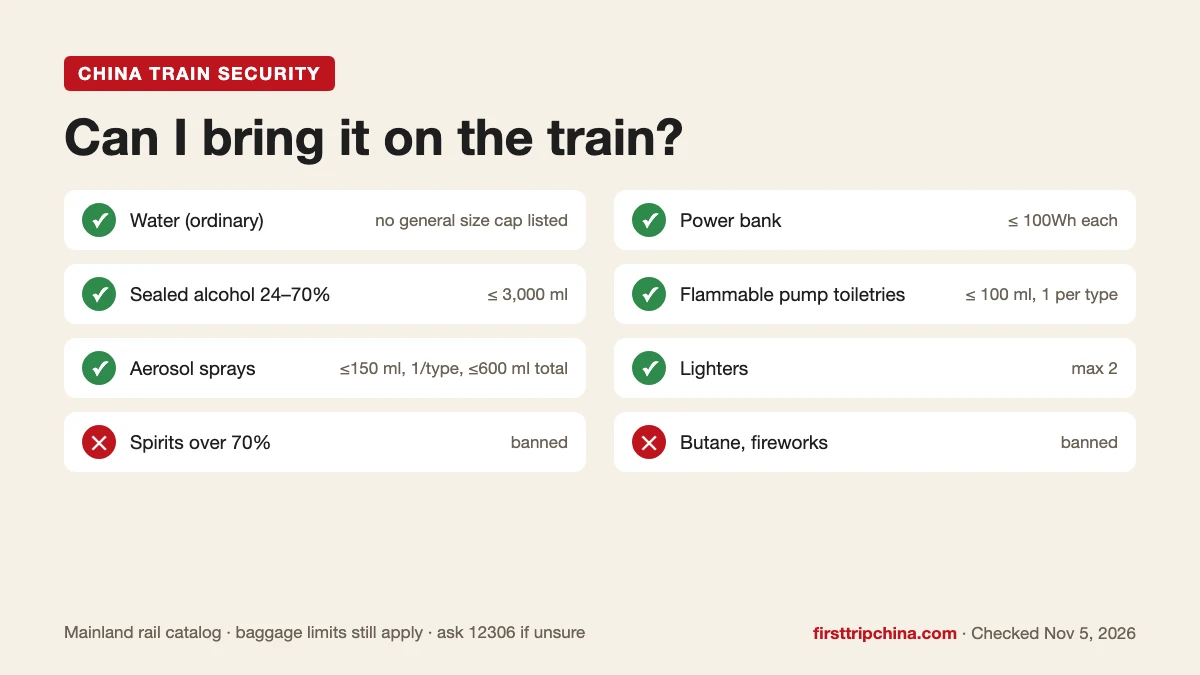
| Item | Allowed? | Limit |
|---|---|---|
| Water and toiletries without flammable ingredients | No general bottle-size cap listed | Baggage allowance and security checks still apply |
| Alcohol, sealed and labeled, 24%–70% ABV | Yes | 3,000 ml in total |
| Alcohol over 70% ABV, unlabeled spirits | No | Banned, also from checked luggage |
| Perfume, toilet water, gels with flammable ingredients (non-aerosol containers, such as hand-pump bottles) | Yes | 100 ml per container, 1 per type |
| Hairspray, mousse, sunscreen spray, bug spray, air freshener (aerosols) | Yes | 150 ml per can, 1 per type, 600 ml in total |
| Nail polish and remover | Yes | 50 ml in total |
| Power banks and lithium batteries | Yes | Clearly labeled, up to 100Wh each |
| Ordinary lighters / safety matches | Limited | 2 ordinary lighters / 2 small boxes of safety matches |
| Certain everyday knives with blades over 60 mm | Not in carry-on | Eligible for separately arranged rail transport; confirm service in advance |
| Butane canisters, fireworks, solid alcohol fuel | No | Prohibited in carry-on and separately arranged rail transport |
Source: Official rules on prohibited and restricted items, issued by the National Railway Administration and Ministry of Public Security and published on 12306. The Chinese title is 《铁路旅客禁止、限制携带和托运物品目录》; the link text here is a descriptive translation.
Liquids: why train security is easier than the airport
The published railway rules do not list a general bottle-size cap for ordinary drinking water or toiletries such as shampoo without flammable ingredients. This does not mean unlimited quantities of every liquid are permitted: dangerous-goods rules, baggage allowances and security checks still apply. Check the ingredients and container category first. A cosmetic containing alcohol or other flammable ingredients is not automatically an unrestricted toiletry.
12306 requires passengers and their belongings to undergo security screening. The absence of an airport-style general 100 ml rule does not exempt liquids from inspection. If staff ask you to remove a bottle or show an item, cooperate with the check. This guide does not promise the same bag-opening procedure at every station.
What the official list doesn't spell out is how staff handle a bottle they can't identify on the scan. That's decided at the station, so keep drinks in their original, labeled packaging where you can.
Perfume and sprays: read the container, not just the amount left. The published railway rules use container volume. A 200 ml aerosol can with only 30 ml remaining still exceeds the 150 ml per-container limit. A hand-pump perfume bottle and a pressurized spray are different categories: check ingredients and packaging before applying the 100 ml or 150 ml clause. Aerosols also have a one-per-type rule and a combined 600 ml cap. A small combined amount alone does not satisfy all three conditions.
Power banks: 100Wh is the number that matters
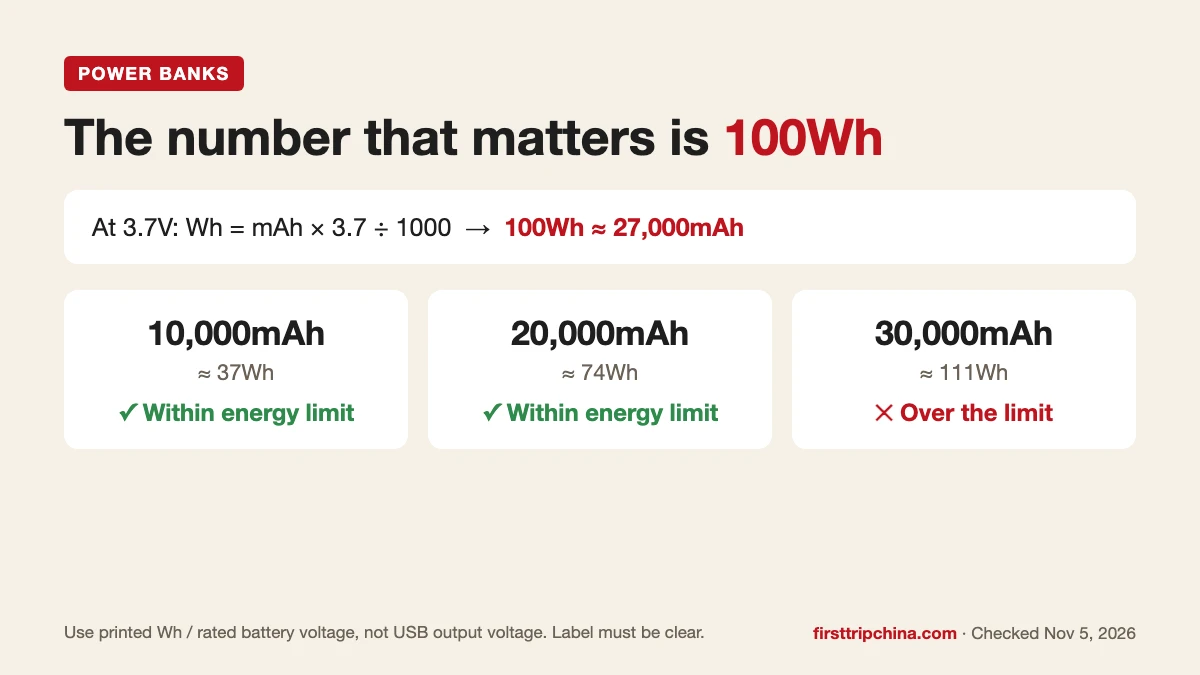
Each power bank or lithium battery must have clear markings and a rated energy of no more than 100Wh; the published railway rules have a separate exception for lithium-battery-powered wheelchairs. If conversion is needed, use the battery's rated voltage on its label: Wh = mAh × V ÷ 1,000. At 3.7V, 10,000mAh is about 37Wh, 20,000mAh about 74Wh, and 30,000mAh about 111Wh. The voltage is an example, not a universal value. Do not substitute the USB output voltage. Prefer the manufacturer's printed Wh rating.
Two points need qualification:
-
3C marking: the railway rule we checked specifies clear markings and a 100Wh limit. It does not state a 3C requirement in that clause. This is not a guarantee that every bank under 100Wh will pass inspection. If you also fly, separately check the aviation rules applicable on your departure date.
-
Quantity: this rule does not give a per-person count. That is not the same as permission to bring unlimited banks. For multiple units, unusual labels or uncertain products, ask railway customer service on 12306 before departure.
If the label has worn off and the capacity can't be read, expect it to be stopped.
Alcohol: bringing baijiu home
For alcoholic drinks from 24% to 70% ABV inclusive, the packaging must be sealed and clearly labeled, and the combined amount cannot exceed 3,000 ml. This clause does not set a minimum alcohol strength for drinks you may carry; lower-strength beer and wine are not covered by this particular volume limit. For example, six sealed, properly labeled 500 ml bottles at 52% ABV total 3,000 ml, reaching that limit; seven exceed it. This is an illustration of the published railway rules limit, not clearance for a particular package.
Spirits over 70% and unlabeled alcoholic drinks, such as homemade rice wine or loose baijiu, are listed as flammable liquids and are banned from both carry-on and checked luggage.
Knives, tools and other things that can't come on board
The published railway rules lists certain everyday knives with blades longer than 60 mm, plus bats, hammers, darts and defense sprays up to 50 ml, as prohibited in carry-on but eligible for separately arranged rail transport. Do not reverse that rule into a promise that every shorter blade is permitted: controlled knives and other dangerous items have separate prohibitions.
Eligible for separately arranged rail transport is an item classification, not a promise of a service at your departure station. Before travelling, ask the station or 12306 whether that item can be accepted, where to arrange it and how long it takes. We have not verified the service at every high-speed station. It is not safe to treat it like an airport checked bag and arrive just before departure expecting an immediate solution.
Examples of completely prohibited items include legally defined controlled knives, stun guns, crossbows, fireworks including cold sparklers, butane canisters and solid alcohol fuel. Classification of a controlled knife depends on the applicable standards, not just the blade-length example above.
If you're traveling with a camping stove, leave the gas canister behind and buy one at your destination.
What happens if security finds a banned item
Under 12306's baggage guidance, you won't be allowed to enter or board with a prohibited item. If a prohibited item or an item exceeding the permitted limits is found on board, it is handed to the station at the next stop for handling. The published guidance provides for a charge of twice the baggage freight rate, calculated using the full weight of that item for the journey from boarding to destination. This is not a penalty for carrying a restricted item within its permitted limits.
Before leaving: read the printed Wh and container capacities; distinguish pressure cans from pump bottles; and have the item's name, ingredients and specifications ready if asking 12306. Check any flight or cross-border leg separately. If an item is questioned at security, ask staff for clarification. A screenshot of this guide is not an authorization to carry it.
Do not wait until just before departure to resolve a questionable item. Ask security staff why it was stopped and what lawful options the station offers. Do not assume storage, courier or separately arranged rail transport services are available, or that an item eligible for separately arranged rail transport can still make your high-speed departure. For arrival planning and passport checks, see the 12306 entry and exit guidance; the station's announced ticket-gate cutoff applies.
Trains vs planes: don't pack once for both
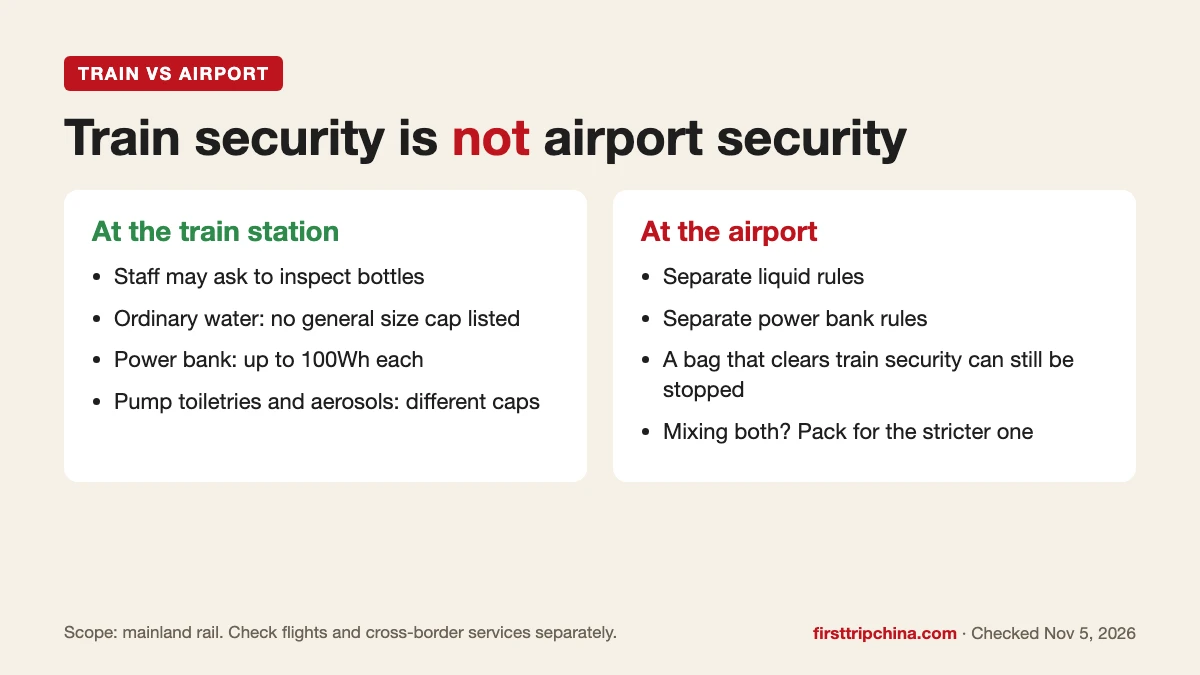
If your trip mixes trains and domestic flights, pack for the stricter one. Airport security has its own liquid rules and its own power bank rules, and they are not the same as the railway list above. A bag that clears train security can still be stopped at the airport.
FAQ
Can I bring sunscreen spray on a China high-speed train?
Check the packaging first. For a pressurized aerosol can, the limit is 150 ml per can, one of each type, and 600 ml of aerosols combined. A hand-pump product with flammable ingredients falls under the separate 100 ml container limit, one per type. The words "sunscreen spray" alone do not tell you which rule applies.
How many ml of perfume can I bring?
For perfume with flammable ingredients in a non-aerosol container, such as a hand-pump bottle, the limit is 100 ml per container and one per type. If it is a pressurized aerosol, check the aerosol limits instead. Use the container capacity, not the amount remaining.
Is a 30,000mAh power bank allowed?
At a rated battery voltage of 3.7V, 30,000mAh is about 111Wh, above the 100Wh limit. Use the product's printed rated energy and battery voltage, not the mAh number or a marketing page alone. An unclear label is not evidence that a bank is permitted.
Do the rules apply to slow trains too, not just high-speed rail?
Yes. The list covers all railway passengers, on high-speed and conventional trains alike.
Can I bring food and drinks on board?
Ordinary food and non-alcoholic drinks are generally not the issue, but this is not blanket permission for every food item. The published railway rules separately addresses strong-smelling items, live seafood intended as food and its sealed packaging. Camping gas and solid alcohol fuel are not allowed simply because they are used for cooking. Ask 12306 about an uncertain product.
Related: China transport guide · Beijing to Xi'an by high-speed train · Booking China attraction tickets
Last rechecked: November 5, 2026. This guide summarizes the 2022 prohibited and restricted items rules available on 12306 on that date; it does not claim to cover every temporary restriction. Check any additional rules applicable to your region, travel date or service.