Three days is enough for the iconic Chengdu trio — pandas, hotpot, teahouses — plus one Sichuan day trip. This itinerary is paced for first-timers, written by someone who actually lives in Chengdu.
A note on where to stay: pick a hotel along Metro Line 1 or Line 2 for easy access, but avoid booking inside the Chunxi Road / Taikoo Li / Jinli triangle — those areas are tourist-priced and the surrounding restaurants charge 2-3× normal rates. A stop or two outside the core is cheaper, quieter, and the metro gets you back in 5-10 minutes.
Day 1: Pandas and city center
Morning: Chengdu Research Base of Giant Panda Breeding
- Book tickets at least 7 days in advance — the Panda Base sells out fast, especially in summer and on weekends. "Night before" rarely works anymore
- Leave the hotel by 7:30 AM — pandas are most active at feeding time
- Metro Line 3 to Panda Avenue station, then shuttle
- Arrive by 8:30 AM when gates open
- Plan 2.5–3 hours inside
- Priority: Panda nursery (baby pandas), then adult enclosures
- One thing to mentally prepare for: the crowds. On a busy day it can feel less like you're watching the pandas and more like the pandas are watching you. Going early helps a lot, but don't expect a peaceful nature reserve experience
Lunch: first hotpot
- Skip the Chunxi Road area for this — the well-known places there are tourist-priced
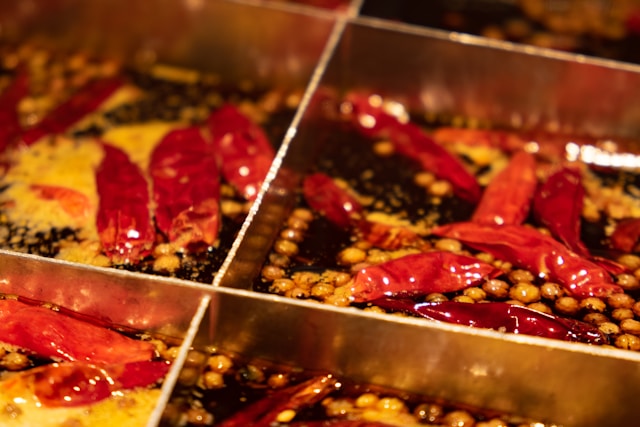
- A reliable local chain: Shu Daxia (蜀大侠). Locals know it for one quirk — the broth actually gets spicier the longer it simmers, so order, eat fast, or pace yourself
- If full spice is too much on Day 1, ask for a yuanyang (鸳鸯) split pot: half spicy, half mild bone broth
- Plan ~1.5 hours
Afternoon: Wide and Narrow Alleys
- Metro to Kuanzhai Xiangzi
- Walk the three parallel lanes (Wide, Narrow, Well)
- Tea houses, souvenir shops, photogenic courtyards
- Plan 1.5–2 hours
Evening: Jinli Street
- DiDi to Jinli Old Street (next to Wuhou Shrine)
- Night snacks, lanterns, street performances
- Touristy but the lantern atmosphere at night is genuinely worth one visit
Day 2: People's Park and food day
Morning: People's Park
- Metro to Tianfu Square, walk to People's Park
- Pick any of the teahouses inside the park — locals don't really have a "best" one, the setup is the same everywhere: around 20 yuan a bowl with unlimited refills, sit as long as you want
- Sit, watch locals play mahjong and cards
- Get an ear cleaning if you're brave (about 30 yuan, real not staged)
- Plan 2–3 hours — don't rush this
Lunch: Sichuan classics nearby
- The area around People's Park has plenty of small Sichuan restaurants. Use the "苍蝇馆子" tell from the Chengdu overview — packed with locals at lunch, no foreigners, no English menu = almost always good
- If you want something lighter than spicy food, look for a tangyuan (汤圆, sweet rice dumpling) or chao shou (抄手, Sichuan wonton) shop — both are everywhere in this area
Afternoon: Wuhou Shrine
- DiDi to Wuhou Shrine (武侯祠) — the temple complex dedicated to Zhuge Liang (诸葛亮), the legendary strategist of the Three Kingdoms (220-280 AD). If you've played Total War: Three Kingdoms, watched Red Cliff, or read Romance of the Three Kingdoms, this is the historical anchor for that whole era
- It's also the only shrine in China where a ruler (Liu Bei, 刘备) and his minister (Zhuge Liang) are worshipped jointly — plus a separate hall for the famous Liu Bei / Guan Yu / Zhang Fei sworn-brotherhood story
- Quiet courtyards, old cypress trees, Han-dynasty stone tablets. English signage is limited, so an offline guide app helps
- Plan ~1 hour. Note: Jinli Old Street is literally next door, so if you skipped it on Day 1, do both in one stop here
Evening: second Sichuan dinner
- For your second Sichuan meal, you'll see the big hotpot brand names everywhere (Xiao Long Kan, Da Long Yi). Locals will tell you the bigger the brand isn't necessarily better flavor here — and the price tends to be higher. Smaller spots often beat them
- A good alternative: chuanr (串串香), the self-serve skewer cousin of hotpot. Hong Xing She (红星社) is a chuanr chain I actually go to — solid food, and the interior is done in 1970s–80s China retro style. (A lot of Chengdu restaurants are leaning into this retro aesthetic right now — it's a small but distinct Chengdu thing.)
- Or switch the dish entirely with Sichuan dry pot (干锅 gānguō) — same flavor profile as hotpot, no broth
After dinner: Chengdu's folk-music live houses
Chengdu has a famously strong folk music (民谣 mínyáo) scene. There's a very well-known Chinese song literally called "Chengdu" (《成都》) by Zhao Lei (赵雷) — the lyrics are all about the city's small bars, rainy streets, and bittersweet goodbyes. The song single-handedly put Yulin Road (玉林路) on the map as Chengdu's folk-bar district.
If you have time after dinner, walk Yulin Road in the evening — small live houses, doors open, singer-songwriter sets, beer for 20-30 yuan, no reservation needed. A spot I've been to a few times is Tangyao (塘谣) — small place with a regular house band, nothing flashy, just a low-key folk-music room. Plenty of similar venues in the same area; this is the most authentically Chengdu night activity that has nothing to do with food.
Day 3: pick one — Dujiangyan or Mount Qingcheng
A note before you plan Day 3: most online itineraries try to combine Dujiangyan + Mount Qingcheng into a single day. Don't. Both involve a lot of walking — Dujiangyan is several kilometers of riverside paths and pavilions, Mount Qingcheng is 3-4 hours of actual hiking. Doing both means you'll be exhausted, won't enjoy either, and miss your last evening in Chengdu. Pick the one that sounds more like your trip.
Option A: Dujiangyan Irrigation System
- Take the intercity train (城际) from Chengdu Station or Chengdu West Station — about half an hour. Search "Chengdu to Dujiangyan" on Trip.com or 12306 for the live timetable
- The 2,300-year-old irrigation system is a UNESCO site
- Walk the Fish Mouth Levee and Anlan Cable Bridge
- Plan 4-5 hours total once you're there
- Lunch tip: small noodle shops near the site are cheap and authentic — Sichuan flavors at local prices, not tourist prices
Option B: Mount Qingcheng (青城山)
- Same train line, just stay on for one more stop to Qingcheng Mountain
- Taoist temples on a forested mountain — one of the most peaceful day trips from Chengdu
- Plan a full day on the marked trails (3-4 hours of actual climbing)
- Cable car available partway if you'd rather hike less
- Bring water, comfortable shoes, and don't underestimate the elevation
Evening: return to Chengdu
- Intercity train back in the late afternoon
- Dinner: try Sichuan cold noodles (凉面) or dan dan mian (担担面) if you haven't yet
Common mistakes
- Trying to book Panda Base tickets last-minute — they sell out 7+ days ahead, especially summer and weekends. Same trap as going in the afternoon (pandas sleep then; most active 8–11 AM)
- Eating hotpot in Chunxi Road / Taikoo Li / Jinli — the well-known restaurants there charge ~100 yuan per person for flavors that are dialed down for tourists. A real local hotpot or noodle shop is 30-40 yuan and much better
- Defaulting to the biggest hotpot brand name — bigger brand isn't always better flavor in Chengdu. The smaller, packed-with-locals places often beat the chain restaurants
- Trying to do Dujiangyan AND Qingcheng in one day — both are walking-heavy. Doing both means you'll hate both. Pick one
- Ordering full-spice hotpot on Day 1 — even locals work up to it, and Shu Daxia's broth gets more spicy as the night goes on
- Skipping the teahouse experience — it's the part of Chengdu most travelers remember
Getting to and from Chengdu
- From Beijing: ~3-hour flight, or high-speed rail (~7 hours direct)
- From Shanghai: ~3-hour flight
- From Xi'an: ~3.5-hour high-speed rail
For exact times and prices, check Trip.com or 12306 — schedules change seasonally.
Continue planning
- Going deeper on the food: Sichuan and Chongqing Food: A First-Timer's Guide and the Chongqing Hotpot Decoder
- Pair with Chongqing (1 hour by high-speed rail): The Perfect 3-Day Chongqing Itinerary
- Back to the Chengdu destination overview
- Next stops: Xi'an or continue to Yunnan / Lijiang