South China Itinerary: 2-Week Rail Route (Hong Kong, Guilin, Chongqing & Chengdu)
Travel from Hong Kong through Guangzhou, Guilin/Yangshuo, Chongqing, and Chengdu in 14 days entirely by high-speed rail with zero backtracking and zero domestic flights.
· By Yunjie

For the best 2-week South China itinerary, fly into Hong Kong and travel northwest entirely by high-speed train: spend 2 days in Hong Kong, 1–2 days in Guangzhou, 3 days in Guilin and Yangshuo, 2–3 days in Chongqing, and 3–4 days in Chengdu—flying home directly from Chengdu Tianfu (TFU) or adding a quick flight to Yunnan (Lijiang) if you stretch to 18 days. This single-direction corridor delivers dim sum, emerald karst rivers, cliffside cyberpunk skylines, spicy hotpot, and giant pandas without backtracking.
South China Travel Hubs: Crafting your multi-week route? Explore our complete destination overviews for Guilin and Chengdu.
Most first-time routes cluster around Beijing and Shanghai in the north and east. South China feels like a completely different country: milder winters, subtropical limestone peaks, Cantonese teahouses, and Sichuan spice. Because high-speed rail now connects Hong Kong straight through Guangxi into Sichuan, you can cross four distinct provinces without stepping onto a single domestic flight.
14-Day South China Rail Route at a Glance
| Days | Stop | Transit From Previous Stop | Core Highlights |
|---|---|---|---|
| Days 1–2 | Hong Kong | International arrival (HKG) |
Victoria Peak, Star Ferry, Sham Shui Po street food, jet-lag recovery |
| Day 3 | Guangzhou | 47 min G-train from Hong Kong West Kowloon (~CNY 215) |
Morning dim sum (早茶), Shamian Island, Canton Tower night view |
| Days 4–6 | Guilin & Yangshuo | 2.5–3 hrs G-train from Guangzhou South (~CNY 165–210) |
Li River cruise, Yulong River bamboo raft, cycling karst countryside |
| Days 7–9 | Chongqing | 4.5–5 hrs G-train from Guilin West (~CNY 310) |
Hongya Cave mist & lights, Liziba monorail, nine-grid hotpot, hillside alleys |
| Days 10–13 | Chengdu | 1–1.5 hrs G-train from Chongqing North/West (~CNY 150) |
Giant Panda Base at 07:30, People's Park tea, Leshan or Dujiangyan day trip |
| Day 14 | Departure | International flight out of Chengdu Tianfu (TFU) |
Fly home open-jaw (or short hop back to Hong Kong / Shanghai) |
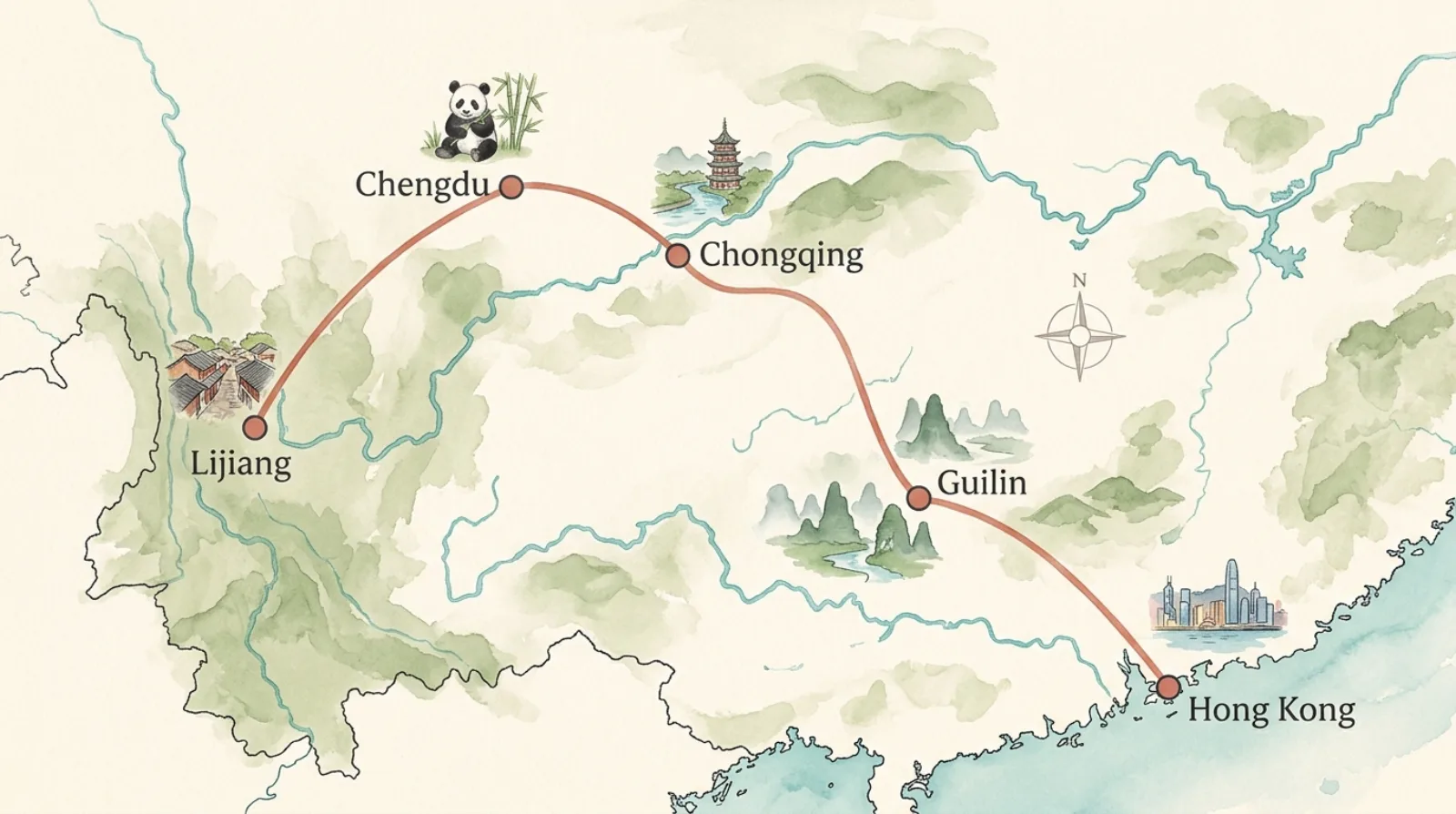
Segment-by-Segment Breakdown (What to Prioritize & What to Cut)
Days 1–2: Hong Kong (Easy Soft Landing)
Landing in Hong Kong eases you into Asia with English signage, contactless transit, and zero Great Firewall restrictions while you finish setting up your Mainland apps (check our Alipay and WeChat Pay guide and China travel eSIM guide before crossing the border). Keep Day 2 light so you can head to West Kowloon Station refreshed on Day 3.
Day 3: Guangzhou (Cantonese Food Capital)
Take the 47-minute cross-border bullet train into Guangzhou South or Guangzhou East (read our Hong Kong to Guangzhou high-speed train guide for the 30-minute West Kowloon border-clearance cutoff).
- What to focus on: Morning dim sum at a historic teahouse like Panxi or Tao Tao Ju, colonial-era Shamian Island, Chen Clan Ancestral Hall, and the Pearl River waterfront around Canton Tower.
- Shortcut option: If you prefer more nature time, skip overnighting in Guangzhou and take a direct 3-hour bullet train straight from Hong Kong West Kowloon to Guilin West.
Days 4–6: Guilin & Yangshuo (Karst River Scenery)
Train from Guangzhou South to Guilin West (2.5–3 hours), then spend one night in Guilin (or transfer straight to Yangshuo) and two nights in Yangshuo.
- Why this pacing works: Guilin city is mainly a transport hub; the real scenery sits downstream along the Li River and in the rural valleys around Yangshuo. Follow our 3-day Guilin and Yangshuo itinerary for river-cruise timing and e-scooter loops—and if traveling in winter, check Guilin in December.
Days 7–9: Chongqing (Vertical Mountain Metropolis)
Ride the direct G-train from Guilin West to Chongqing West (4.5–5 hours). Pack snacks or pre-order lunch via the armrest QR code (see our China bullet train food guide).
- What to focus on: Chongqing's layered hillside walkways, Liziba Monorail, Hongya Cave after dark, and authentic beef-tallow hotpot. Use our 3-day Chongqing itinerary and Chongqing hotpot decoder so you do not burn out on extra-spicy broth on night one.
Days 10–13: Chengdu (Pandas, Tea & Slow Pace)
Hop on the frequent 1–1.5 hour bullet train from Chongqing to Chengdu East. Ending your trip in Chengdu is deliberate: after a busy week of mountain stairs and river boats, Chengdu's flat streets, bamboo-shaded teahouses, and slow rhythm make the ideal wind-down.
- What to focus on: Arrive at the Chengdu Research Base of Giant Panda Breeding right at opening (
07:30–08:00) when pandas actually eat and move, stroll Kuanzhai Alley and Jinli, and pick one day trip (Dujiangyan or Leshan Giant Buddha). See our 3-day Chengdu itinerary and check airport transfer times in our Chengdu Tianfu vs Shuangliu Airport guide.
What This Route Intentionally Skips (And Why)
- Zhangjiajie: Adding Zhangjiajie's Avatar mountains requires a detour northeast from Guilin or Chongqing plus
3 full dayson the ground. Swap out either Guilin or Chongqing if Zhangjiajie is your top priority (see our 3-day Zhangjiajie itinerary). - Yunnan (Lijiang / Dali): Lijiang sits at
2,400 melevation in the far southwest. Cramming Yunnan into 14 days turns a relaxed South China loop into a sprint—save Yunnan for an 18- to 21-day version (see our 2-day Lijiang itinerary and Lijiang railway station guide). - Beijing & Shanghai: Mixing northern imperial capitals with deep South China in 14 days forces internal flights and cuts every stop short. If you want the classic nationwide highlights instead, follow our 2-week China itinerary.
Booking Order & Practical Transit Rules
- Flights first (Open-Jaw): Book arrival into Hong Kong (
HKG) and departure out of Chengdu (TFU) (or GuangzhouCANif looping back). - Train tickets 15 days out: China Railway releases tickets exactly 15 days before departure (see our China train ticket booking guide). Book the Hong Kong → Guangzhou/Guilin and Guilin → Chongqing legs on release day, as direct trains are fewer than on the Chengdu–Chongqing corridor.
- Visa check: Remember that crossing from Hong Kong into Mainland China counts as a border entry. Hong Kong West Kowloon Station is an eligible 240-hour visa-free transit entry port (for 55 eligible nationalities), provided you hold confirmed onward transport departing Mainland China to a third country or region—meaning entering from Hong Kong and returning directly to Hong Kong does not qualify. Because temporary entry permits are processed on-site inside the West Kowloon co-located border zone, arrive with extra buffer time (verify full port and third-country rules in our 240-hour visa-free transit guide).
Route Variations
- 10-Day Shorter Version: Skip Guangzhou overnight and cut Chengdu to 2.5 days → Hong Kong (
2d) → Guilin/Yangshuo (3d) → Chongqing (2d) → Chengdu (3d). - 18–21 Day Extended Version (Add Yunnan): From Chengdu, fly (
1.5 hrs) or take a scenic rail corridor via Kunming to Lijiang (2–3d) and Dali (2d), then fly out of Kunming (KMG) or return to Hong Kong. - Winter Beach Add-On: Traveling between November and February? Fly
2.5 hourssouth from Guangzhou or Chengdu to Sanya for warm25°Cbeaches (see our Sanya travel guide).
Frequently Asked Questions
What is the best season for a South China itinerary?
Spring (April–May) and Autumn (late September–November) offer the clearest skies and mild 18–26°C temperatures. Winter (December–February) is also surprisingly good—far milder than Beijing (6–16°C), low hotel rates, and prime hotpot season, though skies in Chongqing and Chengdu stay overcast. Avoid July–August if you dislike 35–40°C humidity and heavy monsoon showers in Guilin.
Can I do this entire South China route without flying domestically?
Yes. Every single leg—Hong Kong → Guangzhou → Guilin → Chongqing → Chengdu—is linked by direct high-speed G- or D-series bullet trains running on 300 km/h corridors.
How much luggage can I bring on South China bullet trains?
Adult passengers can bring up to 20 kg of luggage with combined dimensions (L + W + H) not exceeding 130 cm on high-speed trains. A standard 24-inch suitcase fits easily in the overhead rack or end-of-car luggage bay (see our China train luggage rules guide).
Last checked: November 25, 2026.