Chongqing hotpot is the meal foreign visitors most often blow up. The menu is a wall of Chinese, the broth is a wall of red oil, the table next to you is moving in a fast choreography you've never seen, and somewhere in the next 90 minutes you're supposed to figure out what's edible, how long to cook it, and what the small dish of oil is for.
This article is the operating manual, not a "what is hotpot" Wikipedia page — I live in Chengdu, and it's what I run visiting friends through before their first pot so the meal doesn't run them. The bigger food framing — Sichuan vs Chongqing flavor, mala explained — lives in the Sichuan and Chongqing Food guide; this one stays in the pot.
The broth: five options, decoded
- Yuanyang (鸳鸯锅) — split pot, half mala, half clear. The only acceptable choice for meal one. The clear side is your relief valve.
- Full mala (全红锅). Meal two and beyond, after you've calibrated. Chongqing mala builds slowly then catastrophically — don't test it jet-lagged.
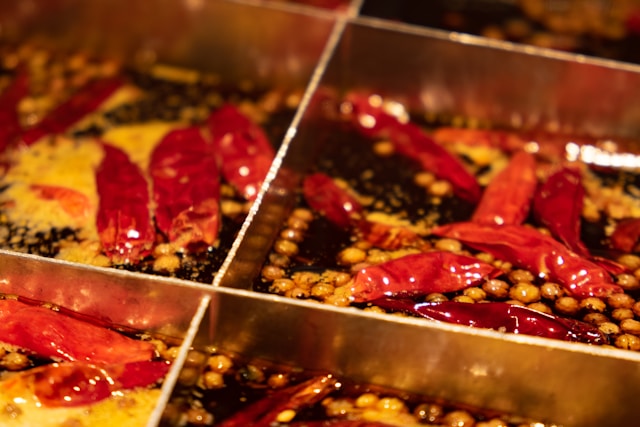
- Nine-grid (九宫格). A traditional Chongqing pot divided into 9 sections. Center grid is hottest (rolling boil — for tripe, duck blood); the 4 edge grids are medium (for thicker meats); the 4 corner grids are coolest (for meatballs, frozen tofu). One pot, three temperature zones — drop each ingredient into the grid matching its cook time.
- Clear oil pot (清油锅). Vegetable-oil-based mala instead of traditional beef tallow. Lighter, considered cleaner, slightly less flavor depth. Younger chains lean this way.
- Old oil pot (老油锅). Traditional rendered tallow broth, filtered and reused. Considered "the real thing" by older locals — and where the food-safety controversy lives. Chongqing's 2004 industry rules require all licensed restaurants to use single-use broth (一次性锅底); chains comply, some neighborhood places quietly don't. For a first visit, default to a licensed chain or visibly modern restaurant — broth will be single-use and the kitchen inspected.
If asked which side you want spicier on a yuanyang, take medium (中辣). "Regular" here doesn't mean what it means in Bangkok.
The 12-ingredient cheat sheet
These are the ingredients you'll actually encounter on a Chongqing hotpot menu, in rough order of "you must try this on your first visit." Each row: Chinese / pinyin / English / what it looks like / how long it cooks.
| Item | What it is | Cook time | Foreigner-friendly? |
|---|---|---|---|
| 毛肚 (máo dǔ) — beef tripe | Black or pale honeycomb-textured sheets. The signature Chongqing hotpot ingredient. | 7–10 seconds (the "七上八下 / qī shàng bā xià" trick — dip 7 times, wait, dip 8 times) | Mid — the texture is rubbery-crunchy and unfamiliar. The flavor is mild; almost everything is texture. |
| 黄喉 (huáng hóu) — aorta of pork or beef | Pale, ribbed translucent tubes. Sounds extreme; tastes neutral. | 20–30 seconds, until tube curls up | Mid — crunchy, almost like very firm cartilage. |
| 鸭肠 (yā cháng) — duck intestine | Long thin strips. Texture-driven, like maó dǔ. | ≤10 seconds (similar "dip-dip-dip" trick) | Lower — chewy, gamier; skip on first visit if you're texture-averse. |
| 肥牛 (féi niú) — thin-sliced fatty beef | Pink-and-white marbled paper-thin sheets. | 45 seconds to 1.5 minutes until fully colored. Do not try to flash-cook beef in 5 seconds — that's a tripe rule, not a meat rule. | High — easy, satisfying, the dish foreign visitors fall back on. |
| 嫩牛肉 (nèn niú ròu) — tender beef cubes | Small marinated beef cubes (often coated in egg white). | 1 minute | High |
| 鸭血 (yā xuě) — duck blood | Dark red gelatinous cubes. Tofu-like texture, mild iron taste. | 1–2 minutes (already cooked; mostly heating through and absorbing broth) | Mid — texture is the only obstacle. Worth trying once. |
| 豆腐皮 (dòu fu pí) — tofu skin sheets | Pale yellow folded sheets. | 30–60 seconds | High — neutral, absorbs broth, good landing platform if mala overwhelms you. |
| 冻豆腐 (dòng dòu fu) — frozen tofu | Sponge-textured tofu cubes; soaks up broth. | 2–3 minutes | High |
| 土豆片 (tǔ dòu piàn) — potato slices | Thin raw potato discs. | 3 minutes until soft | High — also mala absorber. |
| 藕片 (ǒu piàn) — lotus root slices | Pale, lacy-patterned discs. Crunchy. | 3–4 minutes | High |
| 金针菇 (jīn zhēn gū) — enoki mushrooms | Slim white mushroom strands. | 2 minutes | High — the foreigner's safe vegetable. |
| 虾滑 (xiā huá) — shrimp paste | Pink shrimp purée scooped into the pot from a small dish. | 8–10 minutes, becomes firm and floats | High |
Three things to skip on a first visit (controversial textures or low payoff):
- 鹅肠 (é cháng) — goose intestine. Even more challenging than duck intestine.
- 脑花 (nǎo huā) — pig or cow brain. A dare-dish; expert territory.
- Most seafood. Chongqing hotpot's traditional ingredient set is offal + meat + vegetables; seafood works but isn't the canonical experience.
A typical 2-person order: yuanyang pot + 1 plate of máo dǔ + 1 plate of féi niú or nèn niú ròu + 1 plate of duck blood or yellow throat + 2 vegetables (potato + enoki) + 1 tofu (dòng dòu fu) + 1 xiā huá. Add a beer or two cooling drinks (see below).
The sauce dish: get this right or the meal fails
In Chongqing and the surrounding Sichuan region, the standard hotpot sauce dish is oil-based — the "oil dish" (油碟 / yóu dié) — not the sesame-paste dish you may have seen in Beijing-style hotpot. This isn't preference, it's regional: the south uses oil, the north uses sesame paste.
The default traveler recipe for the oil dish:
- 2–3 tablespoons of sesame oil (麻油 / má yóu) as the base
- 1 generous spoon of minced raw garlic (蒜泥 / suàn ní)
- A pinch of chopped cilantro (香菜 / xiāng cài)
- Optional: a small spoon of oyster sauce (蚝油 / háo yóu) for umami depth and a pinch of salt
Why oil and not sesame paste: the sesame oil coats the surface of each ingredient as you pull it through the dish, cooling the temperature, capping the chili oil's grip on your tongue, and adding aromatic depth. Skip this step and you're eating bare mala — locals don't do that. Use it on every bite.
The dry dish (干碟 / gān dié) — a mix of chili powder, ground Sichuan peppercorn, peanut powder, and sesame — exists too, mostly in some Sichuan styles, and you'll see locals using it for grilled meats or for "intensifying" rather than cooling. Stick with the oil dish your first time.
Cooking rhythm: when to drop what
A Chongqing hotpot meal moves in waves, not one big plate-dump:
- First 5 minutes — heat the pot, drop slow-cook items first (xiā huá, frozen tofu, potato, dense vegetables).
- Minutes 5–20 — main eating window. Drop quick-cook items (tripe, duck blood, féi niú) one batch at a time, eat as they finish. Overcooked tripe goes from crunchy to rubber in 30 seconds — never let the pot become a graveyard.
- Minutes 20–40 — mala fatigue starts hitting. Switch to gentler items (more tofu, lotus root, vegetables). Drink cooling drinks (below). Slow down.
- Minute 40+ — wind down. Most locals stop adding plates past this point.
Rule: whatever you put in, mark it. Forgetting which slice of meat went in three minutes ago is the most common over-cooking failure.
Local rituals you'll see (and should copy)
- Cooling drinks (解辣饮品). Mala heat builds in your stomach as well as your mouth; locals counter with soy milk (豆奶), sour-plum soup (酸梅汤), herbal tea (凉茶), or coconut water. Beer doesn't cool. Order at least one cooling drink per person.
- Rice as a reset button. A small bowl of plain rice eaten between spicy bites resets your palate. Locals order it as a tool, not as a main.
- Use the long communal chopsticks (公筷) for adding ingredients, your personal pair for eating. Resting chopsticks in the pot signals you've never done this before.
- Don't fish for someone else's food. The pot is communal in name only — diners track their own pieces.
Chain vs community old-style hotpot
Two real categories:
Big national chains — Liuyishou (刘一手) and Banu (巴奴) have the best reputation; Banu's beef tripe is especially well-regarded. Haidilao (海底捞) is the loudest internationally but locals consider it service-heavy and non-Sichuan — skip if you want the real thing. The rule I keep repeating to visiting friends applies here too: the biggest name is rarely the best pot. Chain strengths: English menus, picture-heavy ordering, dialed-down baseline spice, hygienic kitchens. Use for meal one.
Community old-style hotpot (社区老火锅) — small storefronts in residential blocks, plastic stools, broth made by hand each morning, prices ~30% lower than chains. More intense, more authentic, but no English menus and broth-cleanliness verification is on you (look for a "一次性锅底" sign). Use for meal two or three.
If you only have one meal: chain. If you have two or three and want to actually understand the city: one chain, then one community old-style.
Common mistakes first-timers make
- Dumping every plate in at once. The pot becomes overcrowded; meat overcooks; tripe goes from chewy to chewing-gum. Cook in waves.
- Trying to flash-cook beef in 5 seconds. That's a tripe rule. Beef needs 45–90 seconds to fully cook through.
- Skipping the oil dish. The oil-and-garlic dip isn't decoration. It's the cooling layer and the flavor lifter. Use it on every bite.
- Ordering full red broth on day one. Mala builds. By minute 30 a yuanyang pot is already pushing your tolerance; a full red pot pushes it twice as hard.
- Treating "七上八下" as a universal rule. It's specifically for beef tripe (~10 seconds). Beef, vegetables, meatballs need much longer.
- Drinking only beer to cool the heat. Beer doesn't cool mala — order a cooling drink alongside.
Final notes
If your first Chongqing hotpot meal makes some sense at the end — you knew which sauce dish to use, you didn't ruin a plate of tripe, and the mala didn't overrun you — this article did its job. For the bigger framing and trip planning:
- Sichuan and Chongqing Food: A First-Timer's Guide — how the two cuisines differ, what to order beyond hotpot
- The Perfect 3-Day Chongqing Itinerary — where hotpot fits into the trip, plus the Wulong day-trip logistics
- The Perfect 3-Day Chengdu Itinerary — the other half of the mala story
- Back to the Chongqing destination overview