Eating on China High-Speed Trains: Food Delivery, Dining Cars & Rules
You can eat freely on China bullet trains. Order station meals straight to your seat via armrest QR code, grab hot bento boxes in the dining car, or bring your own food through security.
· By Yunjie
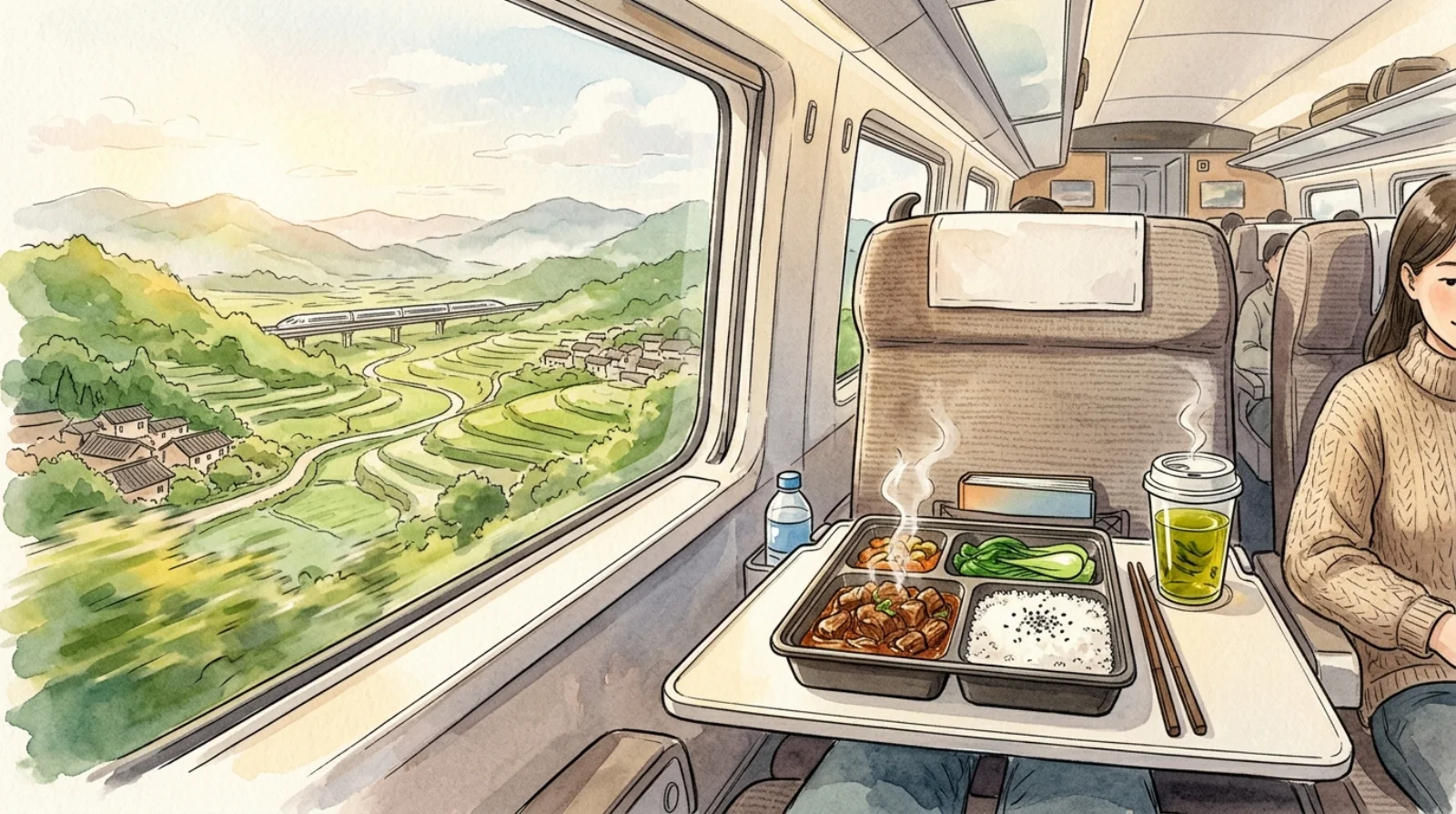
Yes, you can eat and drink freely on China high-speed trains. You have four reliable options: order station-to-seat delivery via the armrest QR code (requires ordering at least 1 hour before a delivery hub), walk to the dining car (usually Car 5, Car 9, or Car 13) for CNY 30–65 hot bento boxes, buy snacks from the passing trolley, or bring your own food through security—just never pack a self-heating hotpot, which security confiscates.
Food Hub Tip: Major regional culinary capitals feature extensive station dining and city food markets—explore food street areas in our Chengdu Destination Overview.
Eating on a four- or five-hour bullet train across China is much easier than eating on a long-haul flight, provided you know two local quirks: hot water dispensers are free in every carriage (making cup noodles a staple), and the famous train food-delivery service will cut off your order if you wait until you are already hungry.
Here is how each onboard dining option works, what costs what, and which foods are restricted at station security.
Quick Comparison: 4 Ways to Eat on China Bullet Trains
| Option | Typical Cost | How to Pay | Cutoff / Timing | Best For |
|---|---|---|---|---|
Station-to-Seat Delivery (铁路12306 / QR) |
CNY 35–80 (+ CNY 8 delivery fee) | Alipay / WeChat Pay | Must order ≥ 1 hour before train reaches the delivery station | Hot KFC, McDonald's, Starbucks, or regional dishes delivered straight to your seat |
Onboard Dining Car (餐车, Car 5, 9, or 13) |
CNY 30–65 (cold-chain bento boxes) | Alipay / WeChat Pay / Cash | Anytime while stock lasts (sells out fast at lunch) | Quick hot rice meal without pre-ordering |
| Aisle Snack Trolley | CNY 10–45 (fruit, coffee, snacks, boxed meals) | Alipay / WeChat Pay / Cash | Passes every 45–60 minutes | Coffee, water, light snacks without leaving your seat |
| Bring Your Own Food | CNY 15–50 (station eateries or supermarket) | Any payment before boarding | Buy inside the station departure hall | Picky eaters, vegetarians, dietary restrictions, and budget travelers |
Option 1: Ordering Station-to-Seat Food Delivery (Armrest QR Code)
China Railway lets passengers order real restaurant meals—McDonald's, KFC, Starbucks, Yonghe King, and local rice-bowl chains—from upcoming major stations along your route. When the train pulls into that station, a railway courier hands the bags to the onboard staff, who walk straight to your seat number and drop off hot food.
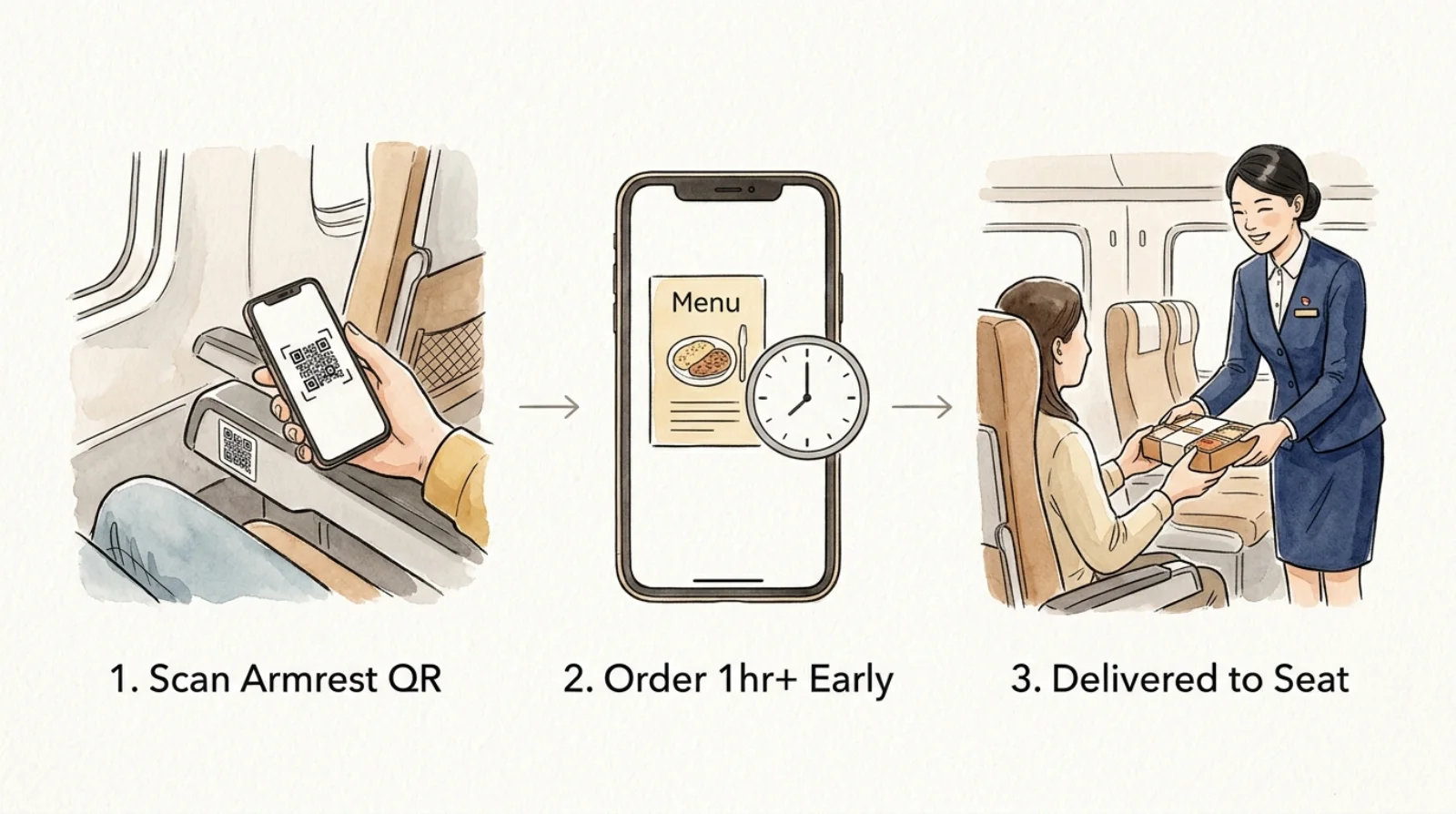
Step-by-Step Ordering Guide
- Scan the QR code on your seat armrest (labeled
铁路畅行/ Railway Changxing) using WeChat or Alipay. Alipay's built-in translation button makes the Chinese menu much easier to read if you do not read Chinese. - Confirm your train number, coach, and seat—scanning the armrest QR usually auto-fills these fields, though you can also enter your train number manually inside the 12306 mini-program before boarding.
- Pick a delivery hub station along your route: The system lists only stations that support delivery and are still at least 1 hour away. Look for familiar international chains (KFC, McDonald's, Burger King, Starbucks) or local rice sets.
- Pay via Alipay or WeChat Pay (ensure your foreign card is linked before departure; see our Alipay and WeChat Pay guide for foreigners).
- Stay in your seat after the delivery station: An attendant will deliver the bag directly to your seat
10–20 minutesafter the train departs that hub.
Two Common Delivery Pitfalls
- The 1-hour hard cutoff: If your train reaches Nanjing South at
12:30, delivery orders for Nanjing South close strictly at11:30. On shorter routes like the Shanghai to Hangzhou high-speed train (45 minutes), external station delivery is unavailable—grab food in the station before boarding. - No Chinese phone number needed if using the armrest QR: Most orders through the Alipay/WeChat
铁路畅行mini-program do not require a local SMS callback, though having an active data connection via a China travel eSIM keeps order updates loading smoothly inside tunnels.
Option 2: The Onboard Dining Car & Trolley
Every G-series and D-series bullet train carries a dining bar car—typically located in Car 5 on an 8-car train, Car 9 on a single-set 16-car train, or Car 5 and Car 13 on a 16-car double-coupled (8+8) train (note that on double-coupled trains, you cannot walk between Car 8 and Car 9; stay in your own half).
- What is actually served: Pre-packaged cold-chain bento boxes (
盒饭) heated in onboard ovens—usually braised pork rice, curry chicken, Kung Pao chicken, or beef with rice—plus freshly brewed coffee, milk tea, sandwiches, and packaged fruit. - Price range: Official meals range from CNY 15 (budget tier, very limited stock and sells out fast) to CNY 30, CNY 45, and CNY 65 (most widely stocked).
- Seating rules: You do not need to sit in the dining car to eat. Most travelers buy a box and bring it back to their own fold-down tray table. If you sit at a dining-car booth, staff expect you to purchase a meal or beverage.
- Business Class perks: If you booked a Business Class seat (for example on the Beijing to Shanghai high-speed train), a complimentary hot meal and snack box are included during lunch (
11:30–13:00) and dinner (17:30–19:00) windows.
Option 3: Bringing Your Own Food (And Free Boiling Water)
Bringing your own food onto the train is completely normal and often the best option for vegetarians, vegans, halal travelers, or anyone with food allergies.
Major stations like Beijing South, Shanghai Hongqiao, Chengdu East, and Xi'an North operate like airport terminals inside the departure hall, packed with Starbucks, McDonald's, KFC, Luckin Coffee, bakeries (Holiland, BreadTalk), and convenience stores (Lawson, FamilyMart, 7-Eleven).
Using the Free Hot Water Dispenser (电茶炉)
- Located at the connector end of every single carriage, right near the restrooms.
- Dispenses boiling water (
95–100°C) for free—ideal for instant cup noodles, tea bags, or refilling an insulated thermos. - Safety tip: Hold the red push-button or lever with care while the train is moving at
300 km/h, and do not fill flimsy paper cups to the brim.
What Food & Drinks Are Banned on China Trains?
Station security X-rays every bag before you enter the waiting hall. While ordinary food and drinks pass without issue, several specific items are strictly prohibited (for the complete non-food security list covering power banks and aerosols, see our China train restricted items guide):
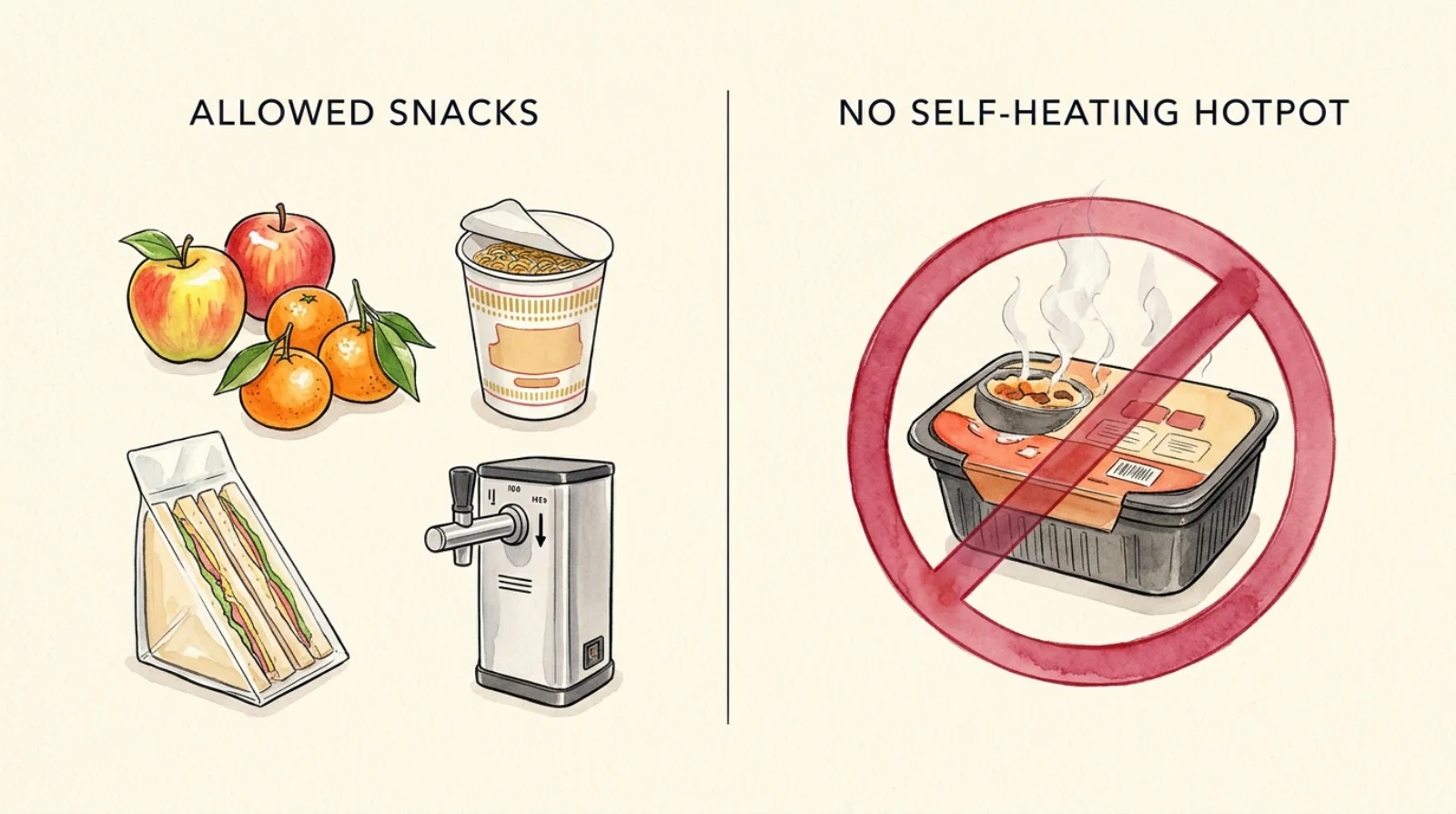
- Self-heating hotpots and self-heating rice (
自热火锅 / 自热米饭) — Strictly Banned: The calcium oxide heating packet generates intense heat, steam, and flammable hydrogen gas, which can trigger train smoke alarms. Security will confiscate the heating packet (or the entire box) at the X-ray belt. - Strong-smelling foods (Durian, Stinky Tofu, Luosifen): Fresh durian is barred from railway carriages, and pungent fermented snacks (
臭豆腐,螺蛳粉) can be refused at security or flagged by staff in sealed cabins. - Open alcohol and high-proof liquor: Unsealed bottles of alcohol are banned. Factory-sealed commercial alcohol between
24% and 70% ABVis capped at 3,000 ml total per passenger; anything above70% ABVis prohibited. - Kitchen knives and fruit peelers: Pre-cut your fruit before heading to the station. Pocket knives and fruit knives over
60 mmare confiscated at security.
Practical Onboard Dining Etiquette
- Trash collection: Cleaning attendants walk down the aisle with large rolling bins every
30–45 minutes. Keep noodle soup lids closed and tuck leftover wrappers in the seat-back paper bag until they pass—never dump liquid soup into the seat-back pocket. - Instant noodles etiquette: Cup noodles are culturally normal on Chinese trains, especially on longer
D-series or overnight rides (see our China sleeper train guide), though choosing mild flavors rather than heavy pickled-fish or garlic broths earns goodwill from your seatmates. - Book early on long routes: If you are still sorting out tickets and station timing, read our China train ticket booking guide and how early to arrive at China train stations.
Frequently Asked Questions
Can I bring water and coffee through China train security?
Yes. Unlike airport security, there is no 100 ml liquid limit on drinking water, iced coffee, or bottled tea at Chinese railway stations. Security staff may simply ask you to take a quick sip (喝一口) or place the bottle on a liquid-scanner pad.
Are there vegetarian or halal meals on China high-speed trains?
Onboard dining cars rarely stock dedicated vegan or certified halal bento boxes; most standard boxes contain pork, beef, or chicken. Vegetarian, vegan, and halal travelers should always buy meals in the station departure hall before boarding or pack snacks from a city bakery or supermarket.
Can I order train food delivery without a Chinese phone number?
Yes, in most cases. Scan the 铁路畅行 QR code on your armrest using Alipay or WeChat, verify your train/seat details, and pay with your linked international card. If an order screen asks for a phone number, entering a valid hotel reception number or foreign number in the contact field usually lets the order go through, because delivery is matched strictly to your coach and seat number.
Last checked: November 23, 2026.