How Early to Arrive at a China Train Station: Security, Gates & Passport Guide
Arrive 50–60 minutes before departure at major rail hubs (Beijing South, Shanghai Hongqiao) and 35–45 minutes at smaller stations. Gates lock strictly 3–5 minutes before departure.
· By Yunjie
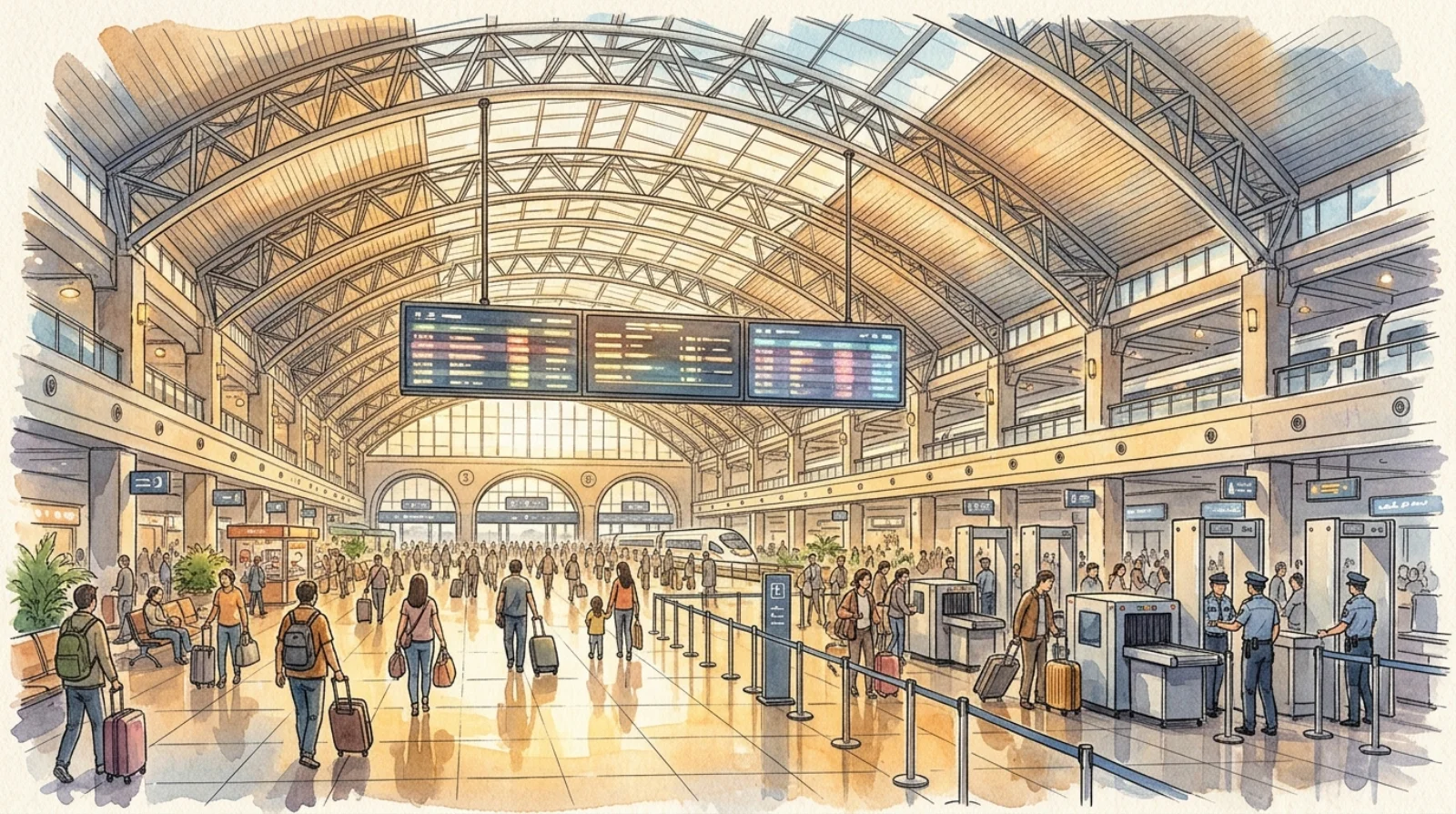
Arrive 50–60 minutes before departure at major China high-speed rail hubs (Beijing South, Shanghai Hongqiao, Guangzhou South, Xi'an North, Chengdu East) and 35–45 minutes early at smaller city stations. Boarding gates typically open 15–20 minutes before departure and lock strictly 3–5 minutes before the train leaves—leaving zero margin for late arrivals. If you are departing from Hong Kong West Kowloon for cross-border immigration, arrive at least 60–90 minutes early.
Station Navigation Tip: Navigating massive high-speed rail terminals? Find station transfer and metro connections in our Beijing Destination Overview and Shanghai Destination Overview.
Unlike European or Japanese stations where you can sprint onto a platform two minutes before departure, Chinese railway stations function like compact airport terminals. Every passenger passes through passport verification, X-ray luggage screening, and a massive elevated waiting hall before reaching the boarding gate.
Here is the exact countdown timeline, how foreign passport lanes work without paper tickets, and what to do if you ever miss your train.
How Early Should You Arrive? (By Station Type)
| Station Type / Scenario | Recommended Arrival Before Departure | Why That Buffer Matters |
|---|---|---|
| Mega HubsBeijing South, Shanghai Hongqiao, Guangzhou South, Chengdu East, Xi'an North | 50–60 minutes | Long walks from metro/taxi drop-off to departure hall (10–15 min), heavy security queues, and 20–30 distant boarding gates |
| Mid-Size & Smaller StationsGuilin, Suzhou, Lijiang, Hangzhou Station | 35–45 minutes | Compact hall layouts; security and passport check typically clear in 10–15 minutes |
| First-Time Foreign Rider / Unverified Passport | Add +15 minutes | If your passport needs manual counter verification or you are unfamiliar with finding the 人工通道 (manual lane) |
| Hong Kong West Kowloon (Cross-Border) | 60–90 minutes | Requires clearing both Hong Kong exit and Mainland China entry immigration inside the station; Level B1 real-name ticket check & border clearance close 30 minutes before departure, and platform gates close 5 minutes before departure (see our Hong Kong to Guangzhou train guide) |
| National Holidays & ChunyunLunar New Year, Oct 1–7, May 1–5 | Add +20–30 minutes | Security lanes back up outside the doors during peak domestic travel |
Step-by-Step Boarding Countdown (From Curb to Seat)
Understanding the four checkpoints eliminates almost all first-day station anxiety.
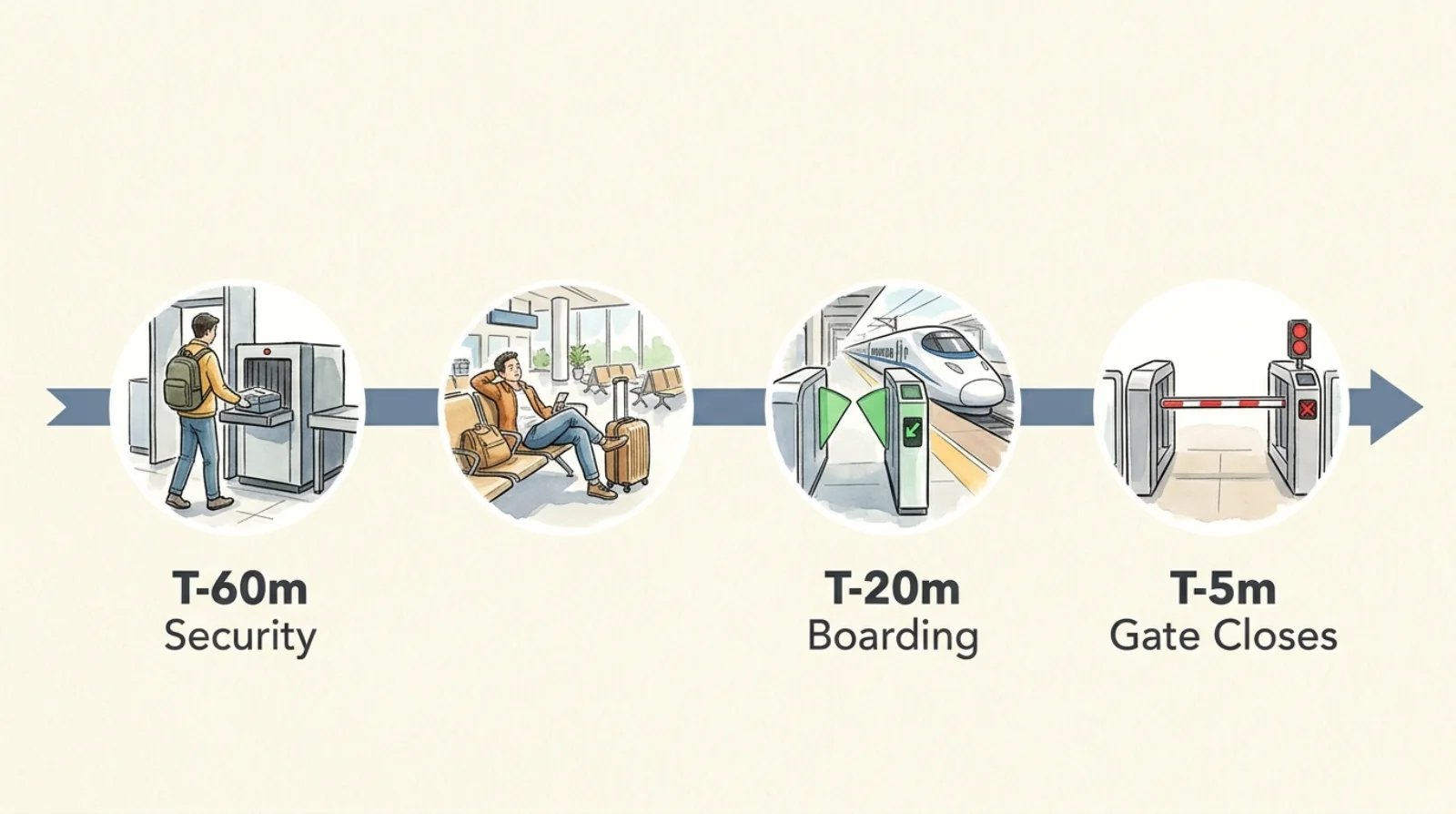
1. Drop-Off to Departure Hall (T-60 to T-45 min)
- If arriving by metro (for example, Shanghai Metro Line 2 into Hongqiao or Beijing Metro Line 4 into Beijing South), follow signs for
Departure / 候车室and take the escalators up to the departure level. - If arriving by taxi or DiDi, drivers drop you directly at the upper-level departure doors (see our DiDi in China guide).
2. ID Check & X-Ray Security Screening (T-45 to T-30 min)
- No paper ticket needed: China's high-speed rail runs on 100% electronic tickets linked directly to your passport number (book ahead using our China train ticket booking guide).
- Entry ID scan: Place your open passport photo page face-down on the optical scanner at the outer entrance gate, or step into the clearly signed
Manual Lane / 人工通道where an officer scans it in 5 seconds. - Bag X-ray: All suitcases and backpacks go on the belt. You do not need to remove laptops or drinking water (there is no
100 mlwater limit, though staff may ask you to take a sip). Just make sure you have no aerosols over150 ml, oversized power banks (>100 Wh), or self-heating hotpots (check our China train restricted items guide and luggage rules).
3. Waiting Hall & Finding Your Gate (T-30 to T-20 min)
- Check the giant overhead departure boards (which alternate between Chinese and English) for your train number (e.g.,
G12) and Gate (检票口, e.g.,14Aor14B). - Mega halls like Shanghai Hongqiao have gates numbered
1through30—walking from Gate 1 to Gate 28 takes nearly 10 minutes. Grab coffee or train snacks near your actual gate (see our China bullet train food guide).
4. Boarding Gate Opens & Locks (T-20 to T-5 min)
- Gate opens (
15–20 minutesbefore departure): Notice theAandBsub-gates—your ticket or Trip.com confirmation shows which side (AorB) is closer to your coach number (车厢), though both lead to the same platform. - Scanning your passport: Most major stations now have automatic gates marked with a passport icon (
护照). Place your passport photo page flat on the glass reader (not the narrow ID-card slot) and wait for the green arrow. If the gate beeps red, immediately step one meter over to the staffed人工通道on the far right or left of the gate bank—never hold up the line retrying five times. - Gate locks strictly (
3–5 minutesbefore departure): Once the overhead screen flips toStopped Checking / 停止检票, electronic turnstiles lock automatically. Staff will not reopen them even if the train is still sitting on the platform downstairs.
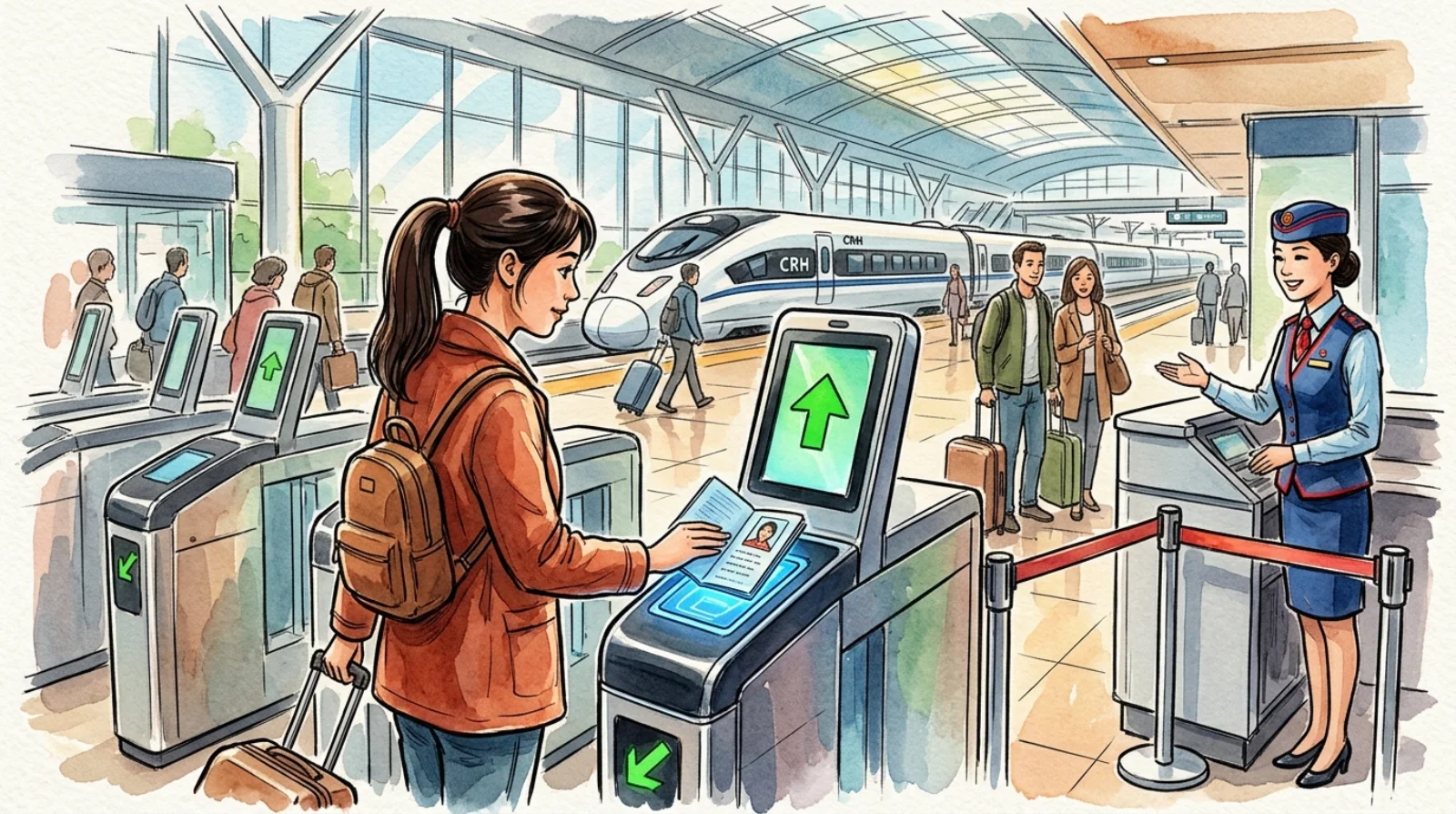
5. Platform to Your Coach (T-10 to T-2 min)
- Look down at the colored numbers painted on the platform floor (and hanging overhead screens) showing where each coach (
01to16) stops. - Board promptly—intermediate stops often last only
2–4 minutesbefore the doors chime and close.
What If You Miss Your Train? (Do Not Panic)
Missing a train in China is not a total financial loss like missing a budget flight:
- You can change to another train the same day for free (once): Open the 12306 App, Trip.com, or walk straight to the station's
Change / Refund Counter (改签窗口)with your passport. - Same-day rule after departure: Once your original train has departed, you can switch to any later train on the same calendar day heading to the same destination (subject to seat availability). You only pay the fare difference if the new train costs more; if it costs less, the difference is refunded.
- No cash refund after departure: You cannot cancel for a cash refund once the train has left, and if you miss the last train of the night, free same-day rebooking is no longer possible (changing to a later day incurs a 40% fee subject to seat availability)—so always leave an extra buffer on evening departures.
Quick Tips for Stress-Free Rail Days
- Allow extra transfer time between flights and trains: If connecting from an airport to a rail station—such as transferring after landing in Beijing or Shanghai—leave at least
3–4 hoursbetween flight touchdown and train departure (compare city transfer times in our Beijing Capital vs Daxing Airport and Shanghai Pudong vs Hongqiao Airport guides). - Check station names twice: Cities like Beijing, Shanghai, Chengdu, and Chongqing have 3 to 5 different railway stations located up to an hour apart. Verify whether your ticket says Beijing South, Beijing West, or Beijing Chaoyang before ordering your taxi.
Frequently Asked Questions
Do foreigners still need to pick up paper train tickets at the station?
No. Paper tickets have been replaced by e-tickets tied directly to your passport. Simply bring the exact original physical passport you used to book—photocopies or photos on your phone will not open the gates.
Can I arrive 2 hours early and wait inside the station?
Yes. Station waiting halls open well ahead of departure (often up to several hours early) and feature free seating, charging stations, restaurants, and clean restrooms. Just do not arrive 20 minutes before departure hoping to sprint straight onto the train.
How early do boarding gates close on China high-speed trains?
At almost all Mainland China stations, gates close strictly 3 to 5 minutes before scheduled departure (停止检票). At cross-border Hong Kong West Kowloon Station, Level B1 real-name verification and border clearance close 30 minutes before departure; platform boarding gates (Level B3) open 15 minutes before departure and close strictly 5 minutes before departure.
Last checked: November 23, 2026.