China Train Types Explained (G vs D, C, Z, T & K): Speeds, Seat Classes & Which to Book
China's train timetables split into modern G, D, and C bullet trains and older Z, T, and K conventional trains. Learn when a cheaper D train matches a G train's arrival time, how 3+2 Second Class compares with 2+2 First Class, and why station suffixes matter.
· By Yunjie
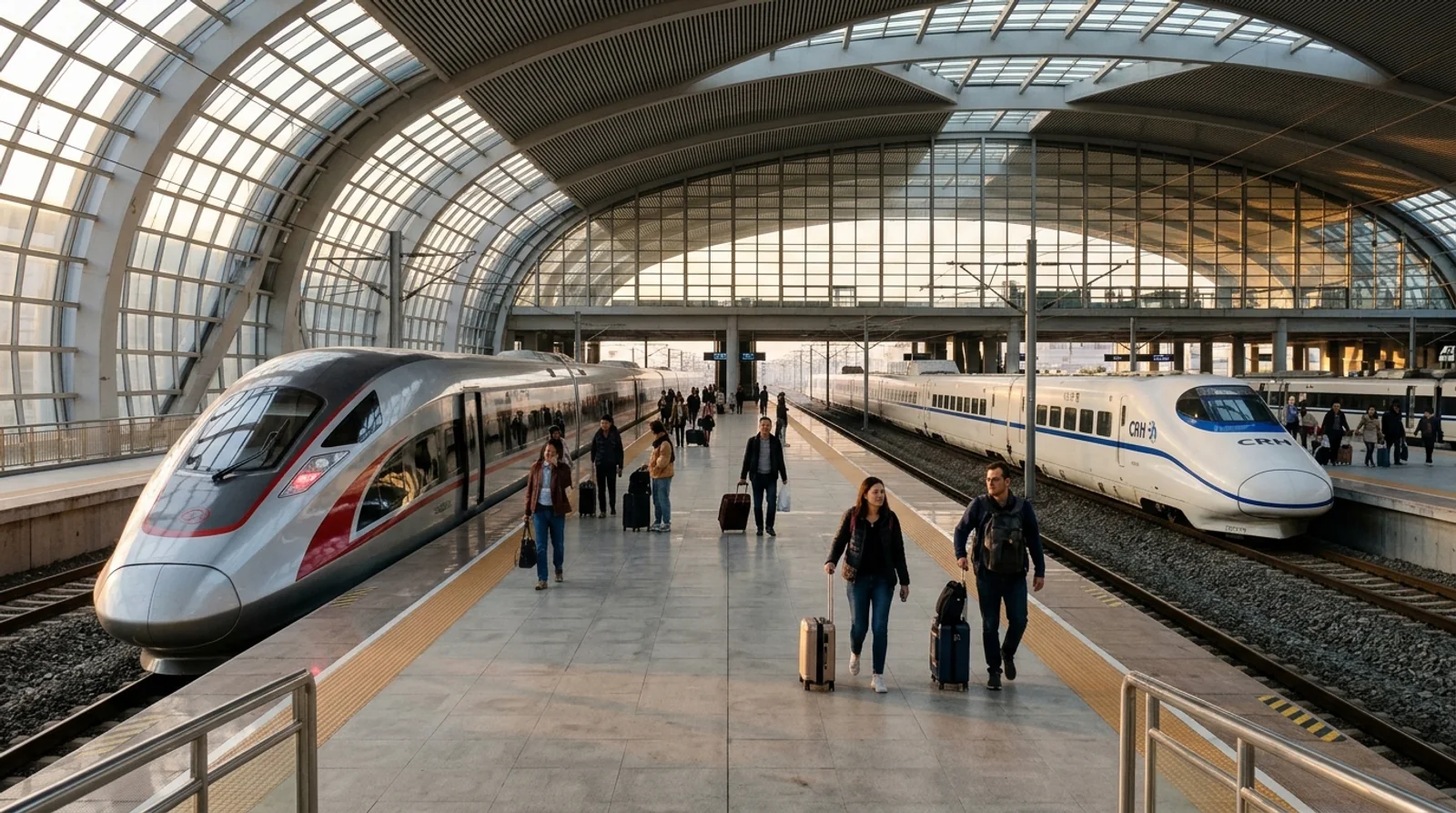
For daytime travel across China, book G, D, or C bullet trains: G trains are the fastest long-distance flagships (typically 250 to 350 km/h), D trains run slightly slower (typically 160 to 250 km/h) for 20% to 35% less money on shared corridors, and Z, T, and K codes mark older conventional trains best reserved for budget overnight sleepers.
When you search a route on 12306.cn or Trip.com, dozens of train numbers pop up starting with G, D, C, Z, T, or K, often departing from completely different railway stations across the same city. Picking a K train by mistake can turn a four-hour bullet-train hop into a fourteen-hour ride without power outlets at every seat, while paying extra for a G train on a mountainous route where tracks cap both G and D trains at 200 km/h wastes money for zero time saved.
Here is how to decode every letter on a Chinese train timetable, compare Second, First, and Business Class seats, and avoid the station-swap trap.
China Train Letter Codes at a Glance (G, D, C vs Z, T, K)
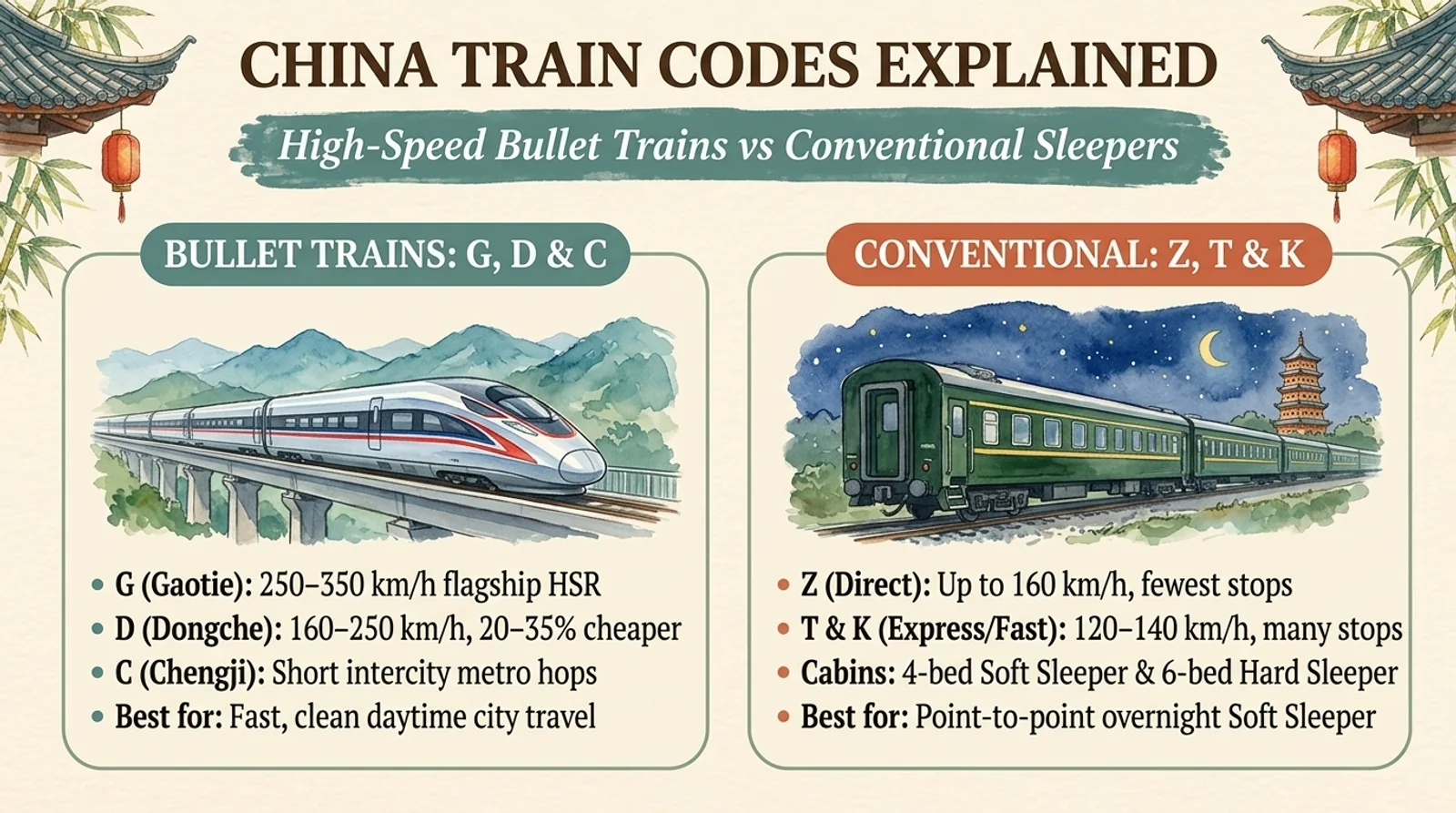
According to China's National Railway Administration, China operates 165,000 km of rail lines, including 50,000 km of dedicated high-speed track. On China Railway 12306's official booking system, train numbers split into two families: modern EMU bullet trains (G, D, C) and conventional locomotive-hauled trains (Z, T, K).
| Train Code | Chinese Name | Typical Operating Speed | Seat & Berth Categories | When Tourists Should Book It |
|---|---|---|---|---|
G |
Gaotie (High-Speed) | ~250 to 350 km/h (route-dependent) | Second Class, First Class, Business Class (plus Preferred First on select Fuxing sets) | Primary choice for medium-to-long daytime routes like Beijing to Shanghai or Beijing to Xi'an |
D |
Dongche (Bullet / EMU) | ~160 to 250 km/h | Second Class, First Class, plus High-Speed Overnight Sleepers on select trunk lines | Great value on 2 to 4-hour corridors (Xi'an to Chengdu, Kunming to Dali) or modern overnight sleepers |
C |
Chengji (Intercity EMU) | ~160 to 350 km/h | Second Class, First Class (some Business Class) | Short metropolitan hops such as Beijing to Tianjin, Chengdu to Chongqing, or Guangzhou to Shenzhen |
Z |
Zhida (Direct Express) | Up to ~160 km/h | Soft Sleeper (4-berth cabin), Hard Sleeper (6-berth bay), Hard Seat | Classic point-to-point overnight sleeper routes with very few intermediate stops |
T & K |
Tekuai / Kuaisu (Express / Fast) | ~120 to 140 km/h | Soft Sleeper, Hard Sleeper, Hard Seat | Skip for daytime sightseeing unless no G/D/C line exists; frequent stops and older carriages |
(You may occasionally spot S for suburban commuter lines such as Beijing's Line S2 to Badaling, or Y for seasonal tourist trains.)
G Train vs D Train: What Is the Real Difference?
First-time visitors often worry that a D train is an old, rattling commuter train compared with a G train. In reality, nearly all daytime G and D trains use modern air-conditioned high-speed trainsets with airplane-style reclining seats, Western-style and squat toilets, hot drinking-water dispensers, power sockets, and overhead luggage racks.
Three practical differences decide whether G or D wins on your route:
- Track speed vs shared-corridor pricing: On dedicated
350 km/htrunk lines like Beijing to Shanghai or our Beijing to Xi'an high-speed rail route,Gtrains shave one to two hours off the trip. However, on mountain corridors such as Xi'an to Chengdu, Guilin to Yangshuo, or Kunming to Lijiang, terrain caps track speeds around200 to 250 km/hanyway. On those lines, aDtrain arrives in almost the exact same time as aGtrain for a lower ticket fare. - Watch out for
160 km/hgreen "Fuxing"Dtrains: China Railway now runs bright greenCR200JFuxing trainsets underD-series numbers on upgraded conventional lines. They have clean modern interiors and power outlets, yet cruise around160 km/hrather than250 km/h. Always check the total travel time shown on the booking screen instead of judging by the letterDalone. - Fuxing (
CR) vs Harmony (CRH) trainsets: BothGandDschedules mix older whiteCRH("Harmony") sets and newerCR("Fuxing") sets. Fuxing carriages give you slightly more legroom, universal power plus USB ports between seats rather than under the row, and overhead seat-status indicator lights. On12306, Fuxing services display an orange "Fu" character badge next to the train number.
Seat Classes on G, D & C Bullet Trains (3+2 vs 2+2 vs 1+2)
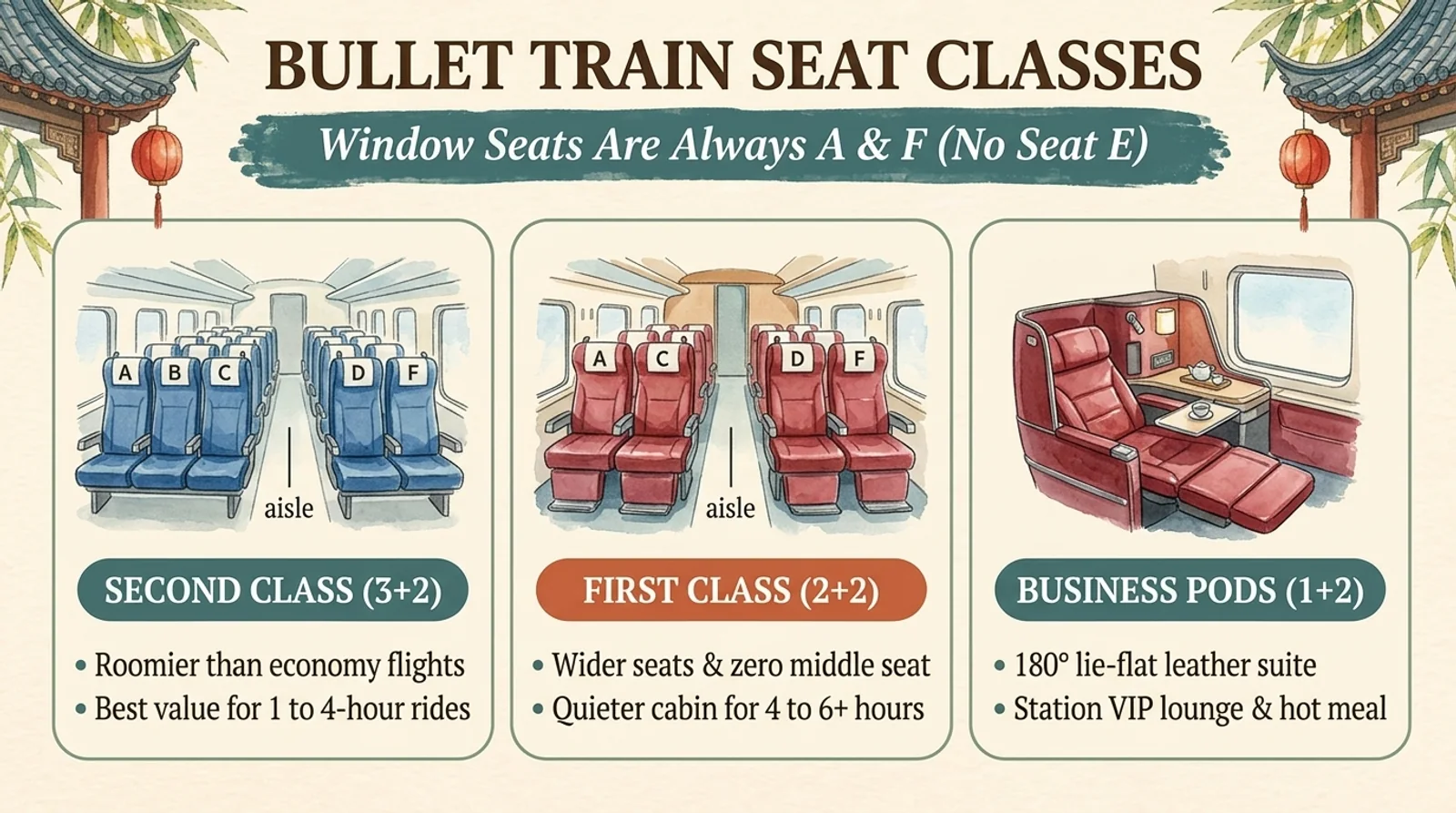
Per 12306's seat-selection rules, G, D, and C trains let you request window (A or F), aisle (C or D), or middle (B) seats when tickets are plentiful:
- Second Class (
Er Deng Zuo,3+2layout:A-B-C| aisle |D-F): Clean, generous legroom (noticeably roomier than economy airline seats), tray tables, and shared AC outlets. Totally comfortable for rides up to 3 or 4 hours. Notice there is no"E"seat, matching international aircraft window and aisle lettering (AandFare always windows). - First Class (
Yi Deng Zuo,2+2layout:A-C| aisle |D-F): Four wider seats per row, extra elbow room, footrests, pillows on some sets, and a quieter cabin with zero middle seats. Usually costs 50% to 65% more than Second Class and is well worth the upgrade on 4-to-6-hour rides or when traveling tall. - Business Class (
Shang Wu Zuo,1+2or1+1pods:A| aisle |C-F): Full lie-flat leather pods (comparable to long-haul airline business class), dedicated station VIP waiting lounges, priority boarding gates, slippers, snacks, and a hot meal served at your seat over mealtimes. MostGtrains carry only 5 to 20 Business Class seats, so they sell out quickly once the 15-day booking window opens.
When to Book Overnight D Sleepers vs Z/T/K Conventional Trains
If you want to wake up in a new city and save a hotel night after our 4-day Beijing itinerary, understand the difference between high-speed D sleepers and green Z/T/K sleepers:
- High-Speed
DOvernight Sleepers (Dong Wo): Operated at night on select major corridors (such as Beijing to Shanghai, Beijing to Guangzhou and Shenzhen, and weekend Beijing or Shanghai to Hong Kong West Kowloon runs). Most offer 4-berth Soft Sleeper compartments with a sliding door, reading lamps, and smooth quiet tracks, arriving in 10 to 12 hours. - Conventional
Z,T, andKTrains: If you book a classic green train, always book Soft Sleeper (4 beds in a lockable room) rather than Hard Sleeper (6 open triple-bunk bays with tight top-bunk headroom and corridor noise) or Hard Seat (upright benches that become grueling overnight).
Note that every berth is sold strictly under real-name passport rules per China Railway 12306's official English FAQ: two travelers cannot buy four berths under just two passports to lock a private 4-bed cabin for themselves.
3 Station & Baggage Rules Every Foreign Rider Should Check
- Check the exact station suffix (
North,South,East,West): High-speedGandDtrains rarely use the same downtown station as oldZ/T/Ktrains. In Xi'an,G/Dbullet trains useXi'an NorthwhileZ/T/Ktrains use central wall-sideXi'an Station; in Beijing, Shanghai trains useBeijing Southwhile Xi'an bullet trains useBeijing West. Always read the full station name on your e-ticket. - Use the manned passport lane if the e-gate rejects your scan: Your physical original passport is your ticket, so there is no paper boarding pass to print. Walk up to the staffed Manual Verification Lane (
Ren Gong Tong Dao) at one end of the turnstile row if the automated glass scanner hesitates on a foreign passport cover. - Check luggage dimensions and prohibited aerosols before boarding: Bullet-train overhead racks fit 24-inch suitcases easily, while 28-inch trunks squeeze into shared end-of-carriage racks; review exact weight and size caps in our China train luggage rules guide and check aerosol, knife, and power-bank limits in our China train restricted items guide. Keep your booking confirmation handy offline via a China travel eSIM so you can check car and seat numbers (
Car 05, Seat 08F) at platform gates.
Frequently Asked Questions
Is First Class worth the extra cost on China's G and D trains?
For trips under 2.5 hours (such as Shanghai to Suzhou or Hangzhou), Second Class (3+2 seating) already has plenty of legroom. On journeys of 4 hours or longer (such as Beijing to Xi'an or Beijing to Shanghai), upgrading to First Class (2+2 seating) eliminates middle seats, widens the seat cushion, and gives you a noticeably quieter carriage.
Why is there no Seat E on Chinese bullet trains?
China's G, D, and C trains copy international single-aisle aircraft lettering: A and F are always window seats, C and D are always aisle seats, and B is the middle seat in Second Class (3+2). Skipping E means F always guarantees a window regardless of whether you book Second, First, or Business Class.
Are D trains in China considered high-speed bullet trains?
Yes. D (Dongche) trains are modern electric multiple-unit (EMU) bullet trains that typically cruise between 160 and 250 km/h, share high-speed stations with G trains on many routes, and offer the same clean 3+2 Second Class and 2+2 First Class seating layouts at a lower fare per kilometer.
Should tourists ever book Z, T, or K trains in China?
Only in two situations: when taking a point-to-point overnight Z train in a 4-berth Soft Sleeper cabin, or on remote regional branches that do not yet have G or D service. For daytime travel between major cities, G and D bullet trains are far faster, cleaner, and easier to board.
When do G and D train tickets go on sale in China?
Regular China Railway tickets normally go on sale 15 days before departure on official 12306.cn (and via reservation queues on platforms like Trip.com), with release times staggered by departure station between morning and late afternoon Beijing time.
Last checked: November 19, 2026.