China Sleeper Train Guide: Hard Sleeper vs Soft Sleeper vs Overnight D-Train Sleepers
When booking a China sleeper train, choose a 4-berth Soft Sleeper or an overnight High-Speed D-Train Sleeper for privacy and power sockets. Compare bunks, luggage space, and doors across Z, T, K, and D trains.
· By Yunjie
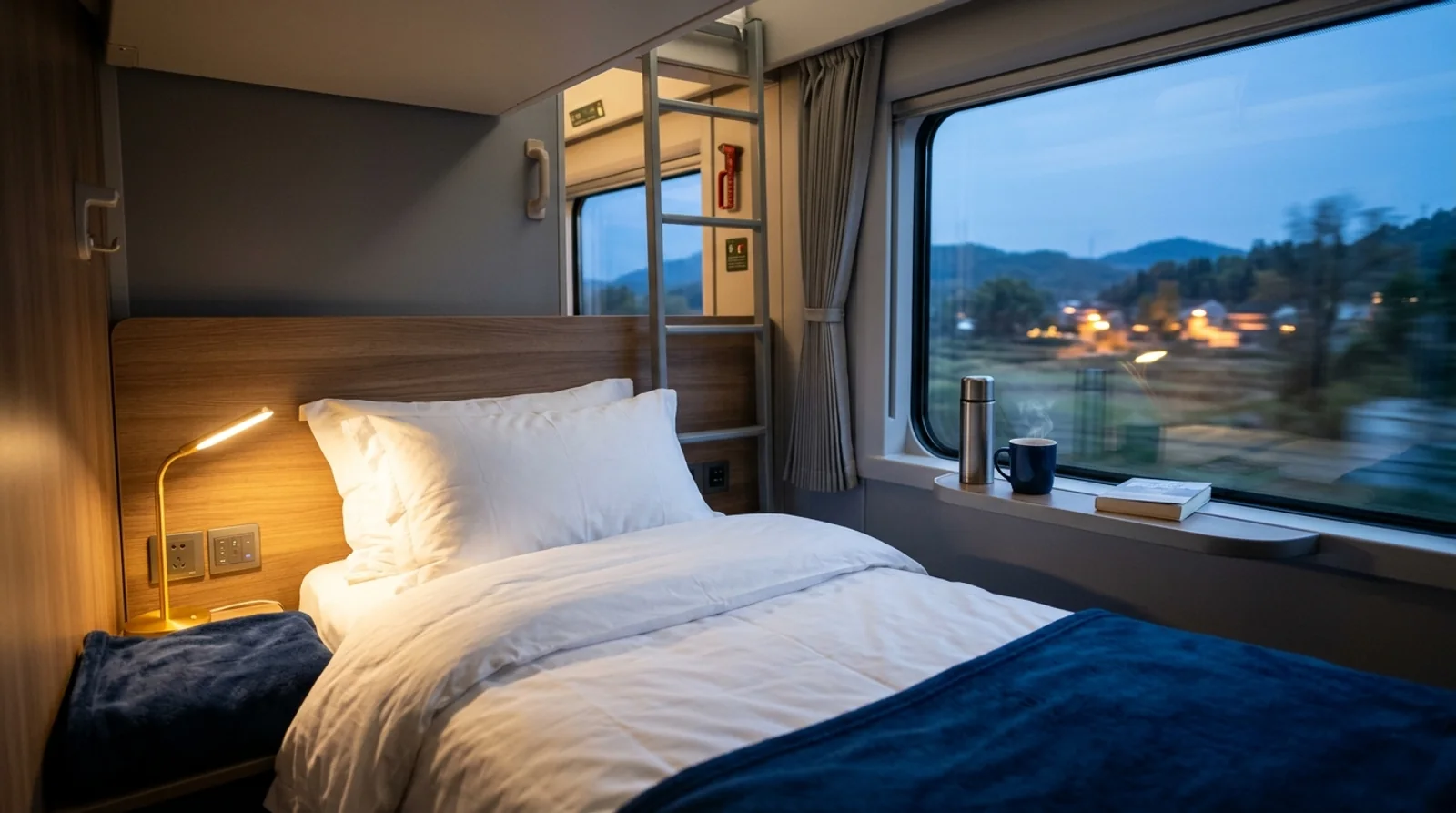
When booking a China sleeper train, choose a 4-berth Soft Sleeper (软卧) or an overnight High-Speed D-Train Sleeper (动卧) for privacy, a lockable door, and quieter rest—plus individual berth power sockets on D-Train Sleepers; pick a 6-berth Hard Sleeper (硬卧) on conventional Z, T, or K trains only when traveling on a tight budget or on scenic western routes where bullet sleepers do not run.
China's overnight rail network covers routes that let you fall asleep in one major hub and wake up refreshed in another—saving a hotel night on corridors like Beijing–Shanghai, Beijing–Xi'an, Shenzhen–Shanghai, or long western lines toward Yunnan and Tibet. The catch is that "Hard Sleeper" does not actually mean a wooden board, while daytime G-series bullet trains do not have beds at all.
Here is how Hard Sleeper, Soft Sleeper, Deluxe Soft Sleeper, and High-Speed D-Train Sleepers compare, which bunk level to pick, and what to pack for a smooth night onboard.
China Sleeper Classes Compared Side by Side
| Sleeper Class | Train Types | Berths Per Bay / Cabin | Privacy & Door | Power Outlets & Comfort | Best For |
|---|---|---|---|---|---|
Hard Sleeper (硬卧) |
Conventional Z, T, K |
6 berths (Upper, Middle, Lower × 2) | Open bay (no door; curtainless aisle) | Shared aisle outlets; padded mattress; limited headroom on upper/middle | Solo budget travelers, short overnight hops |
Soft Sleeper (软卧) |
Conventional Z, T, K & select D |
4 berths (Upper, Lower × 2) | Lockable sliding door | Wider bunks, reading lamps, table, under-bed luggage space | Couples, families, first-time sleeper riders |
High-Speed D-Sleeper (动卧) |
Overnight D-series EMU (200–250 km/h) |
4 berths (or lengthwise privacy pods on select models) | Lockable door (or individual curtains on pod models) | Power/USB socket & reading lamp at every berth; smoother, quieter ride | Beijing–Shanghai, Beijing–Guangzhou/Shenzhen, Shanghai–Xi'an |
Deluxe Soft Sleeper (高级软卧) |
Select Z, T, D flagship routes |
2 berths (Upper, Lower) | Private lockable 2-person cabin | Sofa/wardrobe; some cabins include an ensuite or shared private washroom | Couples wanting total privacy (~3× Hard Sleeper fare) |
(Daytime G-series bullet trains run seats only—never beds. For a full breakdown of all train letters, see our China train types (G vs D, C, Z, T, K) guide.)
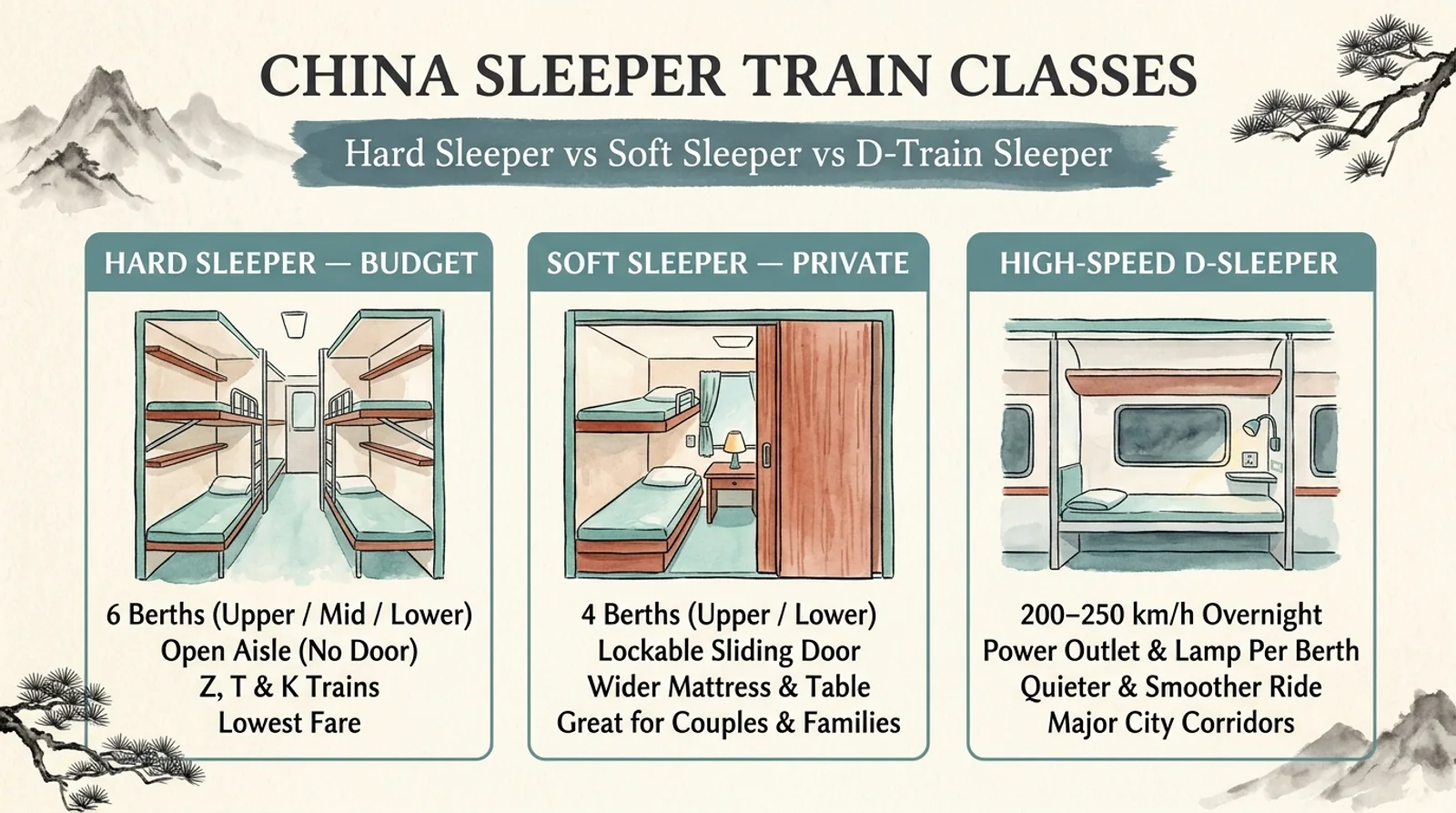
1. Hard Sleeper (硬卧): Not Actually "Hard," Just Open
Despite its intimidating English translation, a Hard Sleeper comes with a padded mattress, clean white sheet, pillow, and duvet washed between trips. What makes it "hard" is the open-plan, 6-berth layout with no door separating your bay from the corridor.
- Space and noise: Lights in the carriage dim around
22:00–22:30, though footsteps, phone chatter, and station announcements along the corridor remain audible. - The daytime sitting rule: Because middle and upper bunks lack sitting headroom, passengers from the top two bunks customarily sit on the Lower bunk during waking hours until bedtime.
- Where it shines: On routes without overnight
Dsleepers (such as Kunming–Lijiang or Xi'an–Lanzhou), Hard Sleeper costs roughly half the price of Soft Sleeper and offers a lively local experience.
2. Soft Sleeper (软卧): Best Balance of Comfort and Cost
For most international visitors trying an overnight Chinese train for the first time, Soft Sleeper is the sweet spot.
- Enclosed 4-berth compartment: A solid sliding door locks from the inside at night, blocking hallway light and chatter.
- Better luggage storage: Large suitcases slide directly beneath the lower bunks or rest on the deep overhead alcove above the compartment doorway (still keep within official size limits—check our China train luggage rules).
- Shared cabin etiquette: If you book 2 tickets in a 4-berth Soft Sleeper, two other travelers may share the remaining bunks; booking all 4 berths gives a family or small group a private room.
3. High-Speed D-Train Sleepers (动卧): Modern Overnight Bullet Trains
Running at 200–250 km/h overnight between mega-cities (such as Beijing–Shanghai, Beijing–Guangzhou/Shenzhen, and Shanghai–Chengdu/Xi'an), High-Speed D-Train Sleepers replace older locomotive clatter with smooth electric-multiple-unit cabins.
- Two cabin layouts: Most overnight
Dtrains use sleek 4-berth Soft Sleeper compartments with individual reading lamps, USB/AC power sockets, and slippers; select newer lengthwise models (纵向动卧) arrange individual curtained capsule-style berths parallel to the aisle so solo travelers get a private window and zero shared cabin awkwardness. - Worth checking daytime
Gtrains too: On corridors like Beijing–Shanghai (4h 18mby day vs12hovernight) or Beijing to Xi'an by high-speed rail, compare an overnightD-sleeper against a fast daytimeGtrain plus a comfortable hotel night before deciding.
Upper vs Middle vs Lower Bunk: Which Berth Should You Pick?
When booking on the official Railway 12306 app (per the China Railway 12306 Official English FAQ) or Trip.com (see our how to book China train tickets guide), you can request a berth preference when inventory permits:
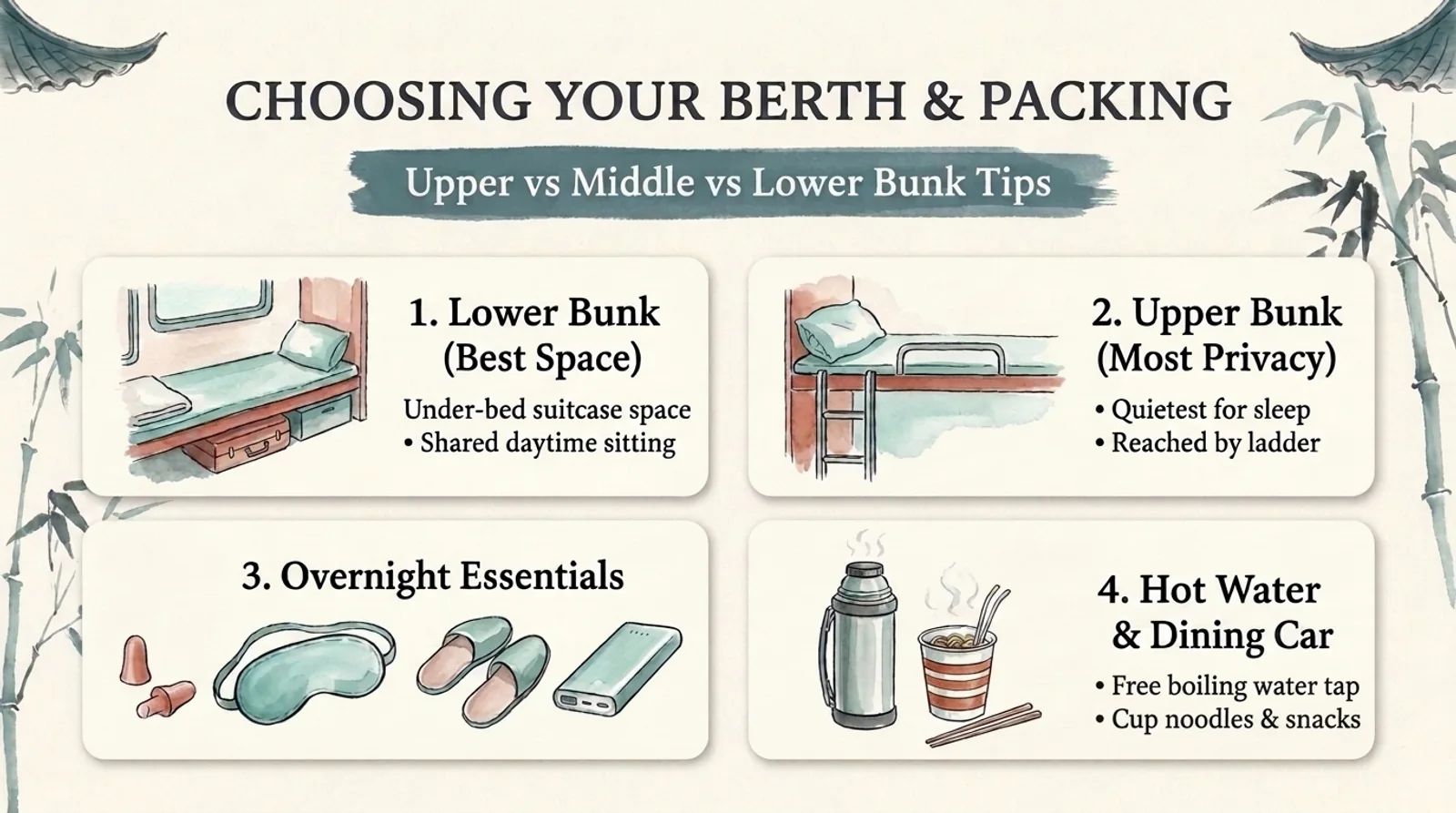
- Lower Bunk (
下铺) — Most expensive, easiest access: Full sitting headroom during the day, no ladder climbing at night, and direct access to under-bed suitcase storage. Trade-off: in Hard Sleeper, middle/upper passengers may sit on the edge of your bunk before lights out. - Middle Bunk (
中铺, Hard Sleeper only) — Mid-priced: Short climb up, slightly less headroom than the lower bunk, but no one sits on your bed during the day. - Upper Bunk (
上铺) — Cheapest, most private: Complete privacy all day and night with zero foot traffic—ideal for light sleepers who climb a short ladder comfortably. Note that upper bunks sit closest to the ceiling air-conditioning vents, so bring a light long-sleeve layer.
What to Pack & Expect Onboard Overnight
- Sleep kit: Pack earplugs, an eye mask, a light sweater (nighttime cabin AC can feel cool), and slip-on sandals or disposable hotel slippers for quick bathroom walks.
- Free boiling water & food: Every sleeper carriage has a free hot-water boiler (
开水处) at one end—bring instant noodles, oatmeal cups, or a tea thermos, or visit the middle dining car (餐车) for hot stir-fried dishes and boxed meals (CNY 35–65). - Toilets & washbasins: Soft Sleeper and
D-Sleeper carriages include both Western seated and squat toilets plus a shared sink area outside the stalls (bring your own toothbrush, toothpaste, small towel, and pocket tissues). - Wake-up alert: The carriage attendant (
乘务员) wakes passengers roughly 30 minutes before each major stop, though setting a quiet vibrating phone alarm is still smart—especially for early-morning arrivals. - Security & restricted items: Standard China Railway security applies before boarding; leave aerosols over size limits and sharp knives out of your pack (see our China train restricted items guide).
Frequently Asked Questions
What is the difference between Hard Sleeper and Soft Sleeper in China?
Hard Sleeper (硬卧) has 6 berths (upper, middle, lower) in an open bay with no door on conventional Z/T/K trains. Soft Sleeper (软卧) has 4 wider berths (upper and lower) inside a quiet, enclosed compartment with a lockable sliding door. Both provide padded mattresses and clean white linens.
Are China sleeper trains safe for solo foreign travelers?
Yes. Every ticket is tied to real-name ID/passport verification, uniformed carriage attendants patrol each car throughout the night, and Soft Sleeper cabins lock from the inside. Keep passports, phones, and wallets tucked beside your pillow or inside a zipped daypack while sleeping.
Can I choose an upper or lower bunk when booking a China sleeper train?
Yes. Both the official Railway 12306 app and Trip.com let you select a bunk preference (Lower, Middle, or Upper) during checkout when berths remain available, though lower bunks sell out fastest and cost slightly more than upper bunks.
Do China sleeper trains have power outlets and Wi-Fi?
Overnight High-Speed D-Train Sleepers have AC/USB power sockets at every berth. Older conventional Z/T/K Soft Sleepers usually have outlets inside the cabin or under the table, while Hard Sleepers have shared corridor outlets—bring a fully charged ≤100Wh power bank. Reliable free Wi-Fi is not available for foreign phones; use mobile data.
Do daytime G-series high-speed trains have sleeper beds?
No. G-series bullet trains operate daytime seat-only carriages (Second, First, and Business Class). Overnight sleeper berths operate on D-series overnight bullet trains and conventional Z, T, and K trains.
Last checked: November 22, 2026.