How to Use the Beijing Subway as a Foreigner: Foreign Card Tap-to-Pay, Alipay & Fares
Foreign visitors can ride every Beijing Subway line and both airport express routes by tapping an overseas Visa, Mastercard, Amex, or JCB card directly at the turnstile. Learn the one-card gate rules, CNY 3+ distance fares, Alipay backup setup, and exact stops for top Beijing sights.
· By Yunjie
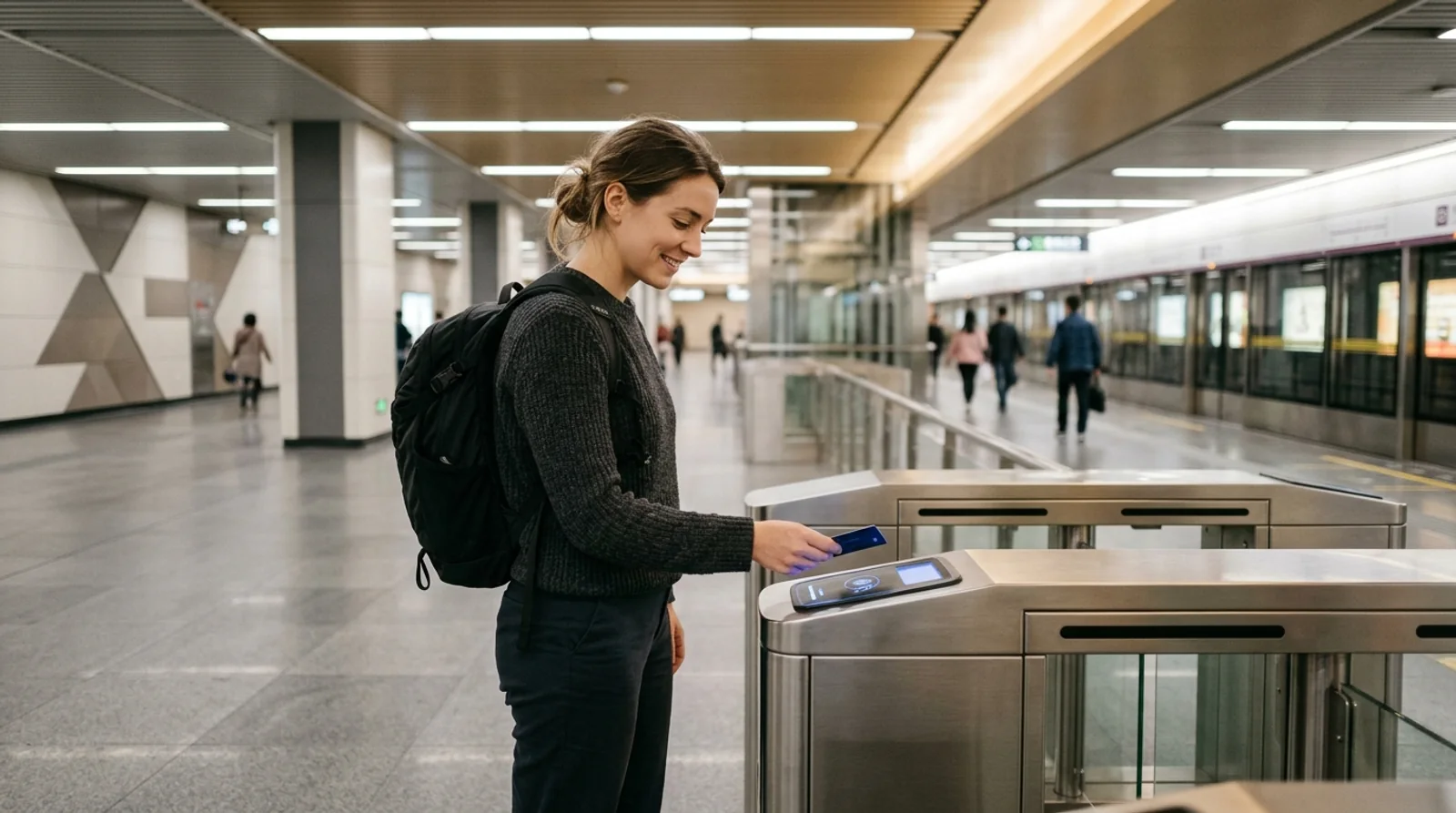
Riding the Beijing Subway requires zero local bank accounts or paper tickets: you can tap a contactless foreign Visa, Mastercard, American Express, JCB, or UnionPay card directly on the turnstile scanner at every station across all urban lines and both airport express routes.
If you prefer mobile QR codes or travel with kids who do not carry their own bank cards, Alipay and WeChat transit QR codes, English self-service ticket kiosks, and the prepaid BEIJING PASS card fill every gap. Standard urban rides start at CNY 3, station signs and train announcements run in both Chinese and English, and mandatory bag X-ray checks at station entrances add roughly two minutes to each trip.
Here is how to pick the right payment method, avoid the one-card turnstile trap, ride from either Beijing airport, and reach flagship sights smoothly.
4 Ways Foreigners Can Pay on the Beijing Subway
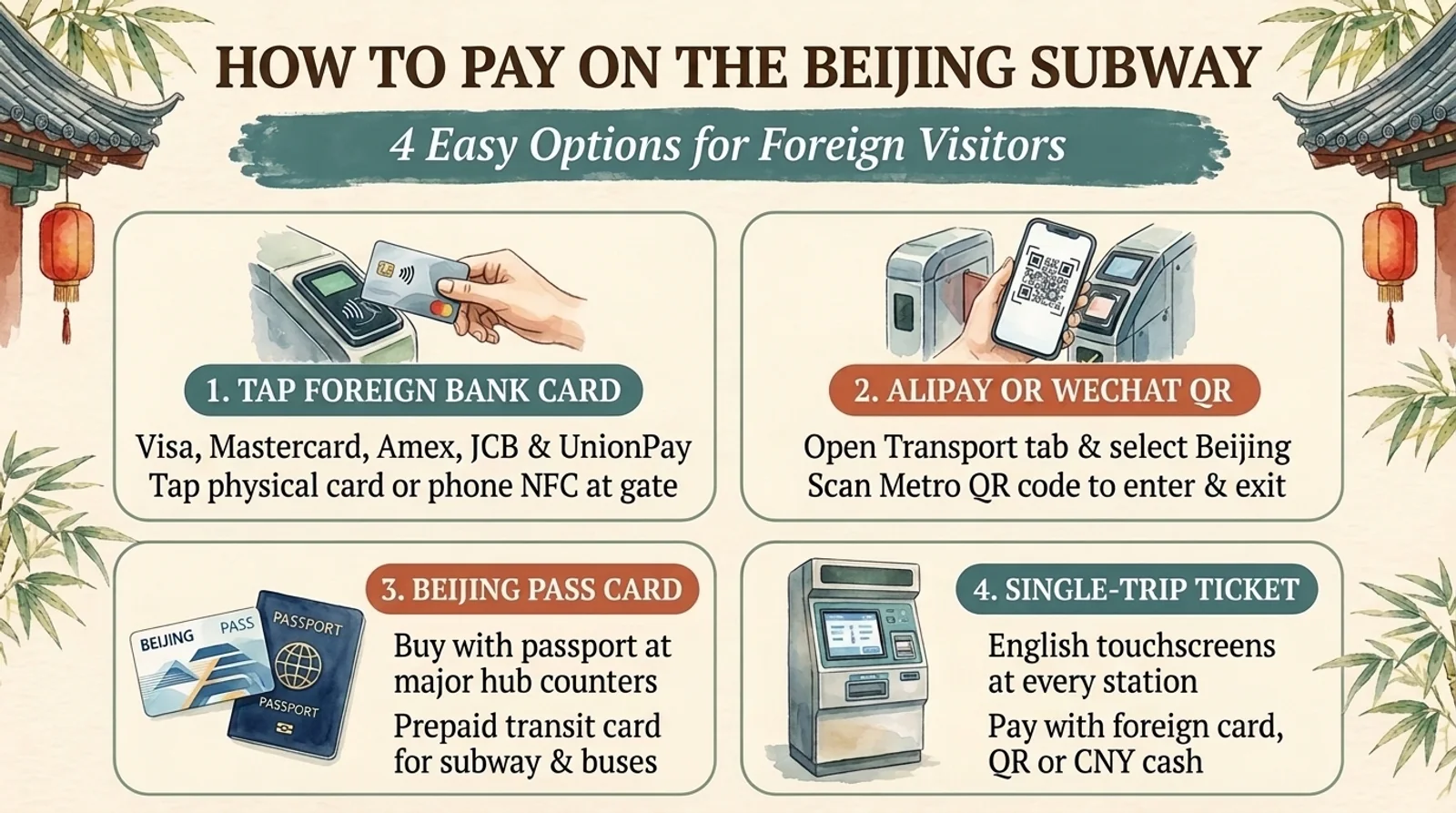
Beijing was the first mainland Chinese city to open direct overseas bank card tap-and-go across its entire rail network, and the Beijing Municipal Government's Foreign Affairs Office confirms support for five major international card brands. Pick whichever option matches how your group travels:
| Payment Method | Accepted Cards / Setup | Works for Multiple Riders on One Account? | Best For |
|---|---|---|---|
| Contactless Foreign Bank Card at Gate | Overseas-issued Visa, Mastercard, American Express, JCB, or UnionPay (physical chip card or Apple Pay / phone NFC) | No (strictly one card or one NFC device per rider) | Fastest zero-setup option for solo travelers and couples carrying separate cards |
| Alipay or WeChat Transit QR Code | Open Alipay → Transport → set city to Beijing → activate Subway QR code with passport verification |
No (one phone QR per rider) | Travelers already using mobile pay for buses, taxis, and other Chinese cities |
| Prepaid BEIJING PASS Card | Buy with original passport at designated airport and major rail station service counters; top up via counter or SilkPass app | One card per rider (up to 5 cards purchasable per passport) | Families wanting physical tap cards for kids or teens without bank cards |
| Single-Journey Ticket at Vending Kiosk | Tap English on station touchscreen, select line and destination station, pay via foreign bank card, QR, or CNY cash |
Yes (one foreign card can buy multiple single-ride tickets at the machine) | Occasional riders or groups sharing a single credit card |
3 Critical Turnstile Rules for Contactless Cards
According to Beijing's official overseas bank card subway rollout notice, contactless tap-and-go works 24/7 across all operating urban lines (including the Capital Airport Express, Daxing Airport Express, Xijiao Line, and Yizhuang T1 Line) plus suburban Line S2. Keep three practical rules in mind at the gate:
- Tap the exact same card or device on entry and exit: Your physical plastic Visa card and the same Visa card stored inside Apple Pay or Google Wallet transmit different virtual card tokens. If you tap in with your physical card and tap out with your watch or phone, the exit gate will treat them as two incomplete trips.
- One card cannot tap two people through back-to-back: Every passenger needs their own contactless card, phone wallet, or QR code. If you carry the only credit card for your family, walk over to the self-service vending machine, switch the screen to English, and buy individual single-ride tickets for everyone with one card swipe.
- Set up Alipay as a 60-second backup: Foreign banks occasionally flag overseas transit micro-charges until you approve a travel alert. Activating Beijing's Metro QR code inside Alipay via our Alipay and WeChat Pay setup guide gives you an instant backup at the turnstile and works smoothly on city buses too.
Beijing Subway Fares & Both Airport Express Lines
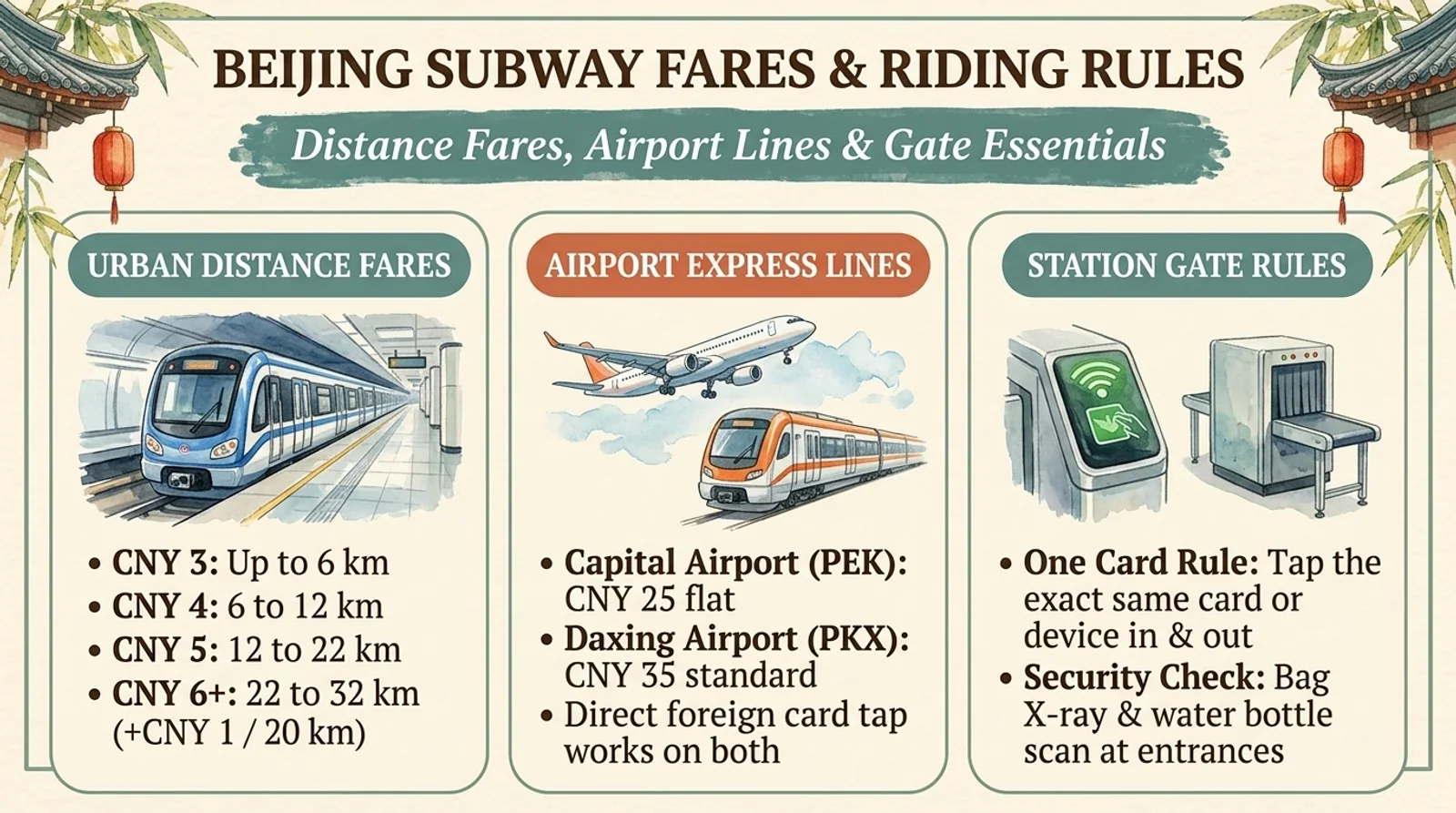
Regular Beijing Subway lines use a distance-based fare ladder rather than zone rings. Per the Beijing Municipal Government's official subway fare schedule, regular urban rides cost between CNY 3 and CNY 7 for almost every tourist trip inside the city:
- Up to 6 km: CNY 3
- 6 to 12 km: CNY 4
- 12 to 22 km: CNY 5
- 22 to 32 km: CNY 6
- Over 32 km: Add CNY 1 for every additional 20 km (no maximum cap; a single journey allows up to 4 hours inside the paid faregates).
Airport Express Fares (Priced Separately)
Beijing's two dedicated airport rail links have their own separate turnstiles and fares, though both accept the exact same contactless foreign cards and Alipay QR codes:
- Capital Airport Express (
PEKTerminals 2 & 3 ↔Sanyuanqiaoon Line 10/12,Dongzhimenon Line 2/13, andBeixinqiaoon Line 5): Flat CNY 25 one-way per passenger. - Daxing Airport Express (
PKX↔Daxing XinchengandCaoqiaoon Line 10/19): CNY 35 one-way in standard class between Caoqiao and Daxing Airport (CNY 50 for business class).
When transferring from either Airport Express onto a regular subway line such as Line 10 or Line 2, you tap out of the airport line gates and tap into the regular metro gates, paying the CNY 3 to CNY 6 urban fare separately.
4 Practical Steps: Station Security, Platforms & Exits
Even first-time visitors who read zero Chinese find Beijing's underground easy once they know the station rhythm:
- Use English metro navigation apps (not Google Maps): Google Maps has outdated transit routing in mainland China. On an iPhone, built-in Apple Maps displays accurate English Beijing Subway lines, transfer walking times, and exact exit letters once you are connected via a roaming plan or China travel eSIM. On Android or iOS, the free
MetroManapp works offline in English. - Clear entrance bag X-ray screening: Every Beijing Subway entrance runs airport-style X-ray belts before the faregates. Place backpacks and suitcases on the conveyor; small purses often get a quick handheld wand check. If you carry an opened water bottle or thermos, security staff will ask you to place it on a liquid scanner or take a quick sip.
- Match line numbers and terminal station names: Platforms show numbered lines (
Line 1,Line 2,Line 4,Line 8), color bands, and next-station arrows in English. Check the final station name on the overhead screen to confirm you are boarding the right direction. - Pick your lettered exit before tapping out: Big transfer stations like Dongzhimen, Qianmen, or Xizhimen span huge intersections with exits labeled
A,B,C,D(often with sub-numbers likeB1orC2). Check the yellow neighborhood exit board inside the concourse before tapping out, because crossing an eight-lane Beijing boulevard above ground can mean a ten-minute detour through pedestrian underpasses.
Key Subway Stops for Major Beijing Sights & Rail Hubs
Most stops on our 4-day Beijing itinerary sit directly beside a subway exit, with two important quirks around Tian'anmen Square and the Great Wall:
| Landmark or Rail Hub | Nearest Subway Line & Station | Practical First-Timer Tip |
|---|---|---|
| Tian'anmen Square & Forbidden City (South Meridian Gate) | Line 1: Tian'anmen East or Tian'anmen West (or Line 8: Qianmen) |
Surface checkpoints require your passport and free Tian'anmen area reservation; exits occasionally close briefly during major ceremonies |
| Jingshan Park & Forbidden City Exit (North Gate) | Line 8: Zhongguo Meishuguan (National Art Museum) or Shichahai |
Forbidden City flows one-way south to north; do not walk back to Line 1 after exiting |
| Temple of Heaven | Line 5: Tiantan Dongmen (Temple of Heaven East Gate, Exit A2) |
Drops you right beside the East Gate ticket entrance leading to the Hall of Prayer for Good Harvests |
| Summer Palace | Line 4: Beigongmen (North Palace Gate) or Xijiao Line: Summer Palace West Gate |
Beigongmen puts you minutes from Suzhou Street and Longevity Hill |
| Beijing South Railway Station (Shanghai trains) | Line 4 & Line 14: Beijing South Railway Station |
Underground concourse connects directly to high-speed rail departure lifts |
| Beijing West Railway Station (Xi'an trains) | Line 7 & Line 9: Beijing West Railway Station |
Main departure hub for our Beijing to Xi'an high-speed rail route |
| Badaling Great Wall (High-Speed Rail) | Line 13 & Changping Line: Qinghe Railway Station |
Note: Mutianyu Great Wall has no direct metro stop; see our best Great Wall section guide |
Operating Hours & Rush-Hour Tips
Beijing Subway lines are not 24-hour lines. First trains generally start around 05:00 to 05:30, and last trains on most central lines depart terminal stations between 22:30 and 23:15 (always check the exact last-train plaque at your transfer station if staying out late in Sanlitun or Shichahai).
Weekday commuter rush hours (07:30 to 09:00 and 17:30 to 19:00) pack Lines 1, 4, 10, and 13 shoulder-to-shoulder. Avoid hauling large rolling suitcases onto interchange lines during those windows, and double-check our list of common Beijing first-timer mistakes before setting out on Day 1.
Frequently Asked Questions
Can foreigners tap Visa or Mastercard directly on the Beijing Subway?
Yes. Overseas-issued contactless Visa, Mastercard, American Express, JCB, and UnionPay cards (as well as smartphones or watches linked via NFC wallet) work directly on turnstile readers at every Beijing Subway station, including both the Capital Airport Express and Daxing Airport Express.
Can two people share one credit card or one Alipay QR code at Beijing Subway gates?
Not at the turnstiles, where each rider must tap their own card, NFC device, or transit QR code on entry and exit. If your group shares one foreign bank card, use that card at any station's English touchscreen ticket machine to buy separate single-journey tickets for each person.
Does the Beijing Subway run 24 hours a day?
No. Most lines run roughly from 05:00 until around 23:00, with last-train times varying by station and transfer direction. After 23:00, plan on taking a licensed airport taxi or booking a ride through Alipay or the DiDi app.
Can you take the Beijing Subway directly to the Great Wall?
Only Badaling has direct rail access (via high-speed train from Qinghe or Beijing North subway-linked stations, or suburban Line S2). Mutianyu, Jinshanling, and Simatai are not connected to the subway directly and are reached via tourist shuttle buses or private cars.
Are luggage suitcases allowed on the Beijing Subway?
Yes, standard travel suitcases fit through the wide accessible turnstiles at every station after passing X-ray screening. Try to travel outside the 07:30–09:00 and 17:30–19:00 weekday rush hours when boarding busy transfer lines like Line 2 or Line 10 with heavy bags.
Last checked: November 18, 2026.