Can Foreigners Stay in Any Hotel in China? How to Book & Avoid Check-In Issues
Foreign passport holders can legally stay in any licensed hotel in mainland China, yet untrained front desks still occasionally stumble over passport registration. Here is which booking app to use, what to confirm before paying, and the exact 12367 backup steps if check-in stalls.
· By Yunjie

Yes, foreign passport holders can legally stay in hotels across mainland China without looking for a special "foreigner-licensed" property. Under national rules issued by China's Ministry of Commerce, Ministry of Public Security, and five other agencies, local authorities and booking platforms cannot use qualification rules to block hotels from hosting overseas guests.
Why do some international visitors still experience occasional late-night turn-aways at budget inns? Because the legal barrier is gone, while practical front-desk friction still exists. Every hotel in China must scan your passport and submit an accommodation registration to the local Public Security Bureau (PSB). At major chains and mid-range city hotels, that takes two minutes. At a tiny family guesthouse or domestic-only roadside motel, an untrained night clerk may not know how to enter a foreign passport format or a visa-free entry stamp, panic, and claim the hotel "cannot take foreigners."
Picking the right booking app, checking four details before paying, and knowing who to call at the counter eliminates nearly all of that friction.
The Short Answer: Law vs. Front-Desk Reality
Older travel blogs and pre-2024 forum threads often warn you to filter for hotels holding a "foreign-related license." That rule is dead. In July 2024, China's Ministry of Commerce, Ministry of Public Security, National Immigration Administration (NIA), Ministry of Culture and Tourism, and three financial regulators issued a joint notice on facilitating accommodation for overseas visitors. The directive states that local departments and online platforms must not use qualification thresholds to restrict accommodation operators from receiving foreign guests, and operators must not post notices refusing overseas visitors.
What did not change is Article 39 of China's Exit and Entry Administration Law: every hotel that hosts a foreign guest must register their stay and transmit the record to local public security authorities.
When a budget property hesitates at check-in today, the bottleneck is almost always operational rather than legal:
- Unfamiliar software fields: Domestic check-in terminals default to 18-digit Chinese resident ID cards that tap on a reader. Entering a foreign passport requires switching tabs, typing
SurnameandGiven Namein the right order, picking a three-letter nationality code, and selecting the right entry type. - Visa-free entry confusion: Travelers entering under China's unilateral 30-day visa-free policy or the 240-hour visa-free transit policy carry an entry stamp or temporary entry permit rather than a full-page visa sticker. Clerks who have only processed tourist
Lvisas sometimes stop when the system asks for a visa number. - Apartment-style listings: Some rooms listed on Chinese apps sit inside residential buildings managed as short-term homestays rather than licensed hotels, meaning they lack a hotel police-registration terminal altogether.
Which Booking Apps Work Best for Foreigners in China?
Where you book determines both your hotel inventory and how much backup support you get if a night clerk gets stuck. China's Ministry of Culture and Tourism explicitly highlights Trip.com (including its website, mobile app, and the TripHotels mini-program inside Alipay) alongside phone reservations in its official hotel check-in guide.
| Booking Channel | Inventory in China | Foreign Payment & English Support | Real-World Verdict for First-Timers |
|---|---|---|---|
| Trip.com (App / Web / Alipay Mini-Program) | Widest selection across tier-1 cities, county towns, and scenic areas | Accepts Visa, Mastercard, Apple Pay, Alipay, WeChat Pay; 24/7 English phone and in-app chat | Best primary choice; agents speak Chinese to the front desk if check-in stalls |
| Booking.com & Agoda | Strong for international chains (Marriott, Hilton, IHG, Accor) and central 4 to 5-star hotels | Foreign cards work online; many listings still mark payment as "pay at property" | Reliable for big chains, thinner coverage in smaller rail towns and mountain parks |
| International Chain Apps (Marriott, IHG, Hyatt, Hilton) | Branded properties in major and secondary cities | Direct foreign card billing and loyalty perks | Zero check-in drama; staff process foreign passports daily |
| Domestic Chinese Apps (Meituan, Chinese Ctrip, Qunar) | Massive local budget and homestay inventory | Chinese-only interface; some listings assume a mainland Chinese ID card | Skip unless you read Chinese and message the front desk before paying |
Established Chinese mid-scale hotel groups such as Atour, Ji Hotel, Orange Hotel, Vienna, and Hanting in city centers routinely host international travelers and run standardized front-desk registration software. Where extra care pays off is with ultra-budget independents under CNY 150 a night, rural scenic-area guesthouses, and serviced apartments.
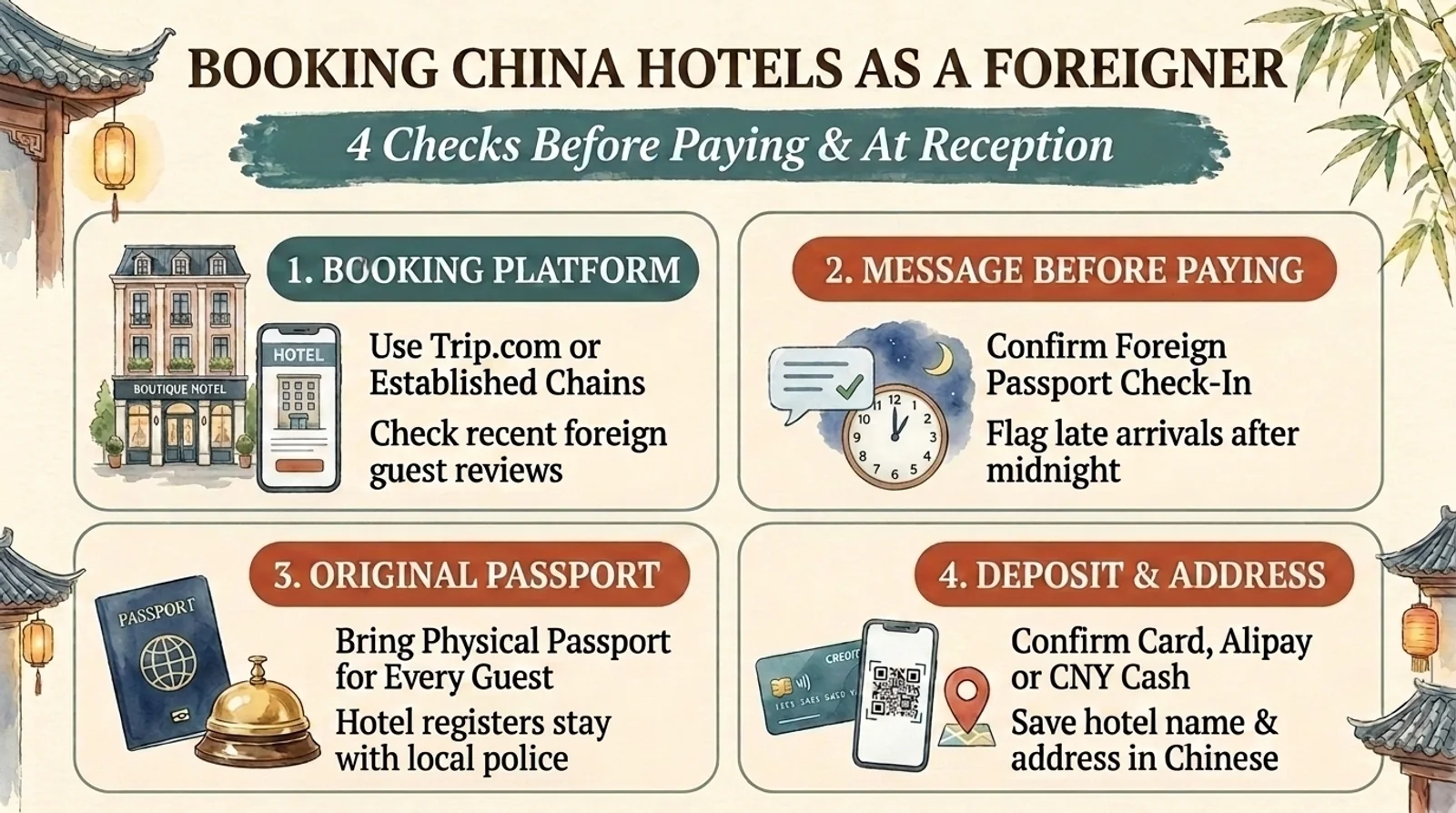
4 Checks to Run Before You Pay
Before locking in a non-refundable room rate, especially at an independent boutique hotel, mountain inn, or apartment-style property, run this two-minute filter:
- Filter reviews by English or non-Chinese travelers: On
Trip.com, tap the guest reviews tab and check whether passport-holding guests have stayed within the past six months. Recent foreign reviews prove the front desk knows which button to press on its PSB terminal. - Watch for ID-card restrictions on homestay listings: Although platforms are barred from blanket hotel bans, some apartment-homestay hosts still note ID limits because their residential unit is not licensed as a hotel. If the room title says "homestay" or "apartment," message the property before paying.
- Flag after-midnight arrivals with both date and time: If your flight lands at
00:45on May 10 and you want a bed immediately, your booking must start on May 9, and you must tell the hotel you are arriving in the early hours of May 10. Otherwise the night auditor may mark you as a no-show at midnight or leave an untrained security guard at the desk. - Check deposit and reception payment rules: Prepaying online covers the room tariff, yet many Chinese hotels still collect a refundable incidental deposit (often CNY 200 to CNY 500) at the counter. Confirm whether reception takes Visa or Mastercard, CNY cash, or mobile pay via our Alipay and WeChat Pay setup guide.
Copy-Paste Message to Send the Hotel Before Paying
If a property has few English reviews or you are arriving late at night, send both the English and Chinese blocks below through Trip.com property chat or email. Save a screenshot of the reply offline alongside the hotel's Chinese name and street address.
English: Hello, we plan to book [Hotel Name] from [Check-in Date] to [Check-out Date] for [Number] guests holding [Country] passports. Can your front desk check in every guest with a foreign passport and submit our hotel accommodation registration? We expect to arrive at [Date & Local Time, for example May 10 at 01:30]. Please also confirm the deposit amount and whether reception accepts international credit cards, Alipay, or CNY cash. Thank you.
中文(发给酒店前台): 您好,我们计划预订【酒店名称】,入住日期【入住日期】至【退房日期】,共【人数】人,均持【国家】外国护照。请问贵店前台能否为每位外籍客人凭护照办理入住并完成旅馆住宿登记?我们预计于【具体日期与当地时间,如5月10日凌晨01:30】到店,届时是否有前台人员办理?另请确认押金金额,以及前台是否支持支付宝、人民币现金或境外银行卡。谢谢!
List every passport nationality in your group rather than only the lead booker, especially when a Chinese citizen and a foreign passport holder share a room.
What Documents You Need at Hotel Check-In
Photocopies and phone photos of your passport bio page do not work at Chinese hotel counters. Every adult and child checking into a room must hand over an accepted physical original document.
According to the Ministry of Culture and Tourism's official check-in guidance, Chinese hotels accept seven types of original ID for foreign guest registration:
- Original valid passport (used by almost all short-term visitors; staff scan both your photo page and your latest Chinese entry stamp or visa page).
- Foreign Permanent Resident ID Card (China's Five-Star Card).
- Foreigner's Exit-Entry Permit.
- Seafarer's Certificate.
- Receipt of acceptance of a visa application issued by a Chinese public security exit-entry office, which lets you check into hotels legally while your physical passport is held for visa extension or residence-permit processing.
- Passport loss report certificate issued by Chinese public security authorities.
- Temporary international travel documents issued by embassies or consulates in China, paired with valid visas or stay certificates issued by Chinese public security exit-entry authorities.
Keep a working data connection at the counter via a roaming plan or China travel eSIM so you can pull up your booking voucher, translation app, and platform chat without relying on lobby Wi-Fi, which often requires a Chinese SMS code to log in.
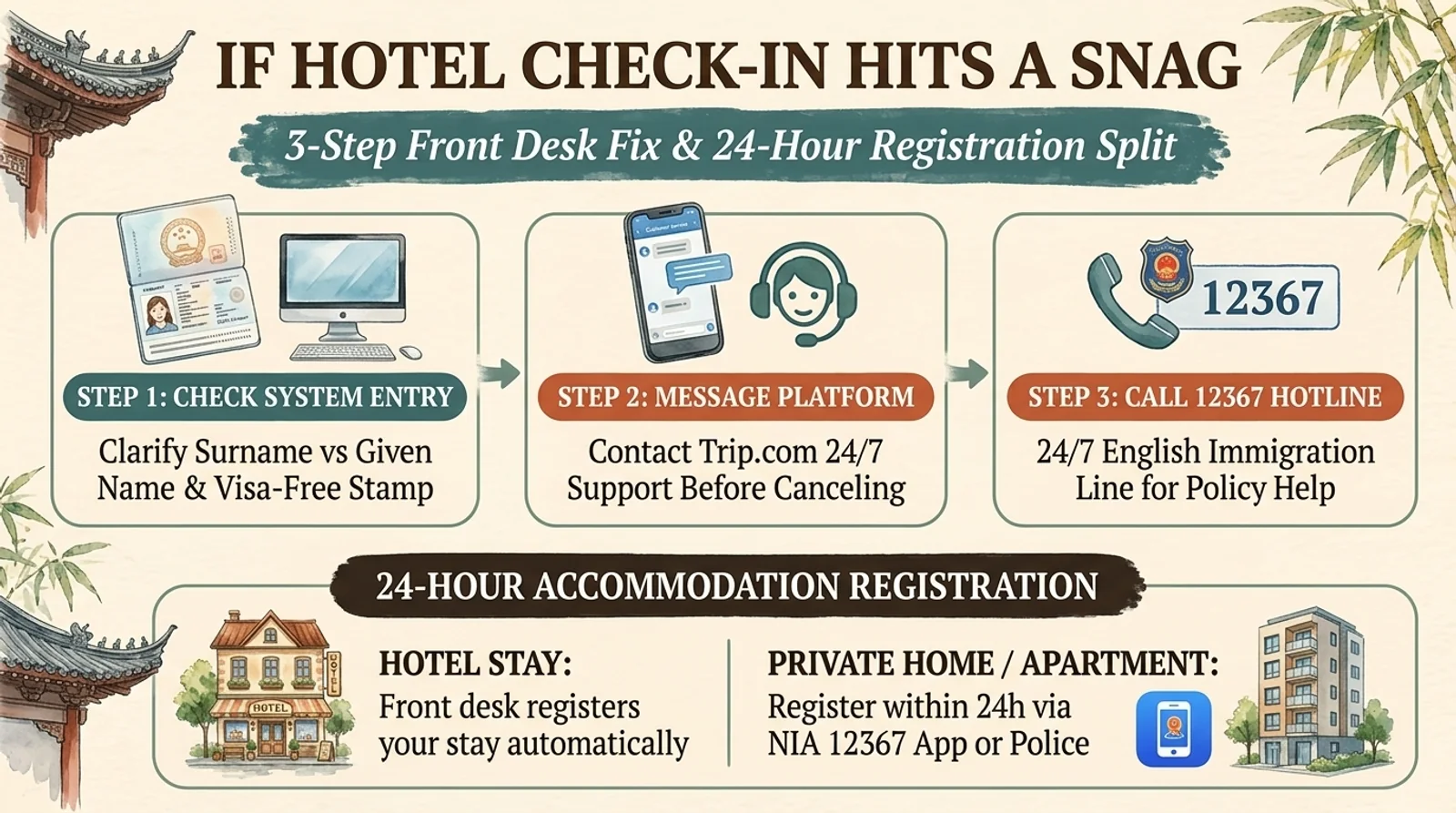
What to Do If the Front Desk Refuses Your Passport
If you arrive with a confirmed booking and the receptionist waves at your passport saying "no foreigners," stay polite and calm. Most refusals resolve within ten minutes once the clerk realizes the law allows check-in and gets help with the computer screen. Follow this exact sequence:
- Check whether it is a simple data-entry snag: Ask whether the issue is the registration software. Point out your Surname vs. Given Name, your latest red entry stamp date, and, if you entered visa-free, ask them to choose the visa-free entry option rather than hunting for a paper visa number. You can show this polite Chinese note on your phone screen:
商务部与公安部等七部门已明确不得以资质限制旅馆接待境外人员。如果您不确定系统里怎么录入免签或外国护照,我们可以拨打12367移民管理热线或联系辖区派出所请民警电话指导录入,非常感谢! - Contact your booking platform before canceling on your own: Do not tap "Cancel Booking" yourself on a non-refundable rate, or the app may treat it as a voluntary guest cancellation. Open
Trip.com(or your booking platform's 24/7 support), ask a Chinese-speaking agent to call the front desk directly, and request that the platform either talk the clerk through check-in or relocate you and record the hotel's refusal in writing. - Dial
12367for official 24/7 English assistance: Under Section VI of the seven-ministry notice, China's National Immigration Administration12367service platform (connected with municipal12345hotlines) provides round-the-clock Chinese and English policy answers, inquiries, and complaint handling. Dial12367from a local phone (or+86-12367/ area code +12367when roaming) and let the duty manager speak with the officer if needed. Keep in mind that12367clarifies legal policy and logs complaints, whereas room refunds and rebooking depend on your booking platform and rate rules. - Never stay "off the books" under a friend's ID: Occasionally an uninformed clerk or host suggests registering the room solely under a Chinese companion's ID card without scanning your passport. Refuse that shortcut. Skipping mandatory registration violates Articles 39 and 76 of the Exit and Entry Administration Law and can trigger police warnings, fines, or awkward questions on future visa applications.
Hotels vs. Staying With Friends or in Homestays (The 24-Hour Rule)
Travelers frequently mix up hotel rules with private-residence rules. Under Article 39 of the Exit and Entry Administration Law, who submits your police registration depends entirely on where you sleep:
- Licensed hotels: The hotel front desk registers you at check-in and transmits your data electronically to the local PSB. You do not need to visit a police station yourself.
- Domiciles other than hotels (friends' apartments, family homes, private non-hotel rentals): You or your host must register your stay with local public security authorities within 24 hours of arrival.
You no longer have to spend your first morning in China hunting for a neighborhood police station in person. According to the National Immigration Administration's official English policy interpretation on online accommodation registration, NIA operates a nationwide online accommodation registration service for non-hotel stays that carries the exact same legal effect as in-person police registration:
- Where to submit online: Open the
Accommodation Registrationmodule underForeigner Servicevia the official NIA Government Service Platform (s.nia.gov.cn), the"NIA 12367"App, the"NIA 12367"WeChat mini-program, or the Alipay mini-program. - Get your host's help on your first upload: Because the form asks for exact Chinese residential address fields and property details, NIA advises completing your initial online registration with your host's assistance, then opening
Registration Record Inquiryto view and save your registration record. - Penalties for skipping registration: Under Article 76 of the Exit and Entry Administration Law, failing to complete required accommodation registration results in a warning and may also incur a fine.
If you book an Airbnb-style serviced apartment or rural homestay on a travel app, ask the host in advance whether they submit registration through the hotel PSB system at check-in or whether you will complete the 24-hour NIA 12367 online filing together upon arrival. Keeping your hotel confirmations, Chinese addresses, and payment apps in one offline folder alongside our China trip preparation checklist keeps arrival night smooth even after a 14-hour flight.
Frequently Asked Questions
Do hotels in China still need a special license to accept foreigners?
No. A joint notice from China's Ministry of Commerce, Ministry of Public Security, National Immigration Administration, and four other departments prohibits local authorities and booking platforms from using qualification requirements to block hotels from hosting foreign guests. Any licensed hotel can legally check you in as long as it submits your passport registration to local police.
What is the safest website or app to book hotels in China as a foreigner?
Trip.com (the international arm of Ctrip, also accessible via the TripHotels mini-program in Alipay) has the deepest hotel coverage across China, accepts Visa and Mastercard online, and backs bookings with 24/7 English customer service whose agents can call Chinese front desks directly if a clerk is unsure how to enter your passport.
Can a Chinese citizen and a foreign passport holder share a hotel room in China?
Yes. Both guests present their own valid original IDs at reception: the Chinese citizen taps their mainland Resident ID Card (or other accepted ID), and the foreign guest hands over their original physical passport so the hotel registers both occupants. Unmarried couples of any nationality can share a room together.
Can I check into a Chinese hotel if the Exit-Entry Bureau is holding my passport for a visa extension?
Yes. Official Ministry of Culture and Tourism check-in guidance lists the original receipt of acceptance of a visa application issued by Chinese public security exit-entry authorities as a valid standalone check-in document while your physical passport is being processed.
Do I need to go to a police station to register when staying at a hotel in China?
No. When you stay at a licensed hotel, the front desk handles your PSB accommodation registration automatically when scanning your passport. You only need to complete 24-hour registration yourself (either online through the NIA 12367 app, WeChat, or Alipay mini-program, or at a local police station) when staying at a friend's home, family apartment, or non-hotel private rental.
Last checked: November 18, 2026.