There's a moment — somewhere past Heishui, climbing the last switchbacks before Hongyuan — when the road crests a ridge and the whole plateau opens up below you. One moment you're grinding the bike up another set of switchbacks; the next, you're looking down at miles of open grassland, with snow on the mountains in the distance.
That moment is what I remember most from this trip. Not the marmot a Tibetan herder later walked me out to see. Not the friend whose rear tire wore down to the steel wires and killed our push to Ruoergai. Not even the headache that came with sleeping at 3,500 meters in Hongyuan town. Just that ridge, and the grass opening up.
I'm a Chengdu local. That ridge is what people here mean when they say 周末骑摩托去川西 — "weekend motorcycle ride to Western Sichuan." It's not a 7-day expedition. It's not a Lonely Planet itinerary. It's the thing a handful of us do on long weekends: leave Friday after work, sleep in some random local guesthouse Friday night, ride deep into the plateau Saturday, sleep at altitude, and ride home Sunday — back at our desks Monday morning, butts numb.
International travelers I meet in Chengdu cafes are usually shocked by this. They picture "Western Sichuan" as an epic G318 pilgrimage requiring two weeks, a Chinese motorcycle license they don't have, and a tour company. The truth: a meaningful slice of it is reachable from Chengdu in less than 24 hours of riding. With some adjustments for the China-specific friction (more on that below), it's a real long-weekend destination — not a once-in-a-lifetime journey.
This is the route I actually rode in August, with friends on our own bikes. About 800 km round trip. Three days, two nights, one truly catastrophic tire failure. Here's what happened, what surprised us, and what I think you should know before attempting your own version — including the stuff most English-language guides leave out (like the fact that, no, you can't rent a motorcycle in China the way you can in Bali).
Why most English guides miss Western Sichuan
Most international travel agencies sell China as a fixed loop: Beijing, Xi'an, Shanghai, Guilin. If you read travel blogs in English, you'll see the same loop with maybe Chengdu bolted on for pandas. Western Sichuan — the part of the province that climbs from 500 meters in Chengdu to 3,500-plus meters of Tibetan grassland — almost never makes it in.
There are real reasons. The logistics are harder. Booking systems are domestic-only. Most signage is Mandarin and Tibetan, no English. Hotels in the small county towns are usually run by people with a WeChat QR code stuck on the wall, not Booking.com listings. You won't find a TripAdvisor "Top 10" page for Hongyuan because the volume of foreign visitors isn't there yet.
But the gap is mostly marketing, not difficulty. The roads are paved, the drive is straightforward by Chinese standards, the county towns have food, fuel, and beds, and the altitude risk is real but manageable. The biggest barrier for a first-time visitor is that nobody is telling you it's an option. The second is that you can't just walk into a shop and rent a motorcycle the way you would in Southeast Asia.
The route (and why locals skip G317)
The classic "tourist route" from Chengdu toward the Tibetan plateau is G317, the national road that goes through Wenchuan, Lixian, Miyaluo, and over the Zhegu Shan pass. It's the route every Chinese self-drive caravan uses on long weekends. It's well-paved, well-signed, and crowded.
Locals who do this regularly tend to prefer an alternative: Mianmao Road (绵茂公路), a mountain highway that connects Mianzhu (north of Chengdu) to Mao County, bypassing the G317 tourist corridor entirely. It's mostly tunnels and bridges through wild, sparsely populated mountains. On a weekday or non-holiday weekend, you'll see almost no traffic.
The full route I rode:
- Chengdu → Mianzhu (绵竹) — flat highway out of the basin, about an hour.
- Mianzhu → Mao County (茂县) via Mianmao Road — the scenic mountain crossing. Heavy on tunnels (the cumulative tunnel length feels like dozens of kilometers when you add them all up). Mostly barren mountains, very blue sky, snow peaks visible on a clear day. Almost empty road outside national holidays.
- Mao County → Heishui (黑水) — climbing further into Aba Prefecture, more Tibetan villages, more yaks.
- Heishui → Hongyuan (红原) — the final climb onto the plateau. This is where the ridge moment happens.
We returned by the same route. There's a faster way back via G317, but we were already used to Mianmao Road, and the same mountains at a different time of day basically look like a different trip.
Day 1 — Friday night escape
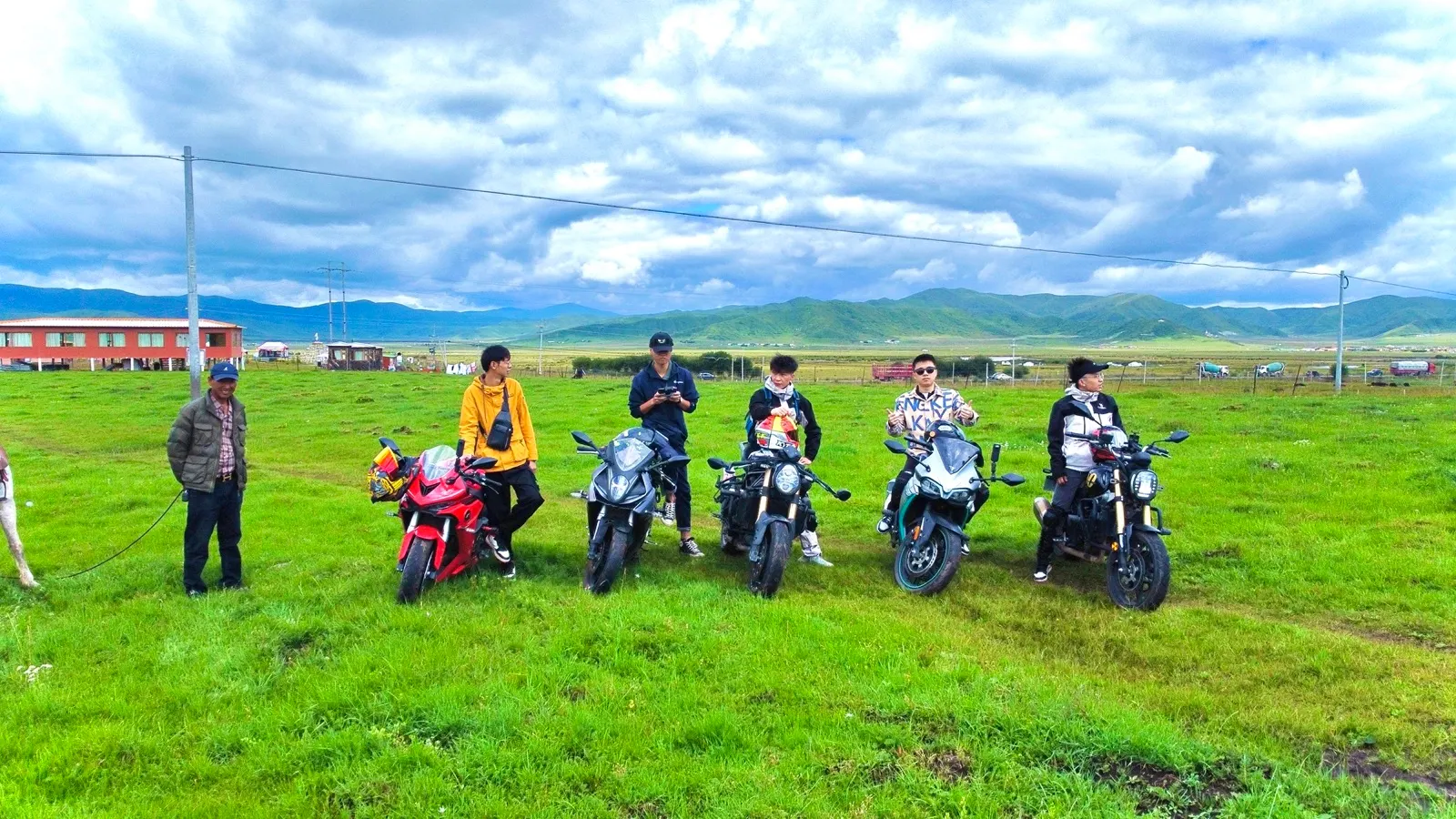
We left Chengdu Friday evening, straight from work. Five of us, five bikes, no real plan beyond "let's try to make Hongyuan tomorrow and maybe push to Ruoergai grassland after that." If Ruoergai worked out, we'd see the First Bend of the Yellow River at Tangke. If not, we'd just turn around at Hongyuan.
Night riding on Mianmao Road is its own thing. The tunnels are long and well-lit; the gaps between tunnels are pitch black — just your headlight and the road. There's almost no other traffic at that hour. Most of the time the only sounds are your engine, the road, and wind.
We rolled into Mao County past midnight. We'd pre-booked the guesthouse on Meituan (the Chinese super-app that handles most things, including lodging) earlier in the day — about 100 RMB (~$14 USD) per person for a small family-run place on the edge of town. Not a hotel, not a chain — more like a couple's spare room, the kind of place where the owner walks down in slippers to hand you the key.
One detail that matters: because it's family-run, not 24/7 staffed, you have to message or call the owner ahead of time to say you'll be arriving late. Otherwise he'll just go to sleep and you'll be standing outside the door, locked out, in the cold. And it does get cold — Mao County sits at around 1,500 meters, and even in August the night temperature drops sharply after sunset in the mountains. Bring a layer.
We slept hard. The next morning we'd be climbing onto the plateau.
Note for international visitors: Meituan is the booking tool that actually works in small Chinese county towns. Trip.com and Booking.com often won't show family-run guesthouses. To use Meituan you need a Chinese phone number and a Chinese payment method — both real barriers, but ones you can work around with help from a Chinese friend or by booking the cheapest chain hotel (7 Days, Hanting) on Trip.com as a fallback. Whichever you use, always message your host before late arrivals.
Day 2 — Into the plateau
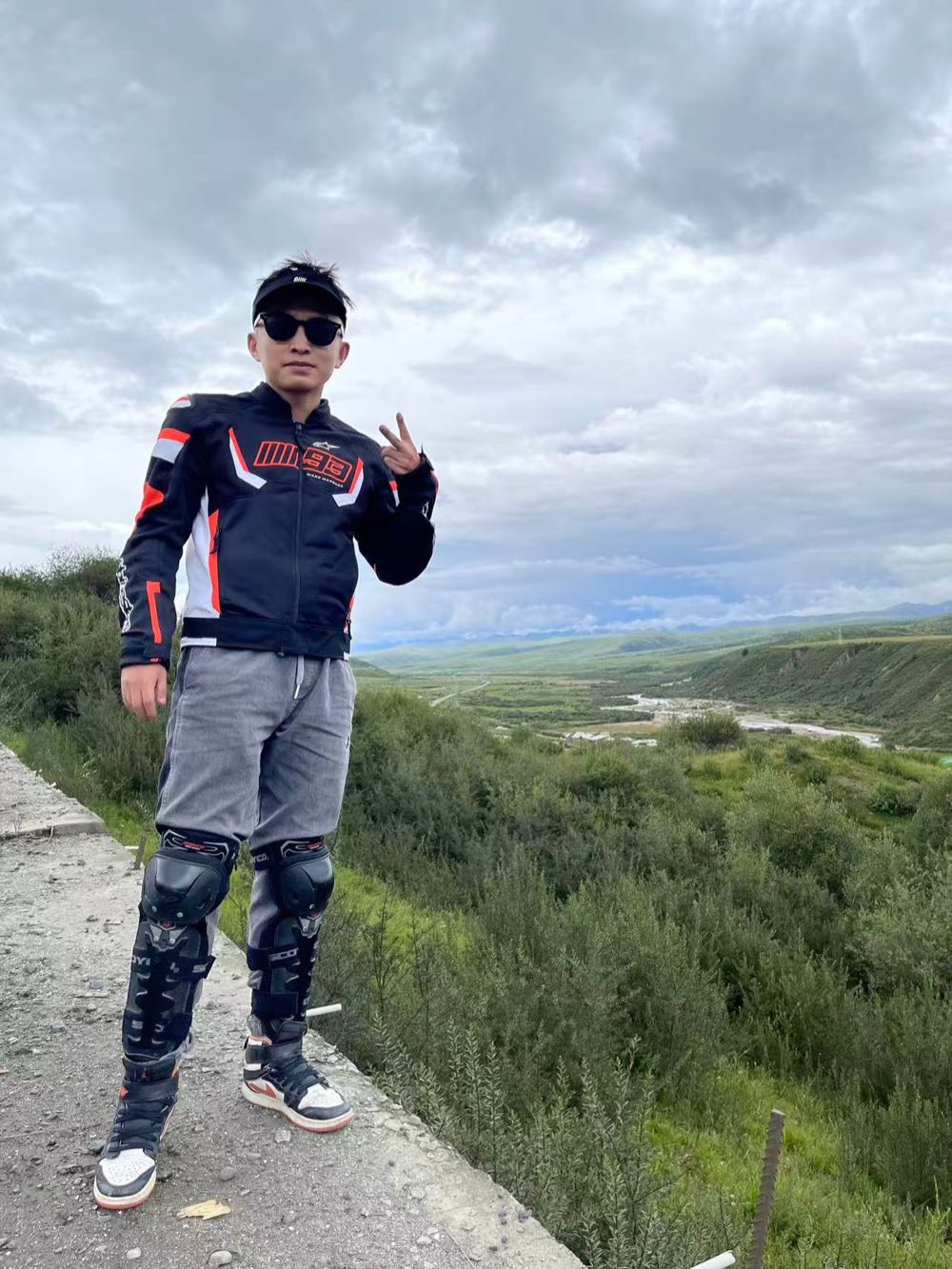
The climb out of Mao County starts gradual, then gets steep. Trees thin out as the mountains get drier and more open. You start seeing prayer flags on ridges and Tibetan villages along the river valleys.
We stopped for lunch in Heishui, the next county town. Heishui sits at roughly 2,400 meters — not yet the full plateau, but the air is already noticeably drier and thinner than in Chengdu. We ate at a Sichuan restaurant, and here's something honest that nobody seems to write down:
Food honesty from a Sichuan local
I'm a Chengdu native. I grew up on Sichuan food. And I'll tell you plainly: I cannot really get into yak hotpot, and I cannot drink butter tea. Both are local specialties in Tibetan areas. Both are aggressively acquired tastes — gamey, oily, and very strong. If you're a first-time visitor with a sensitive stomach, the safest bet in any Tibetan-area county town is the Sichuan restaurant. There is always a Sichuan restaurant. Chengdu food has spread everywhere, and the dishes you'd order in Chengdu — mapo tofu, twice-cooked pork, simple noodle bowls — are exactly what you'll find here, usually well-made, often by people who actually moved from Chengdu.
That isn't a dismissal of Tibetan food. Some people love it. But most travel writing makes "trying the local cuisine" sound like it's always going to be amazing. In my experience and the experience of every local friend I know: yak hotpot and butter tea are an acquired taste even for people from the next province over. Try them once. Be honest with yourself about whether you actually like them. Don't force it.
The ridge
Past Heishui, the road climbs in earnest. The trees disappear. The mountains flatten on top into rolling, treeless hills — the eastern edge of the Tibetan plateau. You climb for an hour, maybe more, in a slow grind of switchbacks. The bike feels weaker because the air is thinner.
And then you crest a ridge, and the whole plateau opens up.
This is the moment I described at the beginning of this post, and I'm not going to try to describe it again with bigger words. It's open grassland with small rolling hills, scattered with Tibetan villages, white tents, and yaks. There are mountains in the distance — some with snow even in August. After hours boxed in by mountain walls, having that much horizon in front of you is the thing that hits you.
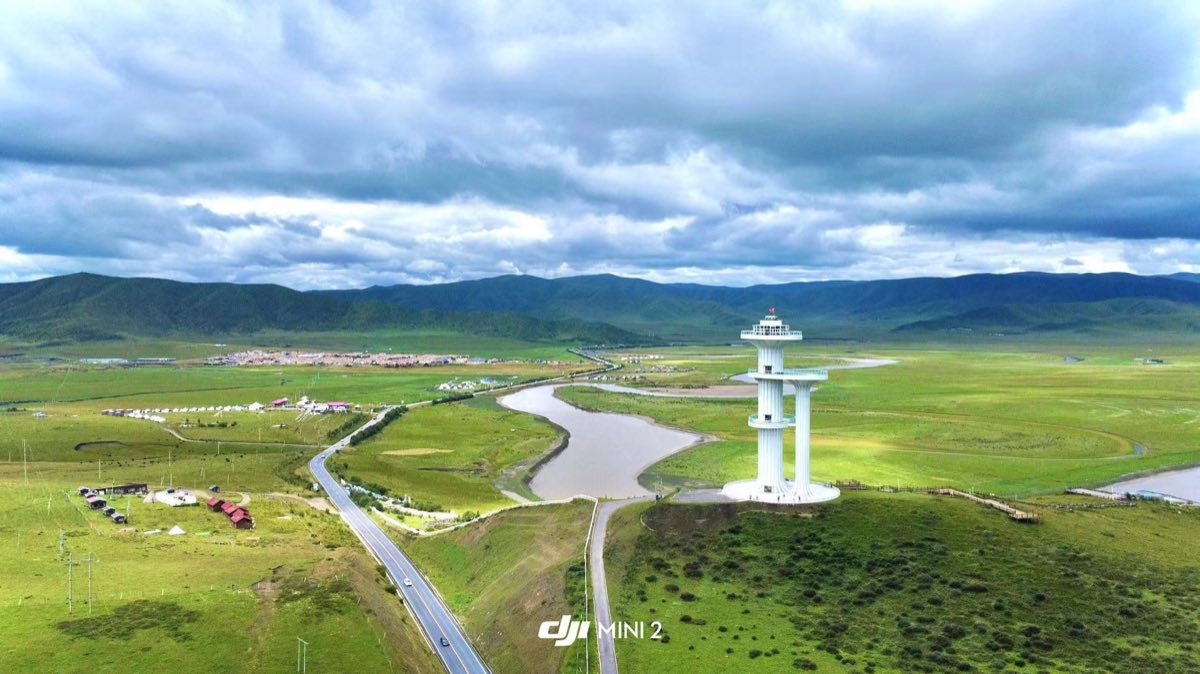
We pulled over and stood there for a while. Then we got back on the bikes.
A note on yaks
You will, almost certainly, have to brake for yaks crossing the highway. They roam free across the grasslands. The herders don't really "manage" them — the plateau is theirs. We saw yaks on the road repeatedly. Sometimes a single one ambling across. Sometimes a small group blocking the lane while a herder on his own motorcycle circled around behind them. You slow down, you wait, you move on. Nobody honks.
The tire that killed our push to Ruoergai
About fifty kilometers before Hongyuan, one of my friends pulled over. His rear tire had worn down to the point where the steel wires inside the rubber were poking through.
This is dangerous. A tire in that state can blow out at speed, which on a mountain road in remote Sichuan is the kind of accident you don't want to think about. He decided to ride the rest of the way to Hongyuan slowly, in low gear, and we'd find a repair shop in town.
The rest of us rode ahead at normal speed to scout. We pulled into Hongyuan county town, which is a place I should describe properly:
Hongyuan has one traffic light.
The whole county town is maybe a few blocks. There's a main street, a couple of guesthouses, a clinic, a few restaurants, and a Sichuan supermarket. That's the town. The "city" exists to support the surrounding grassland — herders coming in to buy supplies, school for the local kids, a place for visitors like us to sleep.
We found the motorcycle repair shops. Plural. They were all clustered on one street.
And here's where reality kicked in: every shop in Hongyuan only services 125cc utility motorcycles. That's what local farmers and herders ride — small, simple, cheap, reliable bikes. Our bikes were modern recreational machines with much larger engines, different tire sizes, different parts. The mechanics took one look and shook their heads. Not their thing. They couldn't help.
We tried calling the manufacturer's 4S dealer rescue service back in Chengdu. The quote came in: it was more expensive than just freight-shipping the bike home. The cost of dispatching a recovery truck from Chengdu to Hongyuan and back was higher than putting the bike on a regular freight truck and shipping it home. Chinese logistics is cheap enough to undercut the manufacturer's own rescue service.
So that's what we did. We rode the wounded bike to the local logistics depot, crated it, and shipped it home like a package.
Then we had to figure out how to get our friend back to Chengdu.
The answer: he rode on the back of one of our bikes, the whole way home — about 400 kilometers, on a passenger seat designed for trips to the supermarket, not eight hours of mountain riding. By the time we hit Chengdu, his lower body was, in his own words, "destroyed." He couldn't sit normally for two days.
That was the end of any plans to push north to Ruoergai grassland or the First Bend of the Yellow River. We never made it. Hongyuan became our turnaround point.
Three things I think a foreign reader should take from this story:
-
Check your tires before going remote. Sounds obvious. We didn't, and it cost us the second half of the trip. If you're going to attempt anything like this — by motorcycle, by car, by anything — the time to inspect tires is in Chengdu, not at 3,500 meters.
-
Small county towns service local vehicles, not your foreign-spec gear. This applies to motorcycles, but also to camera gear, electronics, anything. If you break something specific, you may have to ship it home rather than fix it locally.
-
Chinese logistics shipping is absurdly cheap. This is a feature, not a curiosity. If you're traveling China and break/buy something you can't carry on a flight, shipping it back to your home base (or even internationally via a freight forwarder) is often cheaper than you think.
Sleeping at 3,500 meters
We slept in Hongyuan that night. The place was a basic hotel — more like a guesthouse, two stars at most. Clean enough. Hot water. Heating wasn't really running in August (and we didn't need it during the day) but the nights got cold. I'd recommend bringing layers even in summer.
I woke up at 3 AM with my head pounding.
I'm a Chengdu native. I was born and raised at about 500 meters elevation. I'm in decent shape. None of that mattered: 3,500 meters in one day, after a hard ride, hit me. Just a headache, but a real one. By morning it was mostly gone. Probably as much from the day's exhaustion as from the altitude itself, but I can't separate the two.
The takeaway for first-time visitors: don't assume you're fine just because you're not Tibetan. A first-night headache at 3,500 meters is normal. If it gets worse on day two — meaning genuinely worse, not just the same — you should descend, not push higher. If you're prone to migraines or have a heart condition, talk to a doctor before this trip.
Things that help: drink a lot of water, avoid alcohol, eat lightly, sleep early, and consider taking Rhodiola (红景天) for a few days before you go up. Locals swear by it. Western medical literature is mixed but it's harmless to try.
The wildlife you don't plan to see
The two most-commented animals from this trip — a Himalayan marmot and a mountain weasel — are also the two animals we did not plan to see. They happened because we slowed down and because local people walked us toward them.
The marmot
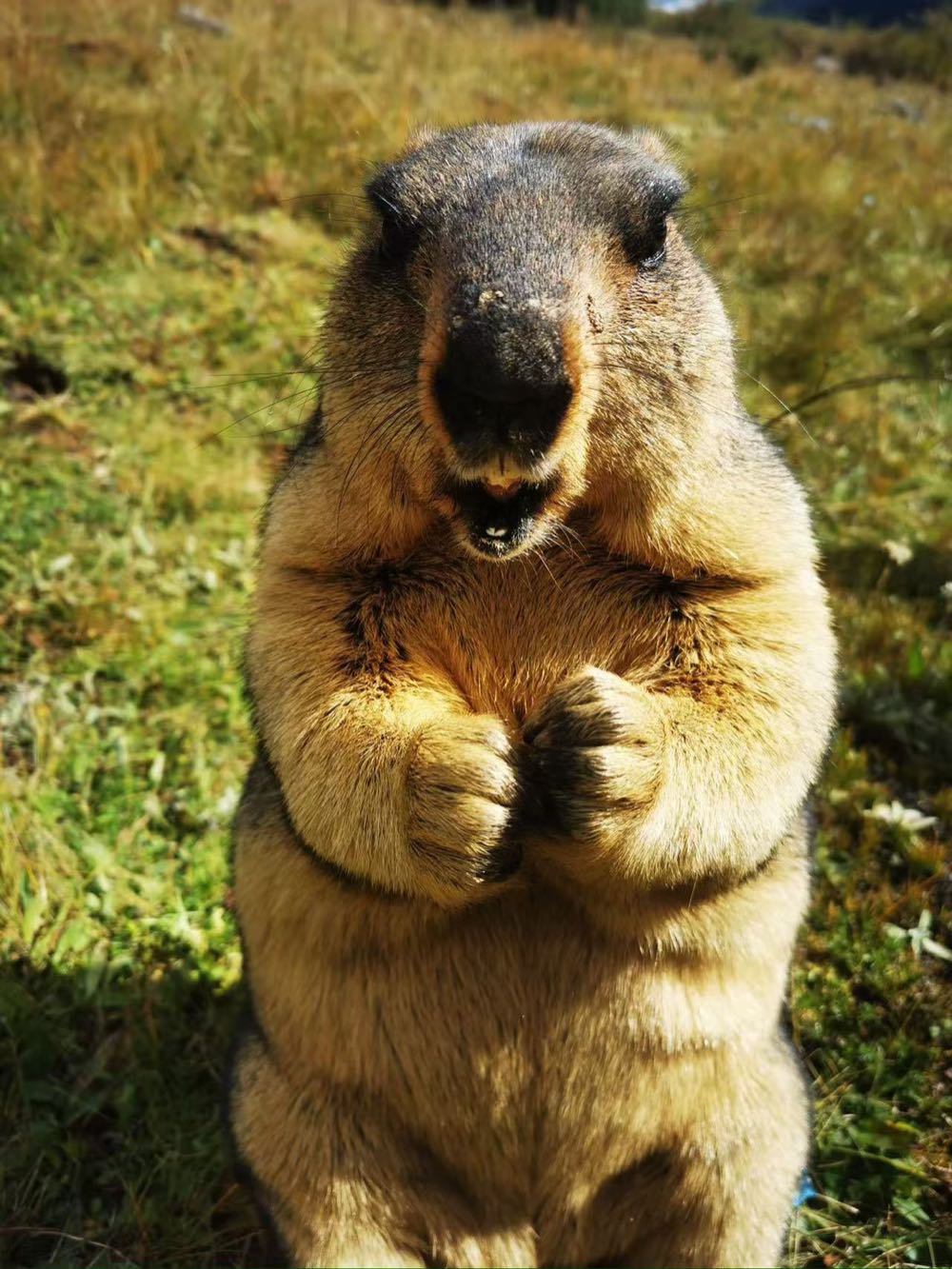
We were watching the grassland from a roadside pull-off when a Tibetan herder spotted us looking. He came over, chatted with us, and then offered to walk us into his backyard area where marmots lived. We followed him for maybe ten minutes across the grass.
The marmot showed up like he was expecting us. He wasn't afraid. The herder said the local marmots had figured out that humans sometimes had food, and ours immediately gravitated toward the cookies one of us was holding. He took them from a hand without hesitation.
This sounds like a tourist-trap scene, but it wasn't. No fee. No setup. The herder just thought we'd enjoy seeing the marmot, walked us there, and walked back. That kind of casual hospitality is everywhere in rural China and almost never makes it into guidebooks.
On a trip like this, the wildlife you actually see is usually shown to you by people who live near it. Stop, be friendly, show interest. That's the whole skill. You don't need a guide. You need to be approachable.
The weasel
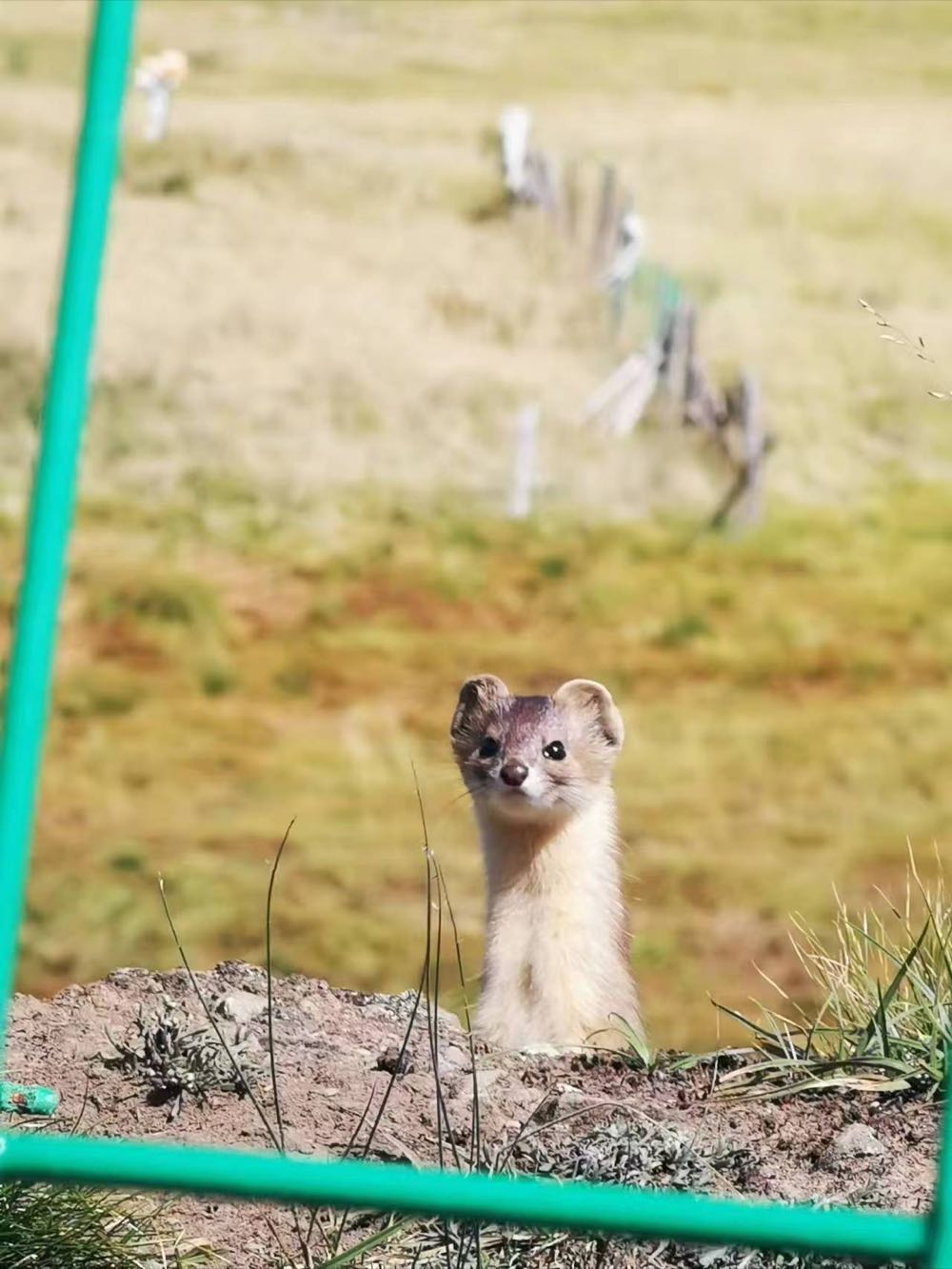
The other animal — a mountain weasel, small enough to fit in a cupped hand, standing upright on its hind legs — we found by accident. There was a packed-mud wall by the side of the road, the kind of low retaining wall you see in mountain construction, and it was full of small holes. We pulled over to stretch and noticed movement.
A weasel poked its head out, then ducked back in. We sat down on the grass and waited. Over the next half hour the weasel came out repeatedly, watching us, completely unafraid. The mud wall was clearly his apartment building.
It was the slowest, quietest stretch of the trip. No phones, no riding, no plans — just sitting on the grass watching a small animal go about his day.
Can you actually do this as a foreign visitor?
This is the part most travel content gets dishonest about, so let me be very direct.
The real challenge isn't the region — it's getting there. Western Sichuan has almost no convenient public transport for tourists. There's a long-distance bus from Chengdu to Hongyuan that exists on paper, but it's a 10+ hour ride that drops you in the county town with no way to actually explore the surrounding grassland. There's no train. There's no shared-shuttle scene like you'd find in Southeast Asia. For practical purposes, you need your own vehicle.
That leaves you with two realistic options.
Recommended: Charter a car with a driver (包车)
This is the right answer for most first-time visitors, and it's what I'd recommend nine times out of ten. The route I described is entirely driveable in a comfortable SUV. A hired driver who knows the route can take you from Chengdu to Hongyuan and back in the same three-day window — no license issues, no altitude-while-driving stress, no parking headaches, time to stop at the same viewpoints we did. The driver also doubles as a local translator, problem-solver, and the person who knows which county-town restaurants are actually good.
Cost: roughly RMB 1,000-1,300 per day for the driver plus the vehicle (it can creep higher in peak holiday weeks or for premium SUVs, but a normal 3-day trip to Hongyuan should land in this range with light negotiation). Arrangement options:
- A Chengdu hostel front desk (most know reliable drivers and will introduce you)
- WeChat-based driver agencies (ask a Chinese friend to help connect — this is how locals do it)
- Trip.com chartered car packages (more expensive but English-friendly)
Alternative: Self-drive an SUV (自驾)
China does let foreigners drive — you can get a temporary Chinese driver's license at major international airports (Beijing, Shanghai, Chengdu) if you have a valid foreign license. The process takes a few hours and is reasonably straightforward. Rental cars are widely available from international chains (Avis, Hertz) and Chinese ones (eHi).
Caveats worth knowing:
- Driving in remote Sichuan is genuinely harder than driving in Chinese cities. Mountain switchbacks, sudden weather, altitude fatigue, and Chinese driving customs (let's call them "assertive") all stack up.
- Phone navigation can drop out in long tunnels and some remote stretches. Download offline maps.
- I would not recommend self-drive as your first time driving in China. If you've driven elsewhere in the country for a few days and feel comfortable, then yes — Western Sichuan is the natural next step.
Edge cases (probably not for you, but for completeness)
Motorcycle. You'll see foreign motorcyclists out there. They exist. But renting a motorcycle as a foreigner in China is genuinely hard: China doesn't recognize International Driving Permits for any vehicle, and you'd need a Chinese motorcycle license to legally ride. The main path is via specialized motorcycle tour companies (a small industry, often Chengdu- or Kunming-based, expect USD $200-400/day). It exists, but it's a niche option for enthusiasts, not a general recommendation.
Group tour. Some Chengdu-based agencies run small-group SUV tours to this region. You're with other travelers, the logistics are handled, and you don't have to think. Lowest friction, least flexibility. A reasonable choice if you're a solo traveler who'd rather not negotiate with drivers.
When to go
We rode in August. Here's the honest seasonal breakdown:
- July–September: The grassland is at its greenest. Wildflowers are out. Days are pleasant (15-22°C up at altitude), nights are cool. Afternoon thunderstorms are common — plan to ride in the morning, hide from rain in the afternoon. This is the best window. It's also the most crowded with domestic Chinese tourists during the August school holidays, though "crowded" in Hongyuan still means quieter than most cities.
- May–June: The grassland is still mostly brown, just turning. Cold mornings, possible snow at altitude. Tourists are scarce. If you're going for solitude and don't mind brown landscapes, this works.
- October: The grassland turns golden. Days are crisp and clear. Nights get cold (close to freezing at altitude). One of the prettiest windows if you can handle layered clothing.
- November–April: Most passes are closed or hazardous due to snow and ice. Several mountain roads are formally restricted to traffic. Don't plan a motorcycle or self-drive trip in this window unless you really know what you're doing.
One trip-killer to watch for: unseasonal weather can close mountain roads on short notice, especially after heavy rain or snow. Check road status the morning of your departure. The Chinese roadside service number is 12122 — they can confirm whether your route is open. (You'll need someone who speaks Mandarin to call.)
Practical notes for first-timers
A grab-bag of small things that matter:
- Altitude prep: Drink water on the way up. Skip alcohol the first night. Don't push to higher elevation if you're symptomatic. Consider Rhodiola (红景天) for a few days before the trip.
- Cash vs. Alipay: Alipay and WeChat Pay work everywhere, even in tiny county towns. Foreign cards now connect to both apps via international tourist features. Still, carry a few hundred RMB in cash as backup — small mountain villages occasionally have signal issues.
- Phone signal: Most of the route has 4G coverage, but some mountain stretches don't. Download offline maps before you go.
- Fuel: Gas stations are reliable along the main routes — Mao County, Heishui, and Hongyuan all have multiple. The longest gap between stations is about 100 km. Don't let your tank drop below half.
- Sun protection: At 3,500 meters the UV is brutal. Bring sunscreen and sunglasses even if it's cool. A day on the grassland will burn an unprepared face badly.
- Don't carry photos of certain political figures or symbols. This region is sensitive. Be a polite traveler and avoid topics that aren't yours to bring.
- Emergency: For medical issues at altitude, the nearest serious hospital is back down in Chengdu. Hongyuan has a small county clinic but anything significant means a long drive. Plan accordingly.
How this fits into your bigger China trip
If you have two weeks in China and Chengdu is on your itinerary, this kind of plateau side-trip is one of the most rewarding three-day additions you can make. The structure that makes the most sense for first-time visitors:
- First, settle into Chengdu for 2-3 days. Get used to the food, the rhythm, the Sichuan accent. See the pandas. Spend an afternoon in a tea house. This is your acclimation base, both culturally and altitudinally (Chengdu is at 500m, which is good prep for going higher). See the Chengdu first-trip guide for how to use those days.
- Then add the 3-day plateau extension. Whether by motorcycle (if you have the license setup), hired SUV (recommended), or group tour. Three days, two nights, the route I described above. You'll come back to Chengdu with stories that nobody on the standard Beijing-Xi'an-Shanghai loop has.
- Before you do any of this, check your visa eligibility. Many travelers don't realize China now offers 240-hour visa-free transit and 30-day visa-free entry for most Western countries. Use the free China visa eligibility checker to confirm which policy applies to your passport. Locking the visa down first means you can plan the rest with confidence.
The Tibetan plateau is closer than your guidebook suggests. The logistics are real but solvable. The ridge above Heishui, the marmot at the herder's place, the weasel in the mud wall, even the tire fiasco — that's not the kind of trip you get from the standard Beijing-Xi'an-Shanghai loop.
You'll probably come back wanting to do it again. We're already planning the next one. This time, with new tires.